Author: khan

  • Stripe Acquires OpenRouter in $7B+ Deal to Power the AI Agent Economy

    Stripe Acquires OpenRouter in $7B+ Deal to Power the AI Agent Economy

    Published by AICodeNews Editorial Team | August 17, 2026

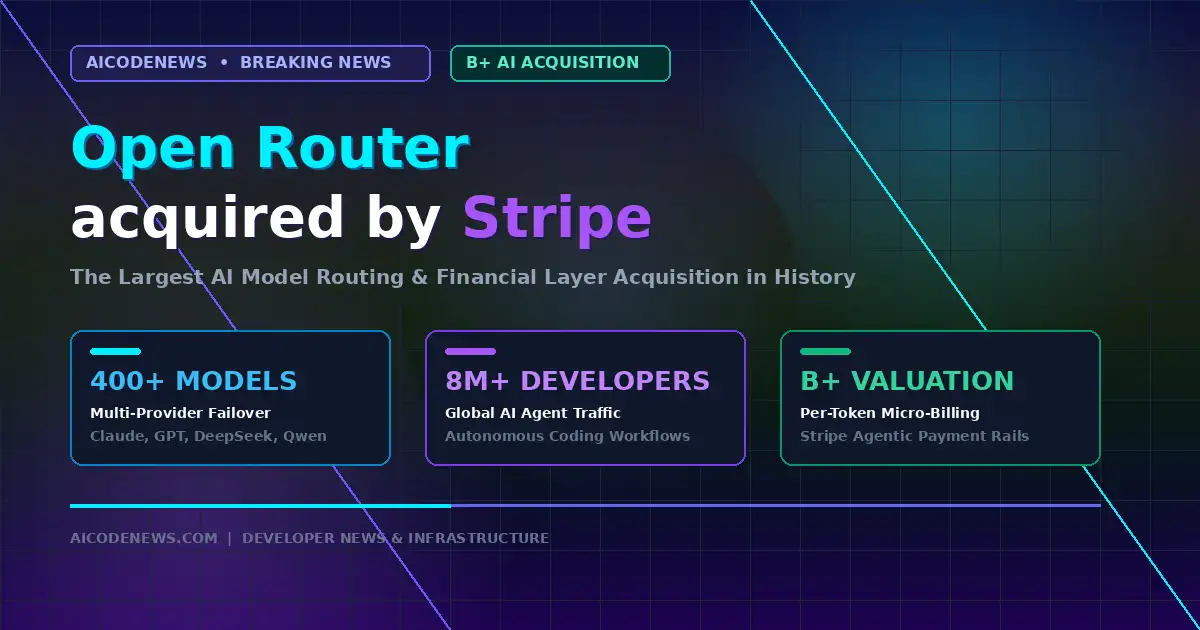
    In a landmark deal reshaping developer AI infrastructure, fintech giant Stripe Acquires OpenRouter for more than $7 billion to establish the dominant routing and financial layer for autonomous software agents.

    The news that Stripe Acquires OpenRouter represents the largest infrastructure acquisition in AI history, uniting OpenRouter’s developer gateway of over 400 models with Stripe’s global payments and metering rails.

    1. Why Stripe Acquires OpenRouter: Controlling the Inference Tollgate

    Over the past two years, OpenRouter quietly became the default API gateway for more than 8 million developers and coding tools:

    • Unified Multi-Model Gateway: Developers access Claude, GPT, DeepSeek, Qwen, and open-weights models through a single standardized API key with automatic failover.
    • Micro-Billing at Token Scale: Managing per-token payments across dozens of model providers is a massive ledger problem that fits Stripe’s core payments infrastructure.
    • Autonomous Agent Rails: As software agents perform autonomous workflows, they require programmatic wallets and dynamic routing gateways to pay for compute per task.

    2. Developer Impact on Routing, APIs, and Pricing

    The strategic move where Stripe Acquires OpenRouter directly addresses developer lock-in and billing complexity:

    • Native Stripe Billing Integration: Developers can now bundle end-user SaaS subscriptions with pass-through per-token AI costs under a single unified dashboard.
    • No Disruption to Open Protocols: The platform will maintain its open OpenAI-compatible API endpoints and Model Context Protocol (MCP) tool integrations.
    • Enterprise SLA Guarantees: Backed by Stripe’s infrastructure, enterprise teams gain dedicated throughput and latency guarantees across global routing clusters.

    3. Key Takeaways

    • Historic Infrastructure Deal: Stripe Acquires OpenRouter for over $7 billion.
    • 8M+ Developer Reach: Consolidates routing across 400+ AI models under Stripe’s financial stack.
    • Agent Economy Foundation: Powers automated micro-payments and multi-model fallback for next-generation software agents.

    Bookmark AICodeNews.com for daily updates on AI infrastructure acquisitions, model pricing, and developer tools.
  • DeepSeek V4 Pro Launches: Near-Opus Agent Reasoning at Fractional API Cost

    DeepSeek V4 Pro Launches: Near-Opus Agent Reasoning at Fractional API Cost

    Published by AICodeNews Editorial Team | August 13, 2026

    In a major advancement for open-weight AI infrastructure, Chinese AI laboratory DeepSeek officially released DeepSeek V4 Pro, an upgraded flagship reasoning model engineered specifically for long-horizon agentic coding workflows.

    Launched on August 12, 2026, DeepSeek V4 Pro delivers autonomous code generation and multi-step tool orchestration capabilities that approach closed frontier models like Claude Opus 5, while operating at a fraction of the per-token API cost.

    2. Architectural Upgrades & Benchmark Capabilities in DeepSeek V4 Pro

    Building upon the lightweight DeepSeek-V4-Flash architecture, the system expands total model capacity while retaining high-density Mixture-of-Experts (MoE) efficiency:

    • 1 Million Token Context Window: DeepSeek V4 Pro natively supports a 1,048,576-token context window alongside an expanded 384,000-token maximum output limit.
    • SWE-Bench Pro & Agent Performance: On standardized software engineering benchmarks, the model scored within 2.1 percentage points of top proprietary models on multi-file bug fixing and automated code reviews.
    • Native Dual-Mode Execution: Allows developers to toggle the engine between high-speed standard generation and extended “Thinking Mode” for complex mathematical and algorithmic tasks.

    2. API Economics & Production Deployment

    While DeepSeek announced upcoming general API price adjustments to manage server capacity, the release offers significant cost-per-token savings compared to Western enterprise endpoints.

    Developers building multi-agent workflows (such as Cursor, Windsurf, or terminal agents) can deploy DeepSeek V4 Pro directly via OpenAI-compatible and Anthropic-compatible API endpoints.

    2. Key Takeaways

    • Official Launch: DeepSeek V4 Pro officially released on August 12, 2026.
    • 1M Context Handling: Supports 1M input tokens and 384k max output tokens.
    • Agentic Parity: Approaches frontier reasoning capabilities at a fraction of proprietary API costs.

    Follow AICodeNews.com for daily updates on AI model releases, API changes, and developer tooling.

  • DeepSeek Signals API Price Hike as DeepSeek-V4-Flash Token Demand Surges

    DeepSeek Signals API Price Hike as DeepSeek-V4-Flash Token Demand Surges

    Published by AICodeNews Editorial Team | August 11, 2026

    Following unprecedented global adoption of its lightweight DeepSeek-V4-Flash-0731 model, Chinese AI laboratory DeepSeek has announced an upcoming DeepSeek API Price Increase for its developer endpoints.

    As reported by TechCentral and Mashable, the upcoming DeepSeek API Price Increase comes just ten days after the laboratory released its 284B parameter model at an ultra-low rate of $0.14 per 1M input tokens.

    1. Why a DeepSeek API Price Increase Is Coming

    The announcement of a DeepSeek API Price Increase highlights the severe server capacity and GPU infrastructure pressure facing low-cost AI providers:

    • Fastest Token Adoption in History: Since its July 31 release, DeepSeek-V4-Flash-0731 has become the fastest-growing model by token volume, overwhelming inference server clusters.
    • Infrastructure Overhead: Maintaining massive 1M context windows at $0.14/1M tokens created unsustainable GPU cluster utilization costs during peak developer hours.
    • Adjusting API Rates: DeepSeek advised enterprise users and developers to account for the DeepSeek API Price Increase in their upcoming infrastructure budgets.

    2. Developer Impact & Market Reaction

    Developer reactions on X/Twitter noted that while internal adjustments narrow the price gap, competition from rival open-weight model ( Qwen3.8 Max) remains fierce.

    Developers building high-volume automated agents are advised to implement multi-provider routing (such as LiteLLM or Unity AI Gateway) to switch between models dynamically as rates adjust.

    3. Key Takeaways

    • Price Hike Announcement: DeepSeek confirmed an upcoming DeepSeek API Price Increase due to record API demand.
    • Record Token Usage: DeepSeek-V4-Flash-0731 saw the fastest token growth in AI history.
    • Developer Advice: Multi-model routing recommended to manage infrastructure costs.

    Follow AICodeNews.com for daily updates on AI model pricing, API changes, and developer tooling.

  • Cloudflare Kitesurf Launch: Agent-First Browser Built for AI Workers

    Cloudflare Kitesurf Launch: Agent-First Browser Built for AI Workers


    As autonomous AI agents evolve from code completion assistants into full-stack browser operators, Cloudflare Kitesurf has officially launched as a cloud-hosted web browser designed specifically for AI agents rather than human users.

    Announced during Cloudflare’s Agents Week on the official Cloudflare Blog, the new platform represents a ground-up redesign of browser architecture optimized for machine execution, token efficiency, and high-density cloud scaling.


    1. Why Kitesurf Outperforms Traditional Chromium Browsers

    For decades, web browsers like Chromium, Safari, and Firefox have been engineered for human eyes—allocating massive CPU and RAM budgets to CSS pixel-rendering, tab management, smooth animations, extension APIs, and video decoding.

    When autonomous AI agents (such as Claude Code, Cursor, or browser automation frameworks) use headless Chromium, they incur massive resource overhead:

    • RAM Bloat: Heavy Chromium instances consume 500MB to 1.5GB of RAM per session, whereas Kitesurf operates on a lightweight ~70MB footprint.
    • Irrelevant CSS/DOM Rendering: Rather than spending GPU cycles rendering visual frames, the engine extracts DOM trees, accessibility nodes, and clean text directly for LLM context windows.
    • Token Budget Efficiency: By stripping away visual clutter, Cloudflare Kitesurf prevents token waste and dramatically reduces API token costs during multi-turn agent browsing sessions.

    2. Under the Hood: Rust, WebAssembly, and V8 Isolates

    The engineering architecture behind Kitesurf discards human UI overhead entirely for pure machine interaction:

    • Built in Rust & WebAssembly: Compiled directly to WebAssembly and executed inside lightweight V8 isolates on the Cloudflare Workers edge network.
    • 3x to 7x Less Memory & CPU: The platform uses up to 7x less RAM than headless Chromium, allowing developers to spawn thousands of concurrent agentic browser sessions at fractional cost.
    • Chrome DevTools Protocol (CDP) Compatibility: Full support for standard CDP commands so existing Playwright, Puppeteer, and agent frameworks can connect with a single configuration parameter.
    • WebMCP Integration: Native support for Cloudflare’s new WebMCP standard, allowing websites to expose clean Model Context Protocol tool endpoints directly to visiting models.

    3. Developer Availability & Benchmarks for Cloudflare Kitesurf

    The new tool is available immediately in open beta through Cloudflare’s Browser Run platform:

    MetricHeadless ChromiumCloudflare Kitesurf
    Primary AudienceHuman Users & UI TestsAutonomous AI Agents
    Execution EnvironmentHeavy Container / VMV8 Isolates on Workers
    Memory Footprint~500MB – 1.5GB~70MB – 150MB (up to 7x reduction)
    Target OutputsRendered Pixels & LayoutDOM Trees, Text, Screenshots, PDFs
    Protocol SupportCDP / WebSocketsCDP, REST, WebMCP

    4. Key Takeaways

    • Agent-First Architecture: Engineered specifically for AI models rather than human users.
    • 7x Resource Reduction: Cloudflare Kitesurf uses up to 7x less memory and CPU than Chromium by running in V8 isolates on Workers.
    • WebMCP Native: Built-in support for Chrome DevTools Protocol and WebMCP tool standards.

    Follow AICodeNews.com for daily coverage on AI agent infrastructure, model releases, and developer tools