
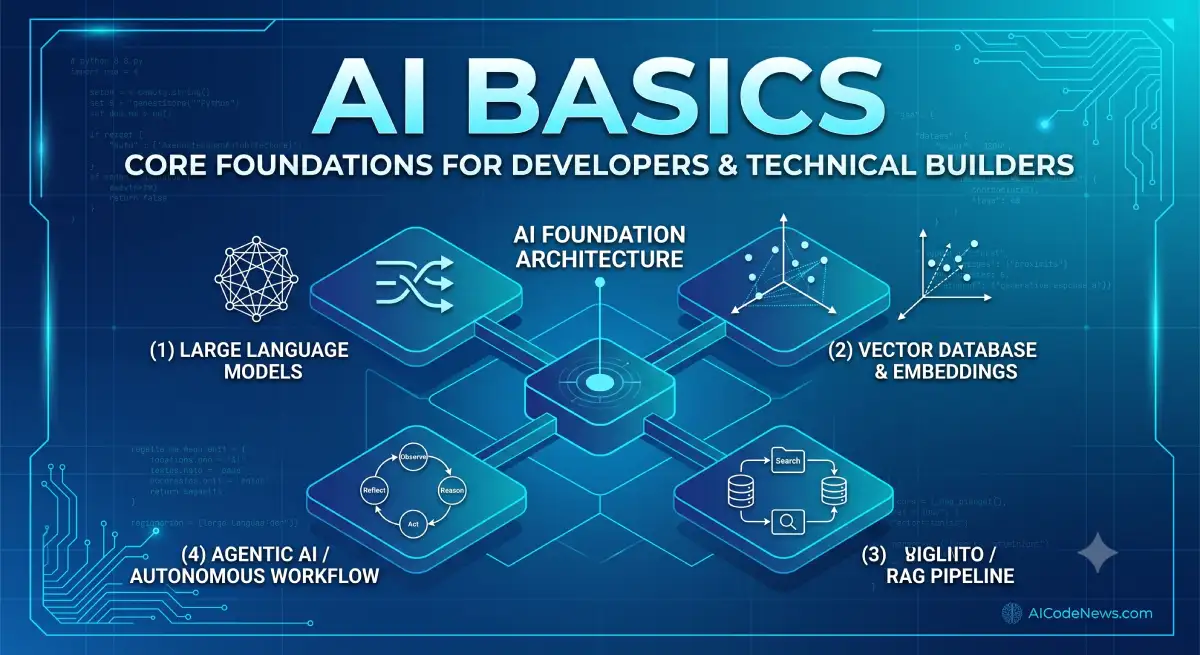
AI Basics: Core Foundations for Developers & Technical Builders
The AI Basics category on AICodeNews is designed to help software engineers, systems architects, and technical builders cut through the marketing noise and master the engineering primitives behind modern artificial intelligence. Rather than treating AI as a black box, the guides in this section unpack the underlying mechanics, mathematical foundations, and system architectures required to build reliable, production-grade applications.
What You’ll Learn in This Category
- Large Language Model (LLM) Fundamentals: How transformer architectures, self-attention mechanisms, tokenization, and context windows operate under the hood, plus the operational trade-offs between proprietary APIs and open-weight models.
- Vector Databases & Embeddings: How unstructured text and code are mapped into high-dimensional vector spaces, how similarity algorithms (cosine, dot product) work, and how indices like HNSW power sub-millisecond semantic search.
- Retrieval-Augmented Generation (RAG): The end-to-end architecture of connecting static foundation models to dynamic private knowledge bases, documentation, and external APIs to eliminate hallucinations.
- Autonomous & Agentic AI: Moving past single-prompt chat interfaces into goal-directed autonomous workflows—covering ReAct loops, deterministic tool calling, persistent memory, and CLI runtime architectures (e.g., Hermes Agent, OpenClaw).
- Core AI Engineering Primitives: The developer mechanics behind sampling parameters (
temperature,top_p), structured JSON outputs, model quantization (GGUF, AWQ), and parameter-efficient fine-tuning (LoRA).
Who These Guides Are For
- Software Engineers: Transitioning from traditional backend, frontend, or DevOps roles into AI systems orchestration and engineering.
- Technical Founders & Architects: Evaluating frameworks, database requirements, and infrastructure costs before deploying generative features to production.
- Hands-on Builders: Anyone who prefers practical, code-focused explanations without academic jargon or surface-level summaries.
Browse the latest guides, architectural breakdowns, and cheat sheets below to start building your foundation.
-
TypeSafe Jev AI Launched: Decision-Only Model Delivers 70ms Latency & Free Output Tokens
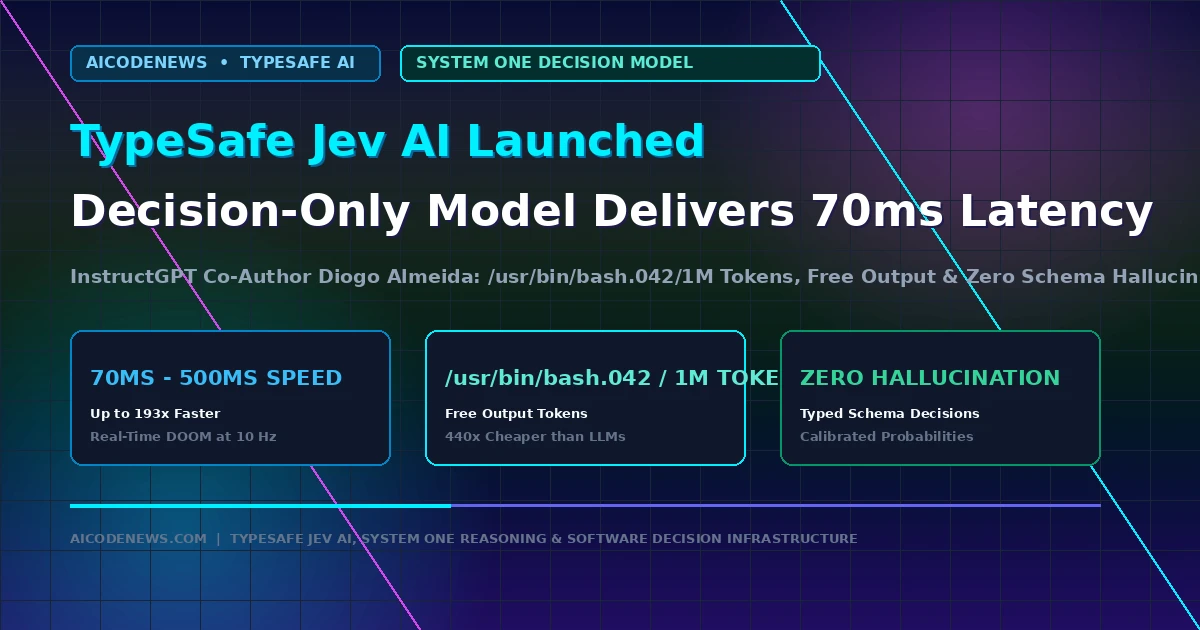
Published by AICodeNews Editorial Team | September 17, 2026 Abandoning conversational text generation in favor of fast, structured software decisions, TypeSafe Jev AI has officially been unveiled by TypeSafe AI and InstructGPT co-author Diogo Almeida. Announced across official developer channels on typesafe.ai and shared by founder Diogo Almeida (@CompleteSkeptic), TypeSafe Jev AI introduces a new…
-
Hermes Agent Cheat Sheet: The Complete CLI, Slash Commands & Architecture Reference Guide
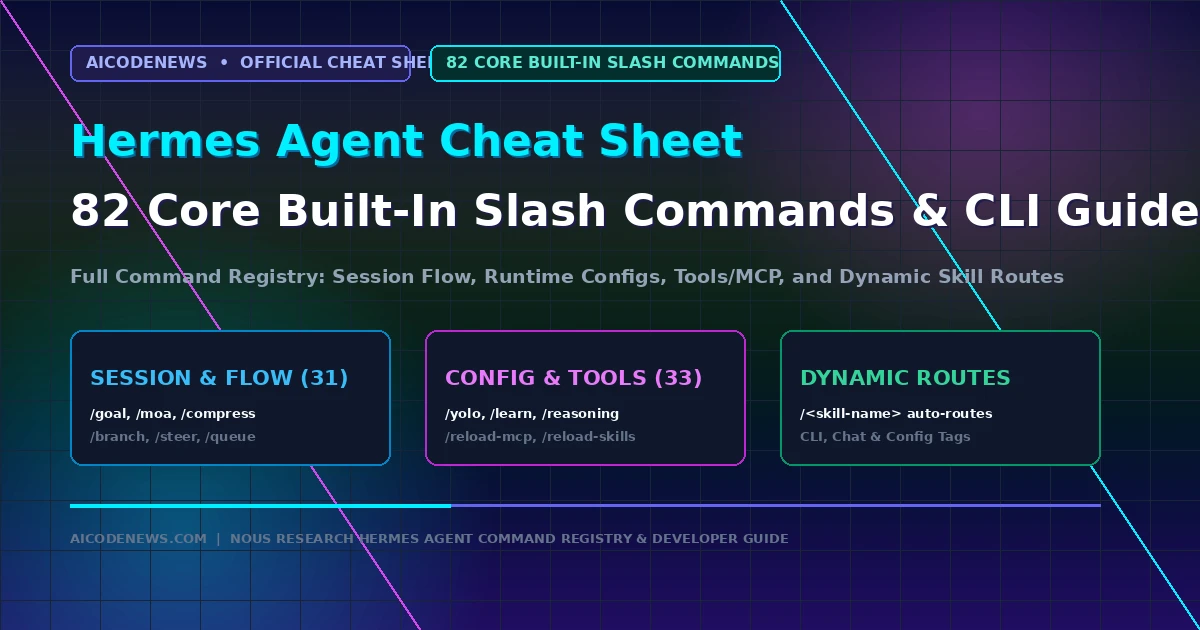
Published by AICodeNews Editorial Team | August 29, 2026 Whether you are building autonomous software engineering pipelines, managing multi-channel bots, or writing self-improving tools, this Hermes Agent Cheat Sheet provides the definitive reference for Nous Research’s terminal-first AI agent runtime. Based directly on the official Nous Research Command Registry, this Hermes Agent Cheat Sheet details…
-
OpenClaw vs Hermes Agent: Architecture, Memory & Coding Benchmark Comparison
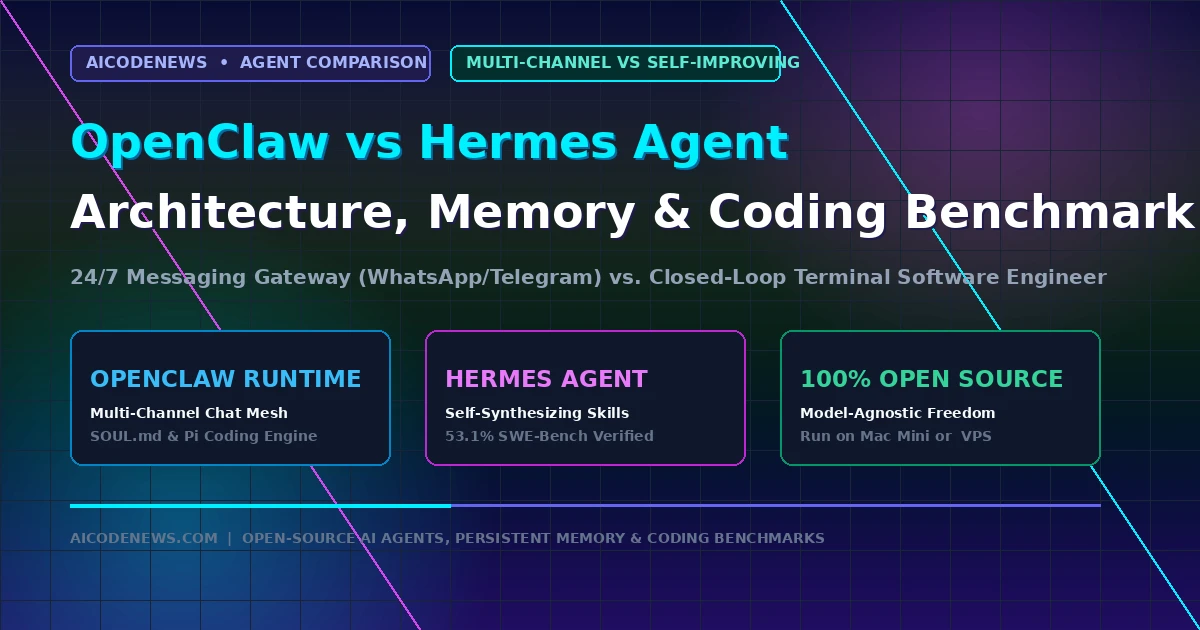
Published by AICodeNews Editorial Team | August 29, 2026 In the battle of open-source autonomous AI agents, comparing OpenClaw vs Hermes Agent reveals two fundamentally different engineering philosophies driving the developer ecosystem in 2026. While OpenClaw (formerly Clawdbot/Moltbot) took the developer community by storm as an always-on personal intelligence layer connected to everyday messaging apps,…
-
Vector Databases and Embeddings Explained: Architecture, HNSW Indexing & Implementation Guide
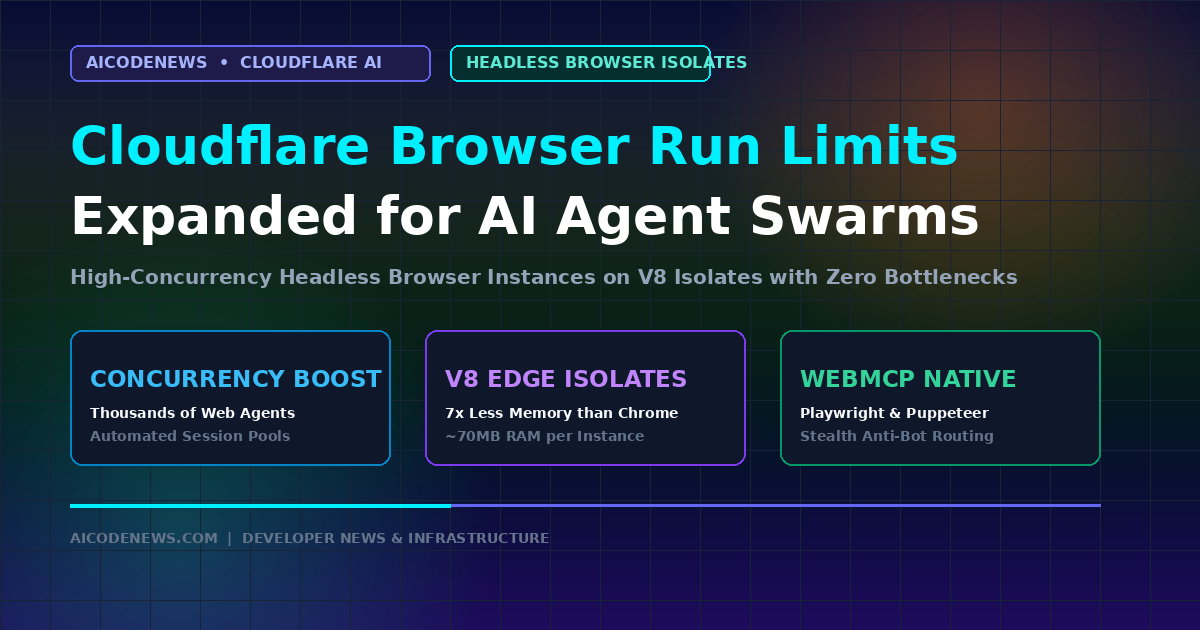
Published by AICodeNews Editorial Team | August 20, 2026 If you have ever wondered how modern AI applications search through millions of documents in milliseconds, match customer queries to relevant code snippets, or give autonomous agents persistent long-term memory, the answer lies in Vector Databases and Embeddings. Traditional relational databases like PostgreSQL or MySQL excel…
-
What is Agentic AI? The Ultimate Guide to Autonomous AI Agents for Developers
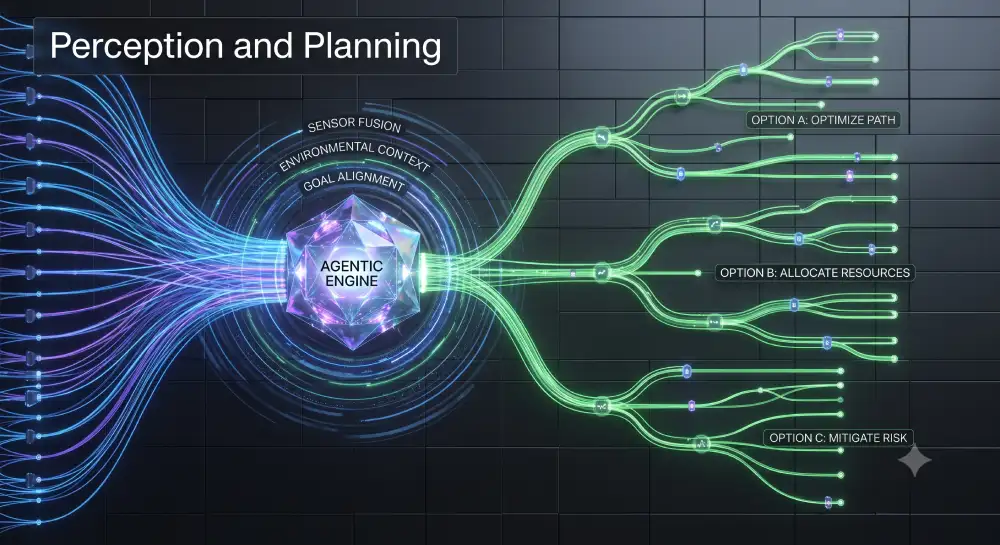
Published by AICodeNews Editorial Team | August 2026 | Category: AI Basics|—|Artificial Intelligence has undergone a profound paradigm shift. For years, Generative AI operated primarily in a passive request-and-response mode: you typed a prompt into a chatbot interface, and it returned a block of text or a code snippet. In 2026, we have officially entered…
-
What is an LLM? The Ultimate Guide to Large Language Models and How They Work
1. Introduction What is an LLM? A Large Language Model (LLM) is an advanced type of artificial intelligence designed to understand, interpret, and generate human-like text by processing vast datasets. At its simplest, an LLM acts as a highly sophisticated “auto-complete” tool. Having ingested billions of pages of public internet data, it uses that knowledge…