Tag: ai agent

  • DeepSeek Releases DeepSeek Harness: Open-Source Agent Runtime Reaches 144K GitHub Stars

    DeepSeek Releases DeepSeek Harness: Open-Source Agent Runtime Reaches 144K GitHub Stars

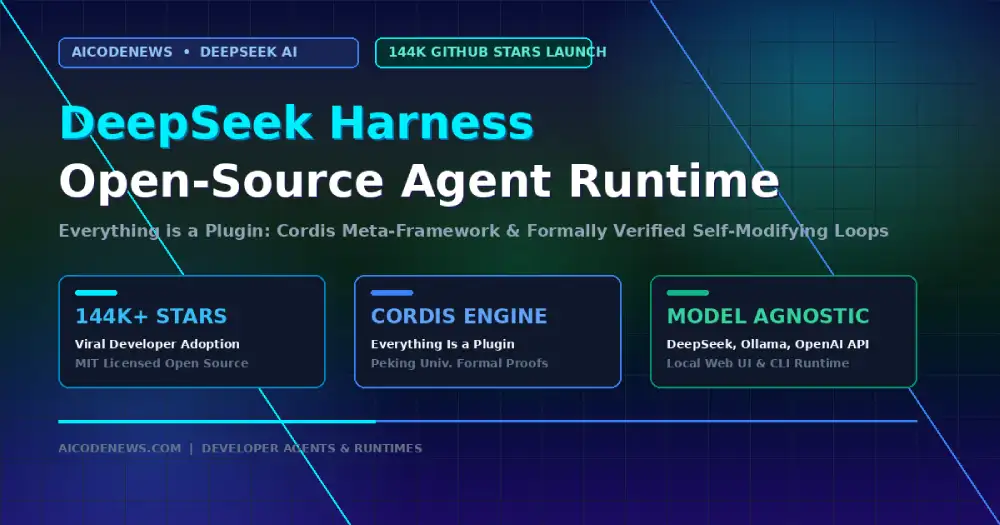
    In a major open-source release reshaping autonomous software development, DeepSeek AI has launched DeepSeek Harness, a fully modular agent execution runtime that has surged past 144,000 stars on GitHub within days of release.

    Available as a developer preview on the official DeepSeek GitHub Repository, DeepSeek Harness takes a radical architectural stance: it is not a language model, but the complete operational layer around one—orchestrating terminal commands, permissions, memory, tool pipelines, and decision-making loops.

    1. The Core Philosophy of DeepSeek Harness: Everything Is a Plugin

    Where proprietary agent tools treat the execution loop as a protected black box, this architecture eliminates the concept of a privileged core:

    • 100% Swappable Components: In this runtime, every single capability—from model adapters and sandbox environments to session storage and the decision loop itself—is a self-contained plugin.
    • Extend Without Forking: Developers can introduce entirely new agentic behaviors by mounting custom plugins rather than maintaining complex project forks.
    • Model-Agnostic Freedom: Released under the permissive MIT license, the framework connects seamlessly to DeepSeek endpoints, local Ollama/vLLM instances, or any OpenAI-compatible API.

    2. Theoretical Grounding: Cordis Meta-Framework & Formal Proofs

    Unlike typical wrapper frameworks, DeepSeek Harness is built on Cordis, a composition meta-framework backed by an 88-page academic research paper co-authored by Peking University and DeepSeek researchers:

    • Formally Verified Self-Modification: The underlying mathematical proofs demonstrate that an autonomous program can safely rewrite its own execution graph and plugin stack at runtime without causing system deadlocks.
    • Reversible Lifecycle Effects: Every plugin registration is treated as an isolated state effect that safely unwinds whenever a component is detached or reloaded.

    3. Developer Availability & Getting Started

    Developers can launch the DeepSeek Harness developer preview and explore its built-in browser interface with a single terminal command:# Launch the DeepSeek Harness local web interface on port 3080

    npx @deepseek-ai/dsh web

    DeepSeek noted that because the release is currently in active developer preview, rapid iteration and architectural breaking changes are expected as the community ecosystem matures.

    4. Key Takeaways

    • Viral Open-Source Release: DeepSeek Harness surpasses 144K GitHub stars under the MIT license.
    • Everything Is a Plugin: Model adapters, tools, sandboxes, and agent loops are 100% modular and replaceable.
    • Formal Theory Under the Hood: Built on Cordis and formal self-rewriting program proofs from Peking University and DeepSeek.

    Bookmark AICodeNews.com for daily updates on open-source agent runtimes, model pricing, and developer tools.

  • Cloudflare Kitesurf Launch: Agent-First Browser Built for AI Workers

    Cloudflare Kitesurf Launch: Agent-First Browser Built for AI Workers


    As autonomous AI agents evolve from code completion assistants into full-stack browser operators, Cloudflare Kitesurf has officially launched as a cloud-hosted web browser designed specifically for AI agents rather than human users.

    Announced during Cloudflare’s Agents Week on the official Cloudflare Blog, the new platform represents a ground-up redesign of browser architecture optimized for machine execution, token efficiency, and high-density cloud scaling.


    1. Why Kitesurf Outperforms Traditional Chromium Browsers

    For decades, web browsers like Chromium, Safari, and Firefox have been engineered for human eyes—allocating massive CPU and RAM budgets to CSS pixel-rendering, tab management, smooth animations, extension APIs, and video decoding.

    When autonomous AI agents (such as Claude Code, Cursor, or browser automation frameworks) use headless Chromium, they incur massive resource overhead:

    • RAM Bloat: Heavy Chromium instances consume 500MB to 1.5GB of RAM per session, whereas Kitesurf operates on a lightweight ~70MB footprint.
    • Irrelevant CSS/DOM Rendering: Rather than spending GPU cycles rendering visual frames, the engine extracts DOM trees, accessibility nodes, and clean text directly for LLM context windows.
    • Token Budget Efficiency: By stripping away visual clutter, Cloudflare Kitesurf prevents token waste and dramatically reduces API token costs during multi-turn agent browsing sessions.

    2. Under the Hood: Rust, WebAssembly, and V8 Isolates

    The engineering architecture behind Kitesurf discards human UI overhead entirely for pure machine interaction:

    • Built in Rust & WebAssembly: Compiled directly to WebAssembly and executed inside lightweight V8 isolates on the Cloudflare Workers edge network.
    • 3x to 7x Less Memory & CPU: The platform uses up to 7x less RAM than headless Chromium, allowing developers to spawn thousands of concurrent agentic browser sessions at fractional cost.
    • Chrome DevTools Protocol (CDP) Compatibility: Full support for standard CDP commands so existing Playwright, Puppeteer, and agent frameworks can connect with a single configuration parameter.
    • WebMCP Integration: Native support for Cloudflare’s new WebMCP standard, allowing websites to expose clean Model Context Protocol tool endpoints directly to visiting models.

    3. Developer Availability & Benchmarks for Cloudflare Kitesurf

    The new tool is available immediately in open beta through Cloudflare’s Browser Run platform:

    MetricHeadless ChromiumCloudflare Kitesurf
    Primary AudienceHuman Users & UI TestsAutonomous AI Agents
    Execution EnvironmentHeavy Container / VMV8 Isolates on Workers
    Memory Footprint~500MB – 1.5GB~70MB – 150MB (up to 7x reduction)
    Target OutputsRendered Pixels & LayoutDOM Trees, Text, Screenshots, PDFs
    Protocol SupportCDP / WebSocketsCDP, REST, WebMCP

    4. Key Takeaways

    • Agent-First Architecture: Engineered specifically for AI models rather than human users.
    • 7x Resource Reduction: Cloudflare Kitesurf uses up to 7x less memory and CPU than Chromium by running in V8 isolates on Workers.
    • WebMCP Native: Built-in support for Chrome DevTools Protocol and WebMCP tool standards.

    Follow AICodeNews.com for daily coverage on AI agent infrastructure, model releases, and developer tools