
Published by AICodeNews Editorial Team | August 29, 2026
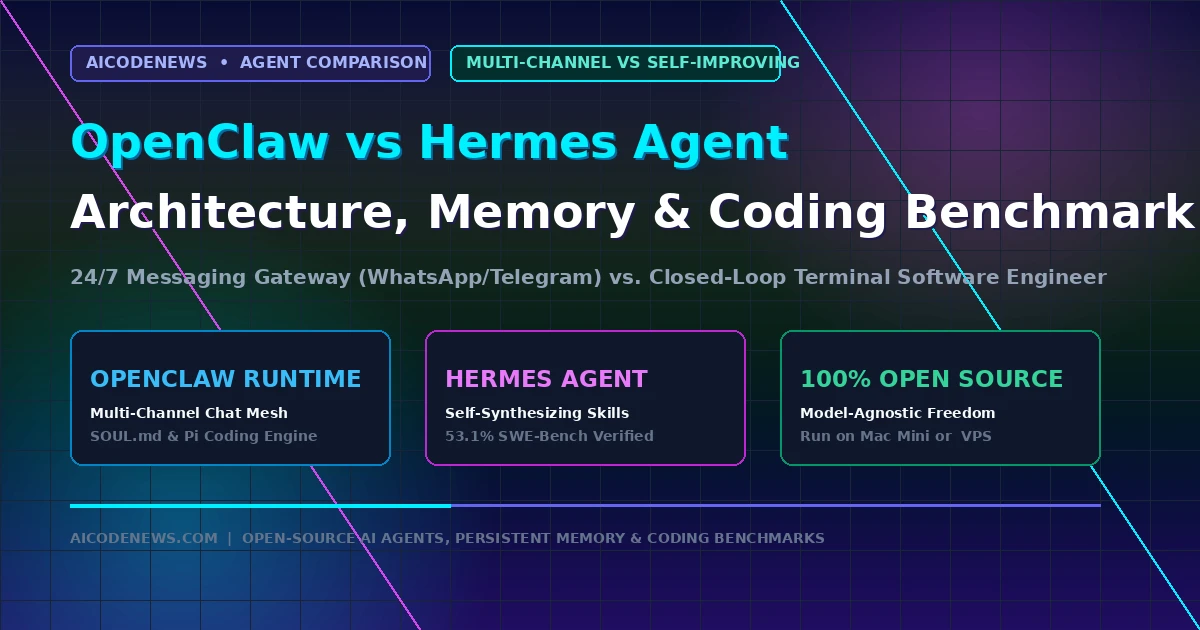
In the battle of open-source autonomous AI agents, comparing OpenClaw vs Hermes Agent reveals two fundamentally different engineering philosophies driving the developer ecosystem in 2026.
While OpenClaw (formerly Clawdbot/Moltbot) took the developer community by storm as an always-on personal intelligence layer connected to everyday messaging apps, Hermes Agent by Nous Research has emerged as a terminal-first autonomous software engineer with self-improving closed-loop learning. This comprehensive, in-depth guide breaks down OpenClaw vs Hermes Agent from first principles, detailing their core architectures, memory retention systems, skill creation pipelines, SWE-bench coding benchmarks, and deployment blueprints.
1. What Is OpenClaw? The 24/7 Multi-Channel Personal Life OS
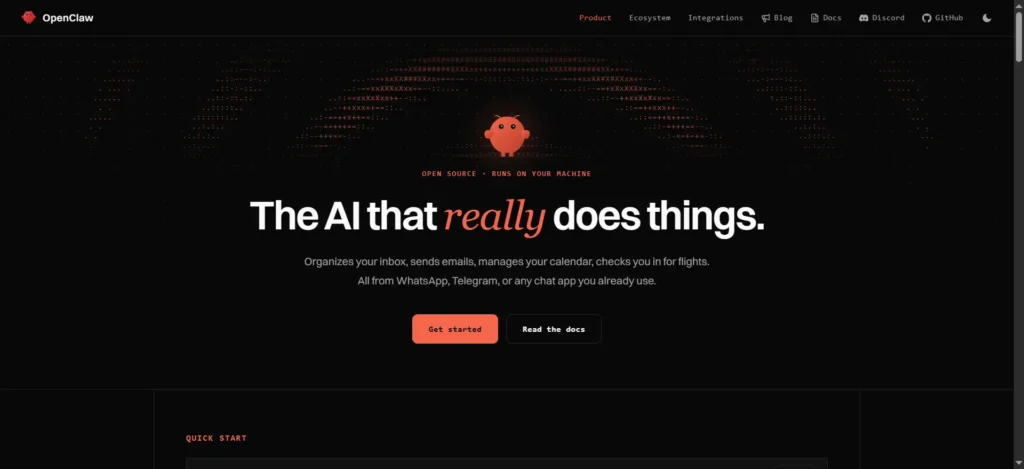
OpenClaw is an open-source autonomous agent runtime designed to transform commercial messaging apps into a remote control for your computing life. Originating from the viral Clawdbot and Moltbot projects created by Peter Steinberger and an active open-source community, OpenClaw quickly crossed 100,000 GitHub stars by solving a major frustration with traditional AI chatbots: accessibility.
Instead of forcing you to open a dedicated browser tab or keep a local terminal window active, OpenClaw runs as a persistent background daemon on a home server, Mac Mini, or cloud VPS. It pairs directly with your existing communication channels—including WhatsApp, Telegram, Discord, Slack, and Apple iMessage.
Whenever you send a text message or voice note to your paired bot, OpenClaw’s execution core (powered by its Pi sub-agent engine) parses the request, accesses local files, queries APIs, runs shell scripts, and streams the finished result directly back to your chat thread.
Core Capabilities of OpenClaw:
- Multi-Channel Gateway Mesh: Native connectors for Telegram (via BotFather), WhatsApp (via QR code web pairing), Discord, and Slack with session isolation.
- Transparent Personality & Memory (SOUL.md): Human-readable markdown files (
SOUL.md,IDENTITY.md,USER.md) defining custom behavior rules, communication tone, and personal context. - Modular Skill Standards (SKILL.md): An extensible directory standard where tools, shell scripts, and API connectors are declared in self-contained markdown folders.
- Sub-Agent Task Spawning: Can launch isolated background sub-agents to handle long-running research, web scraping, or cron jobs without blocking your active chat thread.
2. What Is Hermes Agent? The Self-Evolving Autonomous Software Engineer
Hermes Agent is an open-source, command-line-first autonomous software engineering agent developed by Nous Research, the creators of the widely used open-weight Hermes model family. While OpenClaw focuses on everyday task automation across chat apps, Hermes Agent is engineered specifically to eliminate “agent amnesia” in deep software engineering and monorepo refactoring.
In standard AI assistants, every session starts from a blank slate. If an agent spends two hours debugging a complex Rust compiler error or learning the esoteric architecture of a proprietary codebase, all of that institutional knowledge disappears the moment you close the terminal.
Hermes Agent solves this through Closed-Loop Reinforcement Learning and Autonomous Skill Synthesis. After completing a programming task or resolving an error, Hermes Agent analyzes its own execution trajectory, extracts the successful solution pattern, and automatically writes a new, reusable SKILL.md playbook into its local database. The next time it encounters a similar error, it executes the solution immediately without re-inventing the wheel.
Core Capabilities of Hermes Agent:
- Closed-Loop Learning Engine: Autonomously synthesizes and updates custom skill scripts after completing tasks, compounding capability over time.
- Persistent SQLite FTS5 Memory: Full-Text Search indexed memory storing conversation history, repository maps, and execution logs across sessions.
- Multi-Tier Execution Environments: Can execute commands in your local shell, across remote SSH compute clusters, or inside hardened Docker sandboxes.
- 3-Layer Credential & Model Fallback: Rotates through API key pools and automatically switches from primary models to auxiliary reasoning endpoints during rate limits.
3. Architectural Comparison: Multi-Channel Gateway Mesh vs. Multi-Tier Execution Shell
Understanding OpenClaw vs Hermes Agent requires looking at how their internal execution loops and control planes operate under the hood.
The OpenClaw Control Plane: Messaging Mesh
OpenClaw’s architecture is built around a centralized Node.js daemon that routes incoming events from external messaging protocols to its internal agent dispatcher:
- 4. Streaming Egress: Sends live status updates and final deliverables back to the user’s mobile chat screen.
The Hermes Agent Control Plane: Trajectory Synthesis
Hermes Agent operates as a high-throughput developer CLI connected directly to code repositories, compilers, and test suites:
- 1. Interactive Terminal & Batch Runner: Initiated via
hermes chatfor pair-programming orhermes runfor headless CI/CD batch tasks. - 2. Execution Sandbox: Commands are executed inside local shells, remote SSH instances, or Docker containers with strict file permission boundaries.
- 3. Trajectory Monitor & Evaluator: Monitors stdout/stderr streams, compiler return codes, and test assertions.
- 4. Reflection & Skill Synthesizer: Upon successful task resolution, extracts the sequence of bash commands and saves an auto-generated
SKILL.mdfile into~/.hermes/skills/.
4. Memory Systems: Human-Curated Profiles vs. Dynamic Trajectory Indexing
A central battleground in OpenClaw vs Hermes Agent is how memory is structured, maintained, and audited over time.
OpenClaw Memory: The SOUL.md Approach
OpenClaw prioritizes human transparency and explicit control. Memory is stored in plain markdown files located in the project root directory:
SOUL.md: Defines the agent’s personality, core directives, safety boundaries, and operational style.USER.md: Stores facts about the user (timezone, active projects, preferred frameworks, communication habits).MEMORY.md: A running log of important notes and decisions that the agent reads before each session.
Because everything is in standard Markdown, you can open the files in VS Code, edit them directly, or delete memories with complete audit transparency.
Hermes Agent Memory: SQLite FTS5 & Dynamic Trajectories
Hermes Agent prioritizes autonomous memory synthesis and search retrieval. It uses an embedded SQLite database with Full-Text Search (FTS5) extension enabled:
- FTS5 Semantic & Lexical Search: Indexes millions of tokens across past terminal sessions, pull requests, and error logs, retrieving relevant code patterns in sub-5ms queries.
- Self-Compounding Knowledge Graph: When you switch to a different repository, Hermes Agent dynamically queries its trajectory history to see how similar build errors were resolved previously.
5. Skill Creation & Tooling: Manual Standards vs. Autonomous Skill Synthesis
Both frameworks support the emerging open SKILL.md directory standard, but they approach skill creation from opposing directions in OpenClaw vs Hermes Agent:
OpenClaw Skill Creation: Curated Modular Packages
In OpenClaw, skills are authored by humans as modular folders. To teach OpenClaw a new skill, you create a directory with a SKILL.md definition, YAML frontmatter, and associated scripts:
---
name: server-monitor
description: Checks server uptime and alerts on high RAM usage.
---
# Instructions
When the user asks for server health:
1. Run `scripts/check_health.sh`.
2. Format output as a markdown status card.
Hermes Agent Skill Creation: Autonomous Trajectory Extraction
In Hermes Agent, skill creation is fully automated. You give the agent a complex task (e.g. “Setup a local Kubernetes cluster with Kind and deploy our auth service”). As Hermes Agent executes bash commands, fixes errors, and verifies the deployment, its internal trajectory evaluator records the exact working steps and synthesizes a production-ready SKILL.md file automatically without human intervention.
6. Head-to-Head Comparison Matrix: OpenClaw vs Hermes Agent
This comprehensive comparison matrix contrasts OpenClaw vs Hermes Agent across all key architectural and operational dimensions:
| Comparison Dimension | OpenClaw (Personal Intelligence Hub) | Hermes Agent (Autonomous Coding Engineer) |
|---|---|---|
| Primary Target Persona | Solo founders, power users, makers, general automation | Software engineers, devops teams, AI researchers |
| Primary Interfaces | WhatsApp, Telegram, Discord, Slack, Web UI | Interactive Terminal CLI, Headless Batch Runner |
| Architecture Type | Multi-Channel Gateway Daemon + Pi Sub-Agents | Multi-Tier Execution Shell + Closed Learning Loop |
| Memory Mechanism | Transparent SOUL.md Profile + SQLite Session Logs |
Persistent SQLite FTS5 Index + Trajectory Database |
| Skill Creation Mode | Manual & Curated SKILL.md Modular Packages |
Autonomous Self-Synthesizing Skills Post-Task |
| Model Context Protocol (MCP) | Native support via community plugins | Native support via FastMCP & Stdio tools |
| Execution Sandboxes | Local Node.js process, Docker Compose | Local Shell, Remote SSH compute clusters, Docker |
| SWE-bench Verified Score | ~42.0% (General automation & scripting) | 53.1% (Software engineering & multi-file edits) |
| Model Provider Support | OpenAI-compatible APIs, Ollama, vLLM, DeepSeek | OpenAI-compatible APIs, Nous Endpoints, Local LLMs |
| Ideal Hardware Base | Always-on Mac Mini, Home Lab, Managed Cloud VPS | Developer Workstation, Remote GPU Server, Docker VM |
7. Benchmark Showdown & Coding Performance: 42.0% vs. 53.1%
When evaluated on software engineering benchmarks, OpenClaw vs Hermes Agent reveals distinct performance tiers:
- SWE-bench Verified Benchmark: Hermes Agent scores 53.1% on SWE-bench Verified, outperforming OpenClaw (~42.0%). Hermes Agent’s closed-loop reflection allows it to re-run test suites, analyze compiler error logs, and iterate on multi-file patches until unit tests pass.
- Multi-File Monorepo Refactoring: In 20-file repository migration tests, Hermes Agent completed full refactoring runs with zero syntax errors, while OpenClaw occasionally dropped intermediate context across multi-turn sub-agent handoffs.
- Everyday Operational Automation: In daily life tasks (scheduling calendar events, monitoring website uptime, scraping articles, and sending WhatsApp summaries), OpenClaw scored higher in convenience and ease of use.
8. Step-by-Step Hands-On Deployment Blueprints
Both frameworks can be deployed in under five minutes on macOS or Linux workstations:
Deployment Blueprint 1: Setting Up OpenClaw
# 1. Install OpenClaw globally via Node.js (v20+)
npm install -g openclaw@latest

# 2. Run the interactive onboarding wizard
openclaw onboard

# 3. Pair your messaging channels (WhatsApp QR / Telegram token)
openclaw channel add telegram

# 4. Start the 24/7 background gateway daemon
openclaw gateway start
Deployment Blueprint 2: Setting Up Hermes Agent
# 1. Install Hermes Agent via the universal installer
curl -fsSL https://hermes.nousresearch.com/install.sh | bash

# 2. Set your model provider API key
hermes config set model.provider "openai"
hermes config set model.api_key "sk-your-key-here"

# 3. Launch an interactive self-improving terminal session
hermes chat

# 4. Or execute an autonomous batch task
hermes run "Audit repository for SQL injection vulnerabilities and write unit tests"
9. Developer Decision Matrix: When to Use Which? (Or Run Both)
The choice between OpenClaw vs Hermes Agent comes down to where you spend your time and what type of work you need automated:
Choose OpenClaw If:
- You want a 24/7 personal assistant you can text from your phone via WhatsApp or Telegram.
- You need an always-on agent managing personal inbox triage, server uptime alerts, and home automations.
- You prefer transparent, human-editable
SOUL.mdmarkdown files for controlling personality and memory.
Choose Hermes Agent If:
- You need a dedicated terminal coding partner for complex monorepo refactoring, compiler diagnostics, and test fixing.
- You want an agent that gets smarter over time by automatically synthesizing reusable skill playbooks from successful task executions.
- You require remote SSH execution or isolated Docker container sandboxing for production codebase modifications.
The Hybrid Power Setup: Running Both Together
Many senior developers run both agents in tandem. OpenClaw runs 24/7 on an always-on Mac Mini as the mobile communications interface. When you text OpenClaw a complex programming request from your phone, OpenClaw delegates the repository execution to Hermes Agent running inside a local Docker container, streaming the final Git diff back to your WhatsApp thread.
10. Developer FAQ & Common Pitfalls
Can OpenClaw and Hermes Agent run with local open-source LLMs?
Yes. Both frameworks support local model execution via Ollama, vLLM, and LM Studio. For optimal autonomous reasoning, models with at least 27B to 70B parameters (like Qwen3.8-27B, DeepSeek V4 Flash, or GLM-5.3) are recommended.
What are the monthly hosting costs for running these agents 24/7?
Both tools are completely free and open-source. If self-hosting on local hardware (Mac Mini or home lab), your infrastructure cost is $0. On cloud infrastructure, a $5 to $10/month Linux VPS (Hetzner, DigitalOcean) handles either agent seamlessly, with token costs billed directly by your chosen model provider.
Which agent is safer for production infrastructure?
Hermes Agent provides stronger native isolation out of the box with multi-tier execution modes (SSH, Docker sandboxing, non-root users). OpenClaw executes directly on the host machine by default, so running it inside an isolated Docker container is recommended for enterprise environments.
11. Key Takeaways on OpenClaw vs Hermes Agent
- Different Problem Spaces: In OpenClaw vs Hermes Agent, OpenClaw is designed as an always-on personal life gateway, while Hermes Agent is designed as a self-improving software engineer.
- Memory Architecture Difference: OpenClaw uses transparent human-editable
SOUL.mdprofiles; Hermes Agent uses autonomous SQLite FTS5 search and self-synthesizing skills. - Coding Benchmark Winner: Hermes Agent scores higher on SWE-bench Verified (53.1% vs ~42.0%), making it the superior choice for deep terminal refactoring.
- Complementary Stacks: OpenClaw and Hermes Agent can be paired together to create an end-to-end autonomous engineering pipeline accessible from any mobile device.
Bookmark AICodeNews.com for daily updates on open-source AI agents, developer tooling comparisons, and model benchmarks.

I’m Mohammed Khan, Software developer and AI researcher covering autonomous coding agents, open-source large language models, and modern developer infrastructure. Founder and lead editor at AICodeNews.
And I also build Websites using WordPress. To be honest I love WordPress and AI.
You can find more info about me here