Tag: cloudflare

  • Cloudflare Workers Node.js Compatibility Enabled by Default: Rebuilt Module Registry for Edge AI

    Cloudflare Workers Node.js Compatibility Enabled by Default: Rebuilt Module Registry for Edge AI

    Published by AICodeNews Editorial Team | September 11, 2026

    In a major architectural milestone that streamlines full-stack and AI agent development, Cloudflare Workers Node.js Compatibility has officially been activated by default across all serverless isolates.

    Announced on the official Cloudflare Blog, the upgraded Cloudflare Workers Node.js Compatibility overhaul rebuilds Workers’ internal module registry. By providing native, in-runtime implementations of Node core APIs (including node:buffer, node:crypto, node:stream, and node:events), developers can now deploy standard npm packages, Model Context Protocol (MCP) servers, and agent frameworks directly to the edge without complex build-time polyfills or bundler workarounds.

    1. Why Cloudflare Workers Node.js Compatibility Was Rebuilt

    Historically, running modern AI agent frameworks on edge workers required custom esbuild shims, often resulting in ballooning bundle sizes and broken Node-specific dependencies. The new Cloudflare Workers Node.js Compatibility architecture eliminates these friction points:

    • Native In-Isolate Node Implementations: Core Node modules run directly inside the underlying V8 isolate runtime, improving execution performance and cutting bundle sizes by up to 60%.
    • Seamless AI Agent Tool Hosting: Frameworks like LangChain, OpenClaw gateways, and FastMCP servers deploy out of the box with zero configuration flags.
    • Instant Package Portability: Standard npm libraries that rely on Node async streams and cryptographic hashing work immediately without polyfill degradation.

    2. Legacy Workers Polyfills vs. Default Node.js Compatibility

    Runtime DimensionLegacy Bundled PolyfillsCloudflare Workers Node.js Compatibility (Default)
    Setup RequirementManual compatibility_flags in wrangler.tomlAutomatic out-of-the-box support
    Bundle Size OverheadLarge (JavaScript polyfills bundled into code)Zero overhead (Native C++ V8 implementations)
    Stream & Crypto PerformanceInterpreted JS performance lagHardware-accelerated native speed
    AI Tool CompatibilityFrequent runtime breakage on edge100% standard npm module compatibility

    3. Developer Migration & Platform Availability

    The transition to default Cloudflare Workers Node.js Compatibility applies automatically to all new Workers and Pages deployments globally. Existing projects can remove legacy polyfill plugins from their build pipelines immediately, benefiting from faster cold-start initialization and streamlined continuous integration builds.

    4. Key Takeaways on Cloudflare Workers Node.js Compatibility

    • Zero-Config Edge Development: Cloudflare Workers Node.js Compatibility runs standard Node APIs natively across all edge isolates.
    • 60% Bundle Size Reduction: Native C++ runtime implementations replace bloated JavaScript polyfills.
    • Optimized for AI Agents: Enables instant deployment of Model Context Protocol (MCP) servers and autonomous agent runtimes.

    Bookmark AICodeNews.com for daily updates on serverless edge computing, developer runtimes, and AI cloud infrastructure.

  • Cloudflare Browser Run Limits Expanded: High-Concurrency Headless Isolates for AI Agents

    Cloudflare Browser Run Limits Expanded: High-Concurrency Headless Isolates for AI Agents

    Published by AICodeNews Editorial Team | August 21, 2026

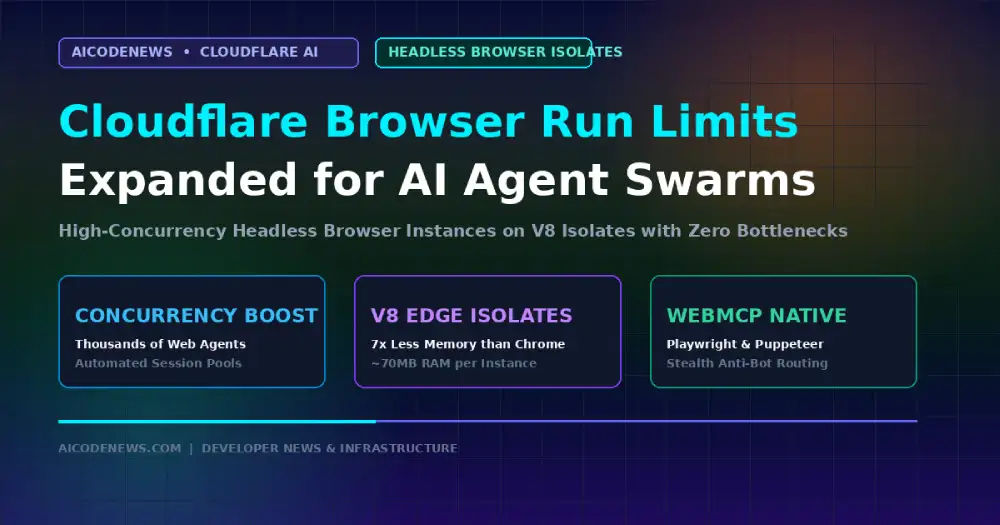
    To support enterprise autonomous web agents and large-scale data extraction pipelines, Cloudflare Browser Run Limits have officially expanded across Cloudflare’s global edge network.

    Announced on the official Cloudflare Changelog, the expanded Cloudflare Browser Run Limits allow developers to spin up thousands of concurrent headless browser instances inside lightweight V8 isolates with automated session pooling.

    1. Why Cloudflare Browser Run Limits Were Upgraded

    As autonomous AI agents shift from passive text completion to active web operations (form-filling, UI testing, competitive price monitoring), legacy headless browser limits created infrastructure bottlenecks:

    • High-Density Concurrency Scaling: The expanded Browser Run Limits enable enterprise accounts to run parallel browser swarms without experiencing connection queue timeouts.
    • Optimized Kitesurf Integration: Built to complement Cloudflare’s newly released Kitesurf browser engine, reducing memory overhead to ~70MB per active agent instance.
    • Session Persistence & Anti-Bot Stealth: Includes native cookie synchronization and residential IP routing to prevent AI agents from triggering CAPTCHA blocks during automated data ingestion.

    2. Developer Provisioning for Cloudflare Browser Run Limits

    Taking advantage of the new Cloudflare Browser Run Limits is streamlined for existing Cloudflare Workers developers:

    • Dashboard & API Quota Requests: Teams requiring custom enterprise concurrency thresholds can request instant limit increases directly through the Cloudflare developer dashboard.
    • Standard Playwright & Puppeteer Compatibility: Connect existing agent automation scripts using standard WebSocket endpoints with zero code refactoring.

    3. Key Takeaways

    • Massive Concurrency Boost: Cloudflare Browser Run Limits expanded to handle high-frequency autonomous agent browser swarms.
    • V8 Edge Efficiency: Runs in lightweight isolates, cutting server RAM consumption by up to 7x compared to standard Chromium.
    • Zero-Config Tool Integration: Native support for WebMCP, Playwright, and Puppeteer agent connectors.

    Follow AICodeNews.com for daily updates on cloud edge computing, browser automation, and AI developer infrastructure.

  • Cloudflare Workers Access AI: Unified Zero Trust Controls for Agent Gateways

    Cloudflare Workers Access AI: Unified Zero Trust Controls for Agent Gateways

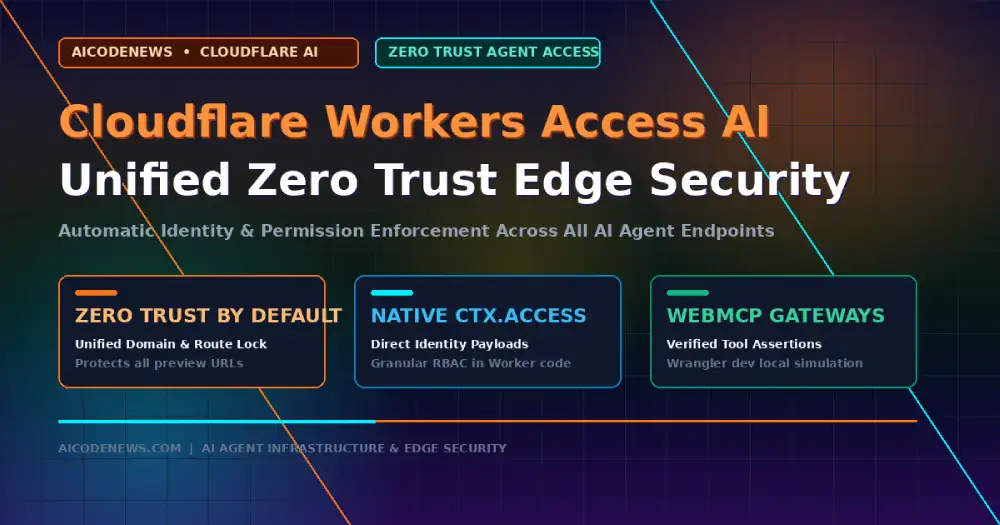
    As developers deploy autonomous coding agents and Model Context Protocol (MCP) servers across distributed serverless infrastructure, Cloudflare Workers Access AI has officially rolled out to provide unified identity verification, private-by-default routing, and edge security policies.

    Announced on the Cloudflare Changelog, Cloudflare Workers Access AI eliminates the need to manually configure access rules across separate routes and custom domains, automatically attaching Zero Trust policies directly to the underlying Worker.

    1. Why Cloudflare Workers Access AI Matters for Agent Gateways

    Securing autonomous agent endpoints and internal database connectors has historically required complex middleware layers:

    • Unified Multi-Domain Protection: With Cloudflare Workers Access AI, an application reachable on a custom domain, standard route, and workers.dev preview URL is protected simultaneously under a single attached policy.
    • Private by Default Architecture: Engineering teams can enforce global rules where all newly created Workers require identity authentication before receiving incoming agent traffic.
    • Native Context Identity (ctx.access): Developers can access user and service identity payloads directly inside Worker code to enforce granular role-based access control (RBAC).

    2. Local Testing & WebMCP Integration with Cloudflare Workers Access AI

    To ensure developer velocity remains uninterrupted, Cloudflare Workers Access AI includes deep tooling integration for existing serverless workflows:

    • Local wrangler dev Simulation: Test authenticated agent handoffs and token payloads locally before deploying to global edge nodes.
    • Automated WebMCP Gateways: Safely expose internal microservices as verified Model Context Protocol endpoints with cryptographic identity assertions.

    3. Key Takeaways

    • Zero Trust by Default: Cloudflare Workers Access AI locks down agent endpoints across all custom domains and preview URLs.
    • Native Context Access: Inspect identity claims inside ctx.access with zero latency overhead.
    • Streamlined Security: Eliminates manual route tracking and protects internal AI tools automatically.

    Follow AICodeNews.com for daily updates on AI agent infrastructure, edge computing, and developer security tooling.