Published by AICodeNews Editorial Team | August 26, 2026
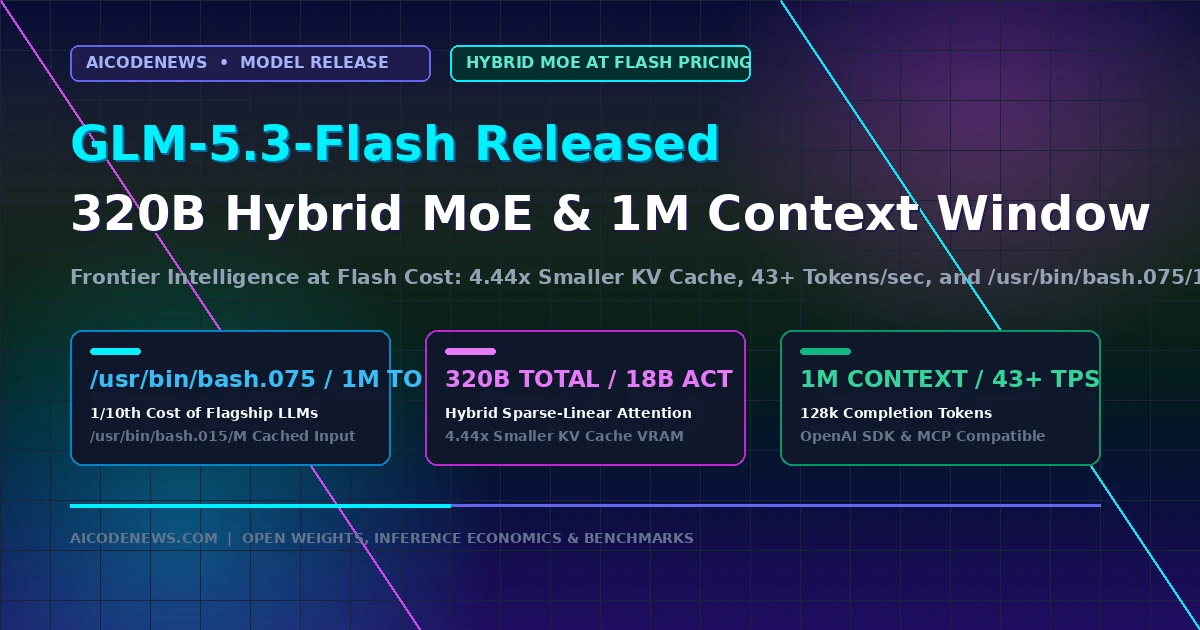
In a major breakthrough for high-throughput developer inference, GLM-5.3-Flash has officially launched, delivering frontier-class reasoning and coding intelligence at a fraction of standard API costs.
Announced across developer channels on Z.ai and released as open weights on Hugging Face, GLM-5.3-Flash introduces a hybrid sparse-linear attention architecture that cuts inference Key-Value (KV) cache memory by over 4.4x while maintaining a massive 1-million-token context window.
1. Core Architecture & Performance Benchmarks of GLM-5.3-Flash
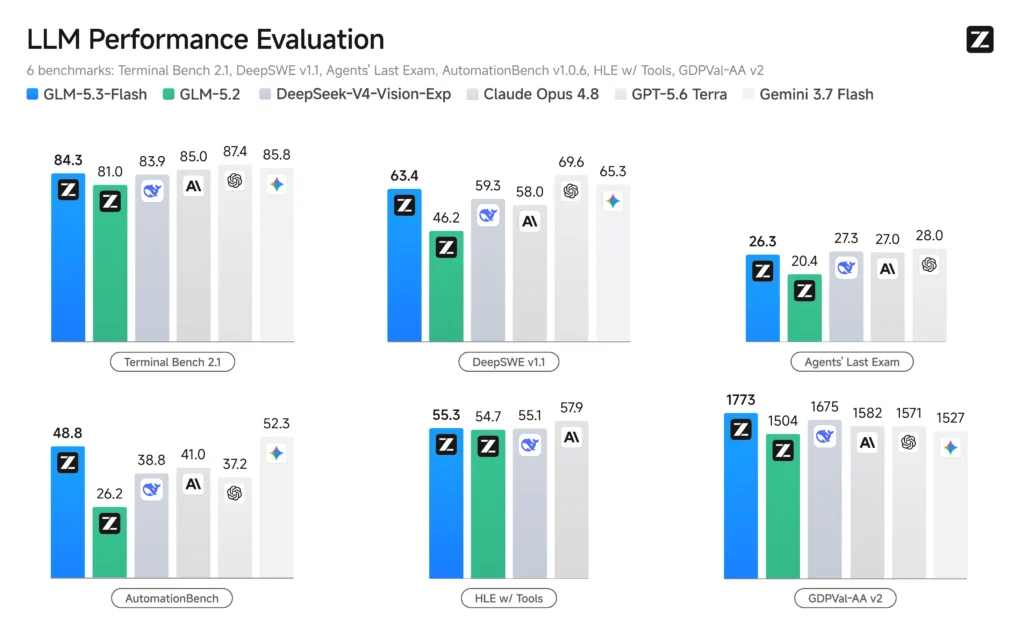
Under the hood, GLM-5.3-Flash features a 320-billion total parameter Mixture-of-Experts (MoE) design with only 18 billion active parameters per token. This dynamic sparsity delivers rapid generation speeds exceeding 43 tokens per second:
- Hybrid Attention Mechanism: Combines sparse windowed attention with linear recurrent attention, reducing compute overhead by 3.01x and KV cache size by 4.44x compared to base GLM-5.3.
- 1M Context & 128k Output Window: Supports 1,048,576 input tokens and up to 131,072 completion tokens, making it ideal for whole-repository refactoring and autonomous debugging loops.
- Frontier Benchmark Scores: Achieves a 57+ rating on the Artificial Analysis Intelligence Index, outperforming comparable lightweight models on multi-file coding and mathematical problem-solving.
2. API Pricing & Token Economics of GLM-5.3-Flash
The defining advantage of GLM 5.3-Flash is its aggressive pricing structure, positioning it as one of the most cost-effective reasoning endpoints in the industry:
| Model Endpoint | Input Price / 1M | Cached Input / 1M | Output Price / 1M | Context Window |
|---|---|---|---|---|
| GLM-5.3-Flash (Launch Rate) | $0.075 – $0.15 | $0.015 – $0.03 | $0.20 – $0.39 | 1,048,576 Tokens |
| DeepSeek-V4-Flash | $0.14 | $0.028 | $0.28 | 1,048,576 Tokens |
| Gemini 3.7 Flash | $0.15 | $0.0375 | $0.60 | 1,048,576 Tokens |
| GLM-5.3 (Flagship Base) | $1.40 | $0.26 | $4.40 | 1,048,576 Tokens |
3. Developer Integration: Python API & Tool Calling with GLM 5.3-Flash
GLM 5.3-Flash provides full drop-in compatibility with the OpenAI SDK, supporting native function calling, Model Context Protocol (MCP) tool execution, and structured JSON outputs:
from openai import OpenAI

# Initialize the client pointing to the Z.ai endpoint
client = OpenAI(
    api_key="YOUR_ZAI_API_KEY",
    base_url="https://api.z.ai/v1"
)

# Stream code generation with GLM-5.3-Flash
response = client.chat.completions.create(
    model="glm-5.3-flash",
    messages=[
        {"role": "system", "content": "You are an expert Python software engineer."},
        {"role": "user", "content": "Write a high-throughput async queue worker using asyncio and Redis."}
    ],
    temperature=0.2,
    stream=True
)

for chunk in response:
    if chunk.choices[0].delta.content:
        print(chunk.choices[0].delta.content, end="")
4. Key Takeaways
- 320B Hybrid MoE Architecture: GLM-5.3-Flash activates 18B parameters per token, cutting KV cache VRAM requirements by 4.44x.
- Ultra-Low Token Pricing: Offers input pricing starting at $0.075/1M tokens, reducing agent operating costs by over 90% compared to dense flagship models.
- Seamless Drop-In API: Compatible with OpenAI SDKs, OpenRouter, Cursor, Claude Code, and native MCP servers.
Bookmark AICodeNews.com for daily updates on open-weight model releases, API pricing benchmarks, and AI developer infrastructure.

I’m Mohammed Khan, Software developer and AI researcher covering autonomous coding agents, open-source large language models, and modern developer infrastructure. Founder and lead editor at AICodeNews.
And I also build Websites using WordPress. To be honest I love WordPress and AI.
You can find more info about me here