
Published by AICodeNews Editorial Team | August 29, 2026
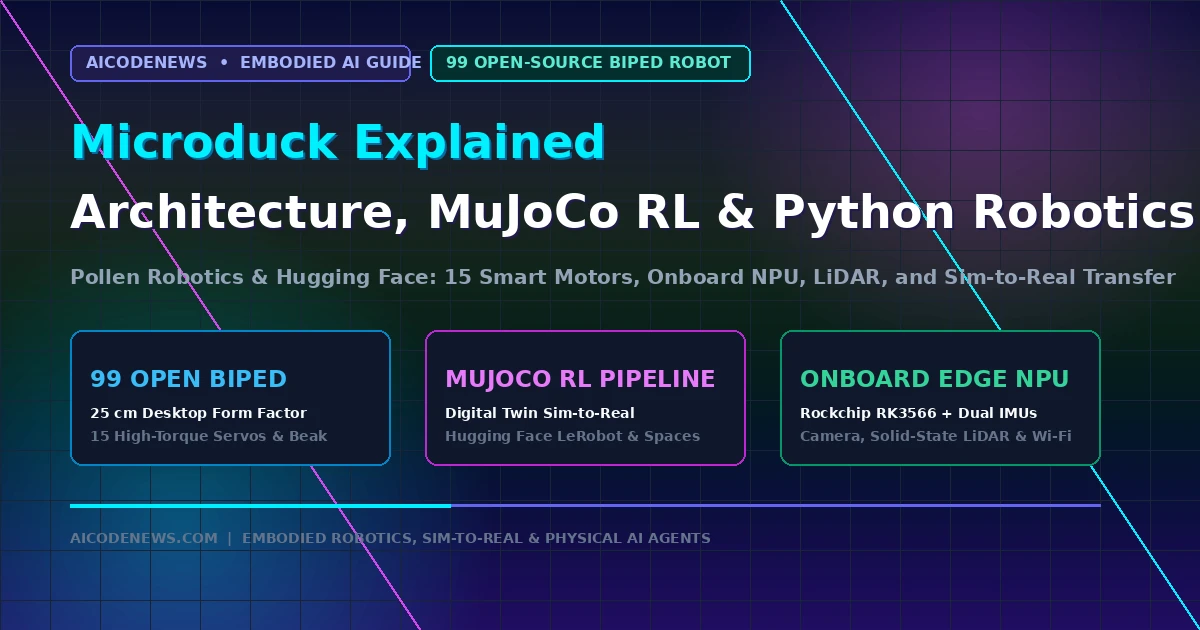
In a major breakthrough for physical AI and embodied robotics, Microduck has been officially unveiled as an open-source 25 cm biped robot co-developed by Pollen Robotics and Hugging Face.
Priced at an accessible $399 and backed by full simulation environments on Hugging Face Spaces, Microduck bridges the gap between digital reinforcement learning (RL) models and real-world physical actuation. This in-depth guide covers Microduck Explained from first principles, detailing its onboard compute, MuJoCo physics simulation, and step-by-step Python programming.
1. What Is Microduck? The Biped Platform for AI Makers
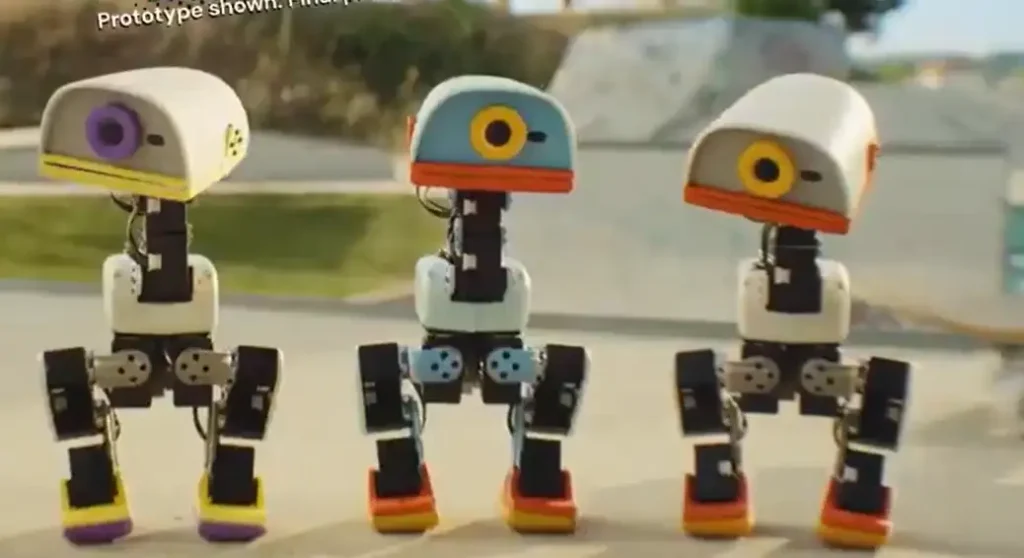
For years, embodied robotics research has been bottlenecked by prohibitive hardware costs. High-end humanoid bipeds typically cost tens of thousands of dollars, restricting reinforcement learning experiments to well-funded academic labs.
Microduck changes that equation entirely. Standing just 25 cm tall, it provides software engineers and AI builders with a fully articulated, programmable desktop robot that learns locomotion policies directly in physics simulators before running on real hardware.
Unlike rigid toy robots with pre-baked hardcoded routines, Microduck is built specifically for machine learning. Every joint angle, sensor stream, and motor torque value is completely exposed via open-source Python APIs and Hugging Face’s LeRobot framework.
2. Hardware Architecture & Sensor Array of Microduck
Despite its compact desktop footprint, Microduck packs an enterprise-grade sensor and compute payload:
- 15 High-Torque Smart Servos: Actuates 5 degrees of freedom (DoF) per leg, 2 DoF in the neck, and an articulated beak gripper designed to pick up small objects.
- Onboard Edge Compute: Powered by a Rockchip RK3566 processor paired with a dedicated Neural Processing Unit (NPU) for real-time edge policy inference.
- Multimodal Perception Suite: Equipped with a forward-facing wide-angle camera, a miniature solid-state LiDAR depth sensor, and dual 6-axis Inertial Measurement Units (IMUs) in the torso and feet.
- Connectivity & Power: Dual-band Wi-Fi, Bluetooth 5.2, USB-C serial diagnostics, and a hot-swappable LiPo battery pack offering 45 minutes of continuous dynamic locomotion.
3. Sim-to-Real Reinforcement Learning: How Microduck Learns to Walk
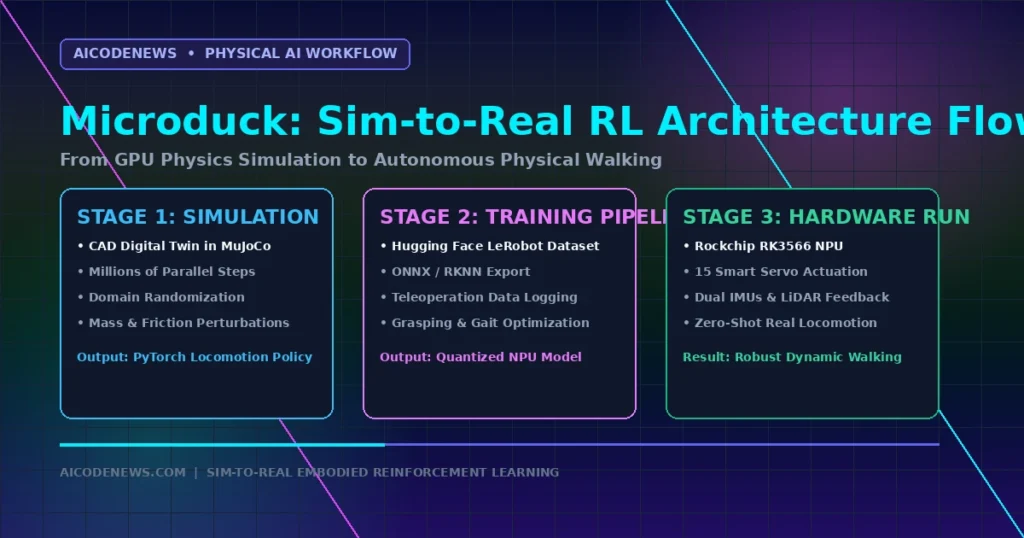
The core innovation behind Micro duck is its seamless Sim-to-Real pipeline. Rather than risking mechanical wear by training in the physical world, policies are trained in thousands of parallel MuJoCo simulations on GPU clusters:
- Step 1 (MuJoCo Physics Simulation): Exact Onshape CAD digital twins simulate gravity, friction, motor latency, and joint backlash across millions of synthetic steps.
- Step 2 (Domain Randomization): Randomizing mass, floor friction, and sensor noise during training ensures the neural network policy generalizes robustly to real-world irregularities.
- Step 3 (Zero-Shot Hardware Deployment): The trained PyTorch policy weights are exported to ONNX/RKNN format and flashed onto the robot’s onboard NPU for zero-latency execution.
4. Hands-On Python Code: Controlling Micro duck via SDK
Developers can interact with Microduck over local Wi-Fi or USB-C using the official open-source Python SDK:
Step 1: Install the Microduck Python SDK
pip install microduck lerobotStep 2: Basic Locomotion & Sensor Streaming Script
import time
from microduck import MicroDuck

# Initialize connection to the robot over local network
duck = MicroDuck(ip_address="192.168.1.142")

# Calibrate sensors and stand upright
duck.calibrate_imus()
duck.stand(height_mm=220)

print("Battery Level:", duck.get_battery_percentage(), "%")
print("IMU Pitch & Roll:", duck.get_orientation())

# Execute a trained dynamic walking policy
try:
    print("Executing forward bipedal gait...")
    duck.walk(velocity_x=0.15, yaw_rate=0.0)
    time.sleep(5.0)
finally:
    # Safely crouch and disable motor torque
    duck.crouch()
    duck.disable_torque()
    duck.close()
5. Microduck vs. Traditional Robotics Platforms
This comparison shows how Micro duck stacks up against other popular open-source and commercial robotics platforms:
| Platform Feature | Pollen / HF Microduck | Unitree Go2 (Quadruped) | TurtleBot 4 (Wheeled) |
|---|---|---|---|
| Price Point | $399 (Accessible) | $1,600 – $2,800 | $1,850 |
| Locomotion Type | Dynamic 2-Leg Biped | 4-Leg Quadruped | Differential 2-Wheel Base |
| Simulation Stack | MuJoCo + Hugging Face Spaces | Isaac Gym | Gazebo / ROS 2 |
| Open-Source Depth | 100% Open CAD + Code | Proprietary firmware | Open-source ROS 2 wrapper |
| Target Audience | AI Researchers & Makers | Robotics labs | Academic classrooms |
6. Developer FAQ on Microduck
Can I train custom policies in simulation without owning the physical robot?
Yes. The complete Micro duck physics model is freely available on Hugging Face Spaces and GitHub, allowing you to train RL policies in MuJoCo inside Google Colab or your local GPU workstation.
Does Microduck support Model Context Protocol (MCP) tool integration?
Yes. Because the Python SDK exposes clean modular functions, you can wrap Micro duck commands inside FastMCP servers to let autonomous agents (like Claude Code or Cursor) command the robot via natural language.
7. Key Takeaways
- Democratizing Biped Robotics: Micro duck delivers a 25 cm, 15-motor open-source biped for $399, removing the financial barrier to physical AI research.
- MuJoCo Sim-to-Real: Train dynamic locomotion and grasping policies in parallel physics simulations before deploying directly to edge hardware.
- Hugging Face LeRobot Integration: Native support for open-source robotics models, datasets, and community Spaces.
Bookmark AICodeNews.com for daily coverage on embodied AI, open-source robotics, and developer infrastructure.

The official editorial desk of AICodeNews. We provide verified breaking news, in-depth tool comparisons, and hands-on technical tutorials for software engineers building with frontier and open-source AI models.
Wanna know more about us? Read here