
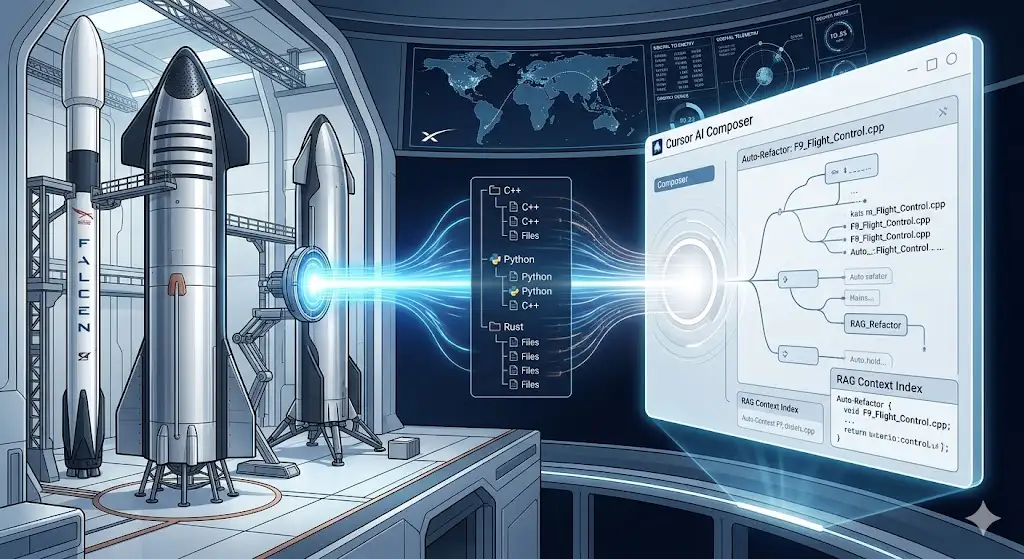
Redefining the intersection of aerospace engineering and artificial intelligence.
In a move that redefines the intersection of aerospace engineering and artificial intelligence, SpaceX has finalized its $60 billion acquisition of the AI-native coding platform, Cursor. This acquisition represents one of the largest software exits in history, signaling a fundamental shift toward autonomous software development in high-stakes, mission-critical environments.
Technical TL;DR
- •Acquisition Value: $60 billion USD, reflecting a massive premium on AI-driven developer productivity tools.
- •Strategic Objective: Integration of agentic IDE workflows into SpaceX’s proprietary flight software stacks and Starlink ground station telemetry.
- •Core Technology: Leveraging Cursor’s “Composer” features and contextual RAG (Retrieval-Augmented Generation) to manage multi-million line C++ and Python codebases.
- •Hardware-Software Co-design: Using AI to bridge the gap between rapid hardware prototyping and the software required to govern it.
Key Features/Benchmarks
The integration focuses on Cursor’s ability to maintain a deep contextual map of complex repositories. In internal SpaceX benchmarks, Cursor-driven workflows demonstrated a 40% reduction in the “Time to First Commit” for new engineers working on Starship’s flight control systems.
- Contextual IntelligenceCursor’s ability to index entire local codebases allows for zero-shot generation of hardware abstraction layers (HALs).
- Automated RefactoringReal-time migration of legacy flight code to memory-safe paradigms, reducing technical debt during rapid iteration cycles.
- Aerospace-Grade AccuracyFine-tuning underlying Large Language Models (LLMs) on SpaceX’s proprietary telemetry data to predict edge-case failures in code logic before they reach the simulation phase.
Developer Impact
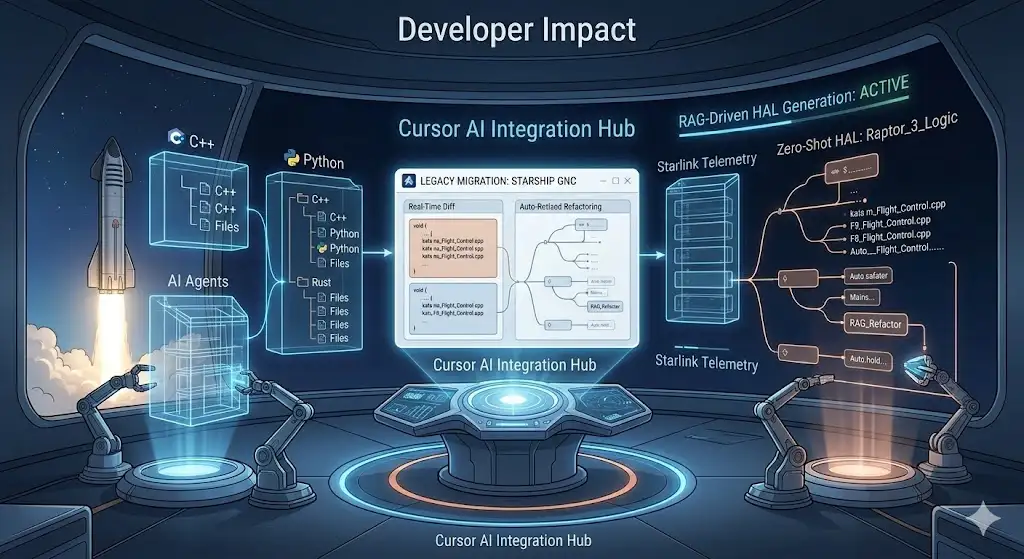
For the broader developer community, this acquisition validates the “AI-first” IDE as the primary interface for modern engineering. At SpaceX, the role of the software engineer is evolving from manual syntax entry to high-level architectural oversight.
Developers are now managing fleets of AI agents that handle boilerplate, testing, and documentation, allowing human engineers to focus on system-level logic and physics constraints.
As SpaceX pushes for full autonomy in its Mars program, the reliance on Cursor suggests that the future of aerospace—and perhaps all software engineering—will be defined by the speed at which developers can prompt, verify, and deploy AI-generated code.
Leave a Reply