Tag: ai

  • DeepSeek Releases DeepSeek Harness: Open-Source Agent Runtime Reaches 144K GitHub Stars

    DeepSeek Releases DeepSeek Harness: Open-Source Agent Runtime Reaches 144K GitHub Stars

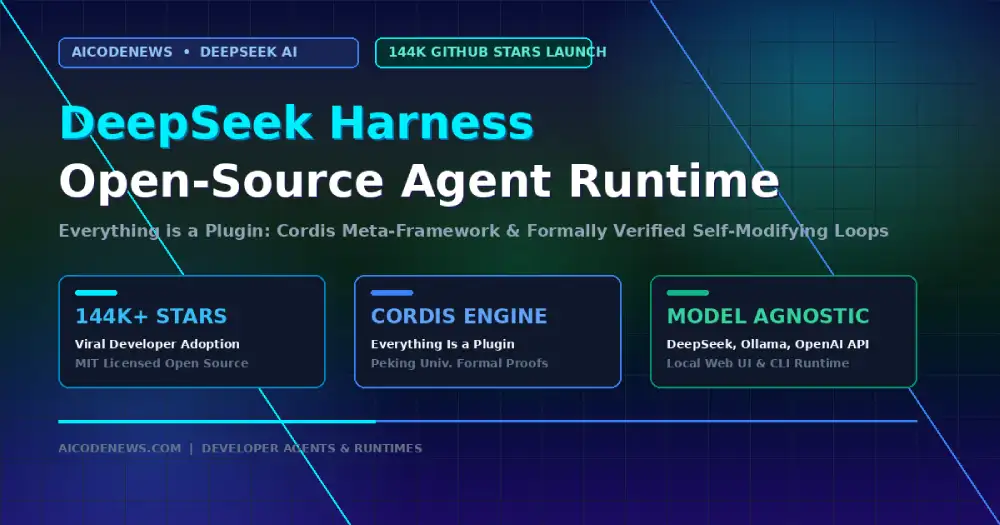
    In a major open-source release reshaping autonomous software development, DeepSeek AI has launched DeepSeek Harness, a fully modular agent execution runtime that has surged past 144,000 stars on GitHub within days of release.

    Available as a developer preview on the official DeepSeek GitHub Repository, DeepSeek Harness takes a radical architectural stance: it is not a language model, but the complete operational layer around one—orchestrating terminal commands, permissions, memory, tool pipelines, and decision-making loops.

    1. The Core Philosophy of DeepSeek Harness: Everything Is a Plugin

    Where proprietary agent tools treat the execution loop as a protected black box, this architecture eliminates the concept of a privileged core:

    • 100% Swappable Components: In this runtime, every single capability—from model adapters and sandbox environments to session storage and the decision loop itself—is a self-contained plugin.
    • Extend Without Forking: Developers can introduce entirely new agentic behaviors by mounting custom plugins rather than maintaining complex project forks.
    • Model-Agnostic Freedom: Released under the permissive MIT license, the framework connects seamlessly to DeepSeek endpoints, local Ollama/vLLM instances, or any OpenAI-compatible API.

    2. Theoretical Grounding: Cordis Meta-Framework & Formal Proofs

    Unlike typical wrapper frameworks, DeepSeek Harness is built on Cordis, a composition meta-framework backed by an 88-page academic research paper co-authored by Peking University and DeepSeek researchers:

    • Formally Verified Self-Modification: The underlying mathematical proofs demonstrate that an autonomous program can safely rewrite its own execution graph and plugin stack at runtime without causing system deadlocks.
    • Reversible Lifecycle Effects: Every plugin registration is treated as an isolated state effect that safely unwinds whenever a component is detached or reloaded.

    3. Developer Availability & Getting Started

    Developers can launch the DeepSeek Harness developer preview and explore its built-in browser interface with a single terminal command:# Launch the DeepSeek Harness local web interface on port 3080

    npx @deepseek-ai/dsh web

    DeepSeek noted that because the release is currently in active developer preview, rapid iteration and architectural breaking changes are expected as the community ecosystem matures.

    4. Key Takeaways

    • Viral Open-Source Release: DeepSeek Harness surpasses 144K GitHub stars under the MIT license.
    • Everything Is a Plugin: Model adapters, tools, sandboxes, and agent loops are 100% modular and replaceable.
    • Formal Theory Under the Hood: Built on Cordis and formal self-rewriting program proofs from Peking University and DeepSeek.

    Bookmark AICodeNews.com for daily updates on open-source agent runtimes, model pricing, and developer tools.

  • Stripe Acquires OpenRouter in $7B+ Deal to Power the AI Agent Economy

    Stripe Acquires OpenRouter in $7B+ Deal to Power the AI Agent Economy

    Published by AICodeNews Editorial Team | August 17, 2026

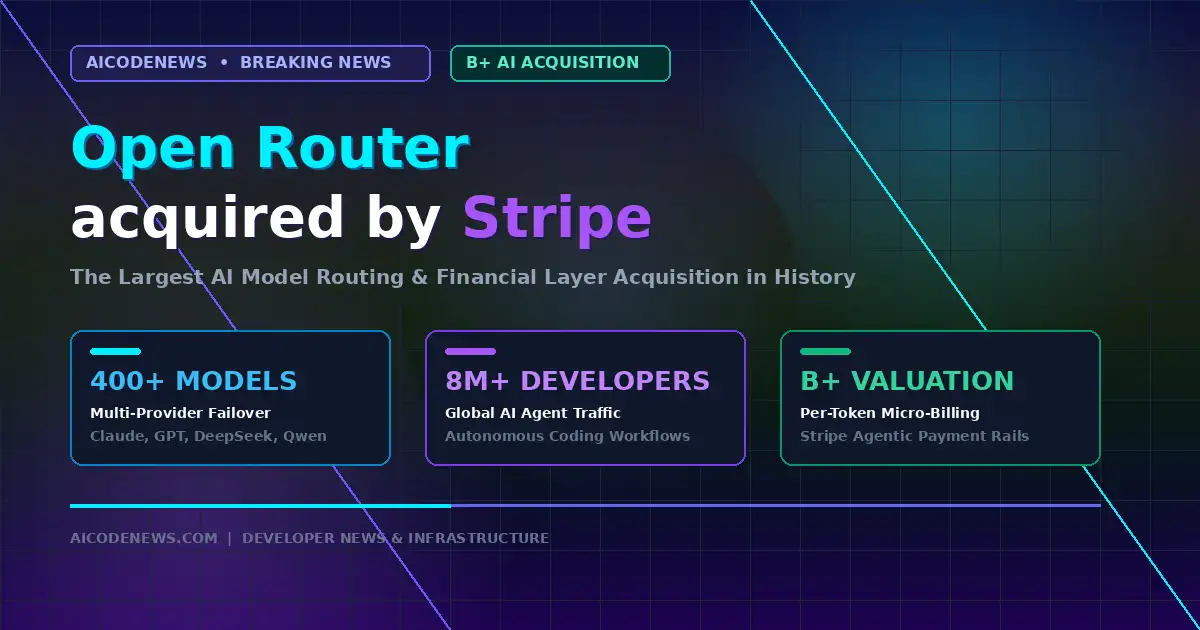
    In a landmark deal reshaping developer AI infrastructure, fintech giant Stripe Acquires OpenRouter for more than $7 billion to establish the dominant routing and financial layer for autonomous software agents.

    The news that Stripe Acquires OpenRouter represents the largest infrastructure acquisition in AI history, uniting OpenRouter’s developer gateway of over 400 models with Stripe’s global payments and metering rails.

    1. Why Stripe Acquires OpenRouter: Controlling the Inference Tollgate

    Over the past two years, OpenRouter quietly became the default API gateway for more than 8 million developers and coding tools:

    • Unified Multi-Model Gateway: Developers access Claude, GPT, DeepSeek, Qwen, and open-weights models through a single standardized API key with automatic failover.
    • Micro-Billing at Token Scale: Managing per-token payments across dozens of model providers is a massive ledger problem that fits Stripe’s core payments infrastructure.
    • Autonomous Agent Rails: As software agents perform autonomous workflows, they require programmatic wallets and dynamic routing gateways to pay for compute per task.

    2. Developer Impact on Routing, APIs, and Pricing

    The strategic move where Stripe Acquires OpenRouter directly addresses developer lock-in and billing complexity:

    • Native Stripe Billing Integration: Developers can now bundle end-user SaaS subscriptions with pass-through per-token AI costs under a single unified dashboard.
    • No Disruption to Open Protocols: The platform will maintain its open OpenAI-compatible API endpoints and Model Context Protocol (MCP) tool integrations.
    • Enterprise SLA Guarantees: Backed by Stripe’s infrastructure, enterprise teams gain dedicated throughput and latency guarantees across global routing clusters.

    3. Key Takeaways

    • Historic Infrastructure Deal: Stripe Acquires OpenRouter for over $7 billion.
    • 8M+ Developer Reach: Consolidates routing across 400+ AI models under Stripe’s financial stack.
    • Agent Economy Foundation: Powers automated micro-payments and multi-model fallback for next-generation software agents.

    Bookmark AICodeNews.com for daily updates on AI infrastructure acquisitions, model pricing, and developer tools.

  • Alibaba Releases Qwen3.8-27B on Hugging Face: Apache 2.0 Open Weights for Local GPUs

    Alibaba Releases Qwen3.8-27B on Hugging Face: Apache 2.0 Open Weights for Local GPUs

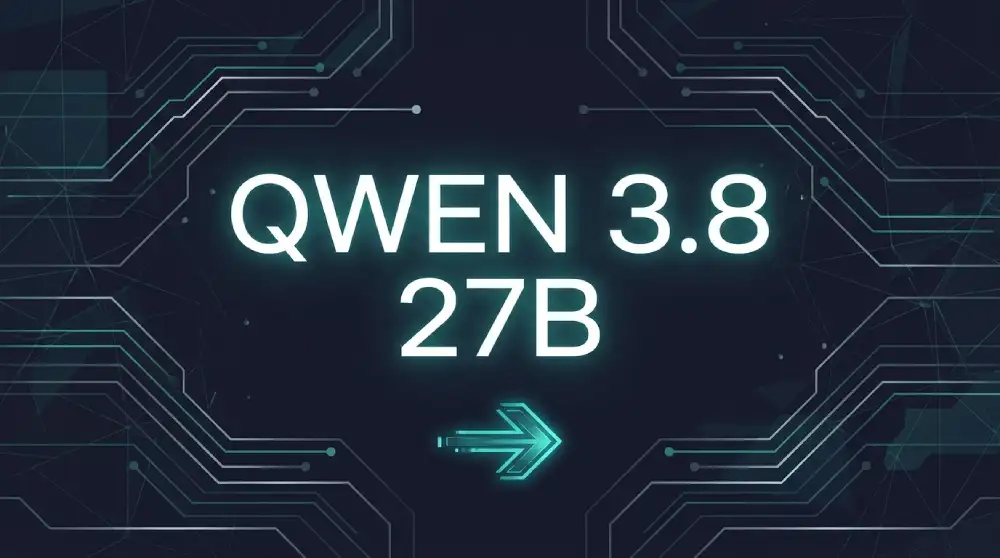
    Alibaba Cloud’s Qwen Team has officially released Qwen 3.8 27B on Hugging Face under the fully permissive Apache 2.0 open-source license.

    Available immediately on the Hugging Face Qwen Repository, Qwen 3.8 27B delivers dense vision-language and high-performance code generation capabilities engineered specifically to run on consumer hardware without sacrificing benchmark intelligence.

    1. Core Architecture & Hardware Requirements for Qwen 3.8 27B

    Unlike massive cloud-only Mixture-of-Experts clusters, Qwen 3 8 27B strikes an optimal balance between parameter scale and local developer accessibility.

    • Single-GPU Deployment: In 4-bit GGUF or official FP8 precision (Qwen3.8-27B-FP8), Qwen 3.8 27B fits comfortably inside a single 24GB GPU (such as an Nvidia RTX 3090 or 4090) or a modern Apple Silicon Mac with 32GB of unified memory.
    • 55.6 GB BF16 Weights: The official repository provides 18 shards of uncompressed BF16 safetensors alongside official FP8 quantized checkpoints.
    • Permissive Apache 2.0 License: Organizations can deploy Qwen 3.8-27B in commercial SaaS products, private on-prem clusters, and terminal coding agents with zero licensing fees.

    2. Benchmark Performance in Software Engineering Workflows

    Early developer testing across developer communities indicates that Qwen 3.8-27B rivals larger 70B parameter models on code completion, multi-language translation, and function calling.

    • SWE-Bench & HumanEval: Scores within striking distance of proprietary closed endpoints while operating entirely offline on private workstations.
    • Ecosystem Integration: Day-one support across llama.cpp, Ollama, vLLM, SGLang, and Unsloth makes running the model locally effortless.

    3. Key Takeaways

    • Official Hugging Face Release: Qwen 3.8-27B is now live under Apache 2.0.
    • Consumer Hardware Friendly: Runs locally on single 24GB GPUs and 32GB Mac Studios using FP8 and 4-bit quantizations.
    • Zero API Dependency: 100% private, self-hosted coding intelligence with no per-token costs.

    Bookmark AICodeNews.com for daily updates on open-weight AI releases, local model deployment guides, and developer tooling.

  • Z.ai Launches GLM 5.3: The Open-Weights AI Shattering Coding and Cyber Benchmarks

    Z.ai Launches GLM 5.3: The Open-Weights AI Shattering Coding and Cyber Benchmarks

    Artificial intelligence research firm Z.ai has launched glm 5.3, a groundbreaking open-weights model setting new industry standards for frontier coding and cyber capabilities. Built strictly by scaling post-training on the architectural stack established by its predecessor, it demonstrates that massive reinforcement learning (RL) on long-horizon task environments can yield immense performance gains without altering the base model.

    GLM 5.3 – A New Standard for Autonomous Coding

    For complex software engineering, glm 5.3 delivers a major 50% improvement over GLM-5.2 on Z.ai’s private Code Bench. The model handles intensive production tasks, taking full ownership of end-to-end infrastructure diagnostics and code optimization rather than relying on humans to decompose problems.

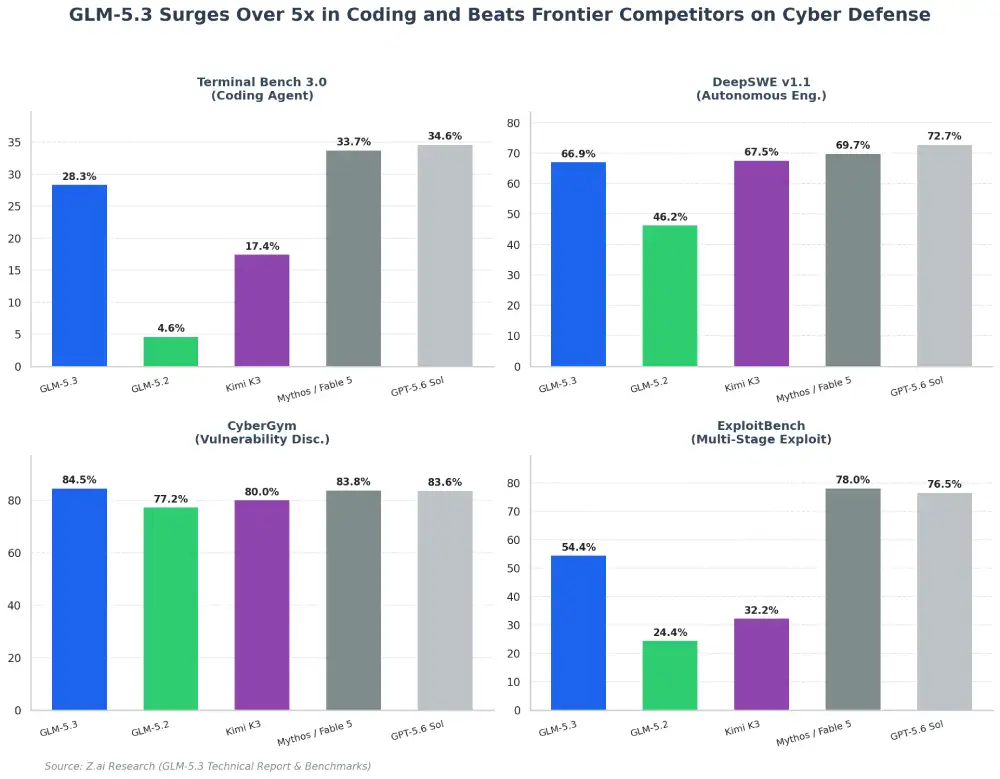
    These post-training advancements are validated on public benchmarks. On Terminal Bench 3.0, glm 5.3 surged to a score of 28.3, up from 4.6 for GLM-5.2. It also scored 66.9 on DeepSWE v1.1, compared to 46.2 previously. These coding breakthroughs are powered by Z.ai’s open-source slime framework and SAO with compaction RL strategies, ensuring these gains hold over long-horizon workflows.

    Emergent Cyber Defense

    During post-training, the model developed highly advanced cyber capabilities. Rather than just identifying isolated flaws, glm 5.3 reasons across complex, multi-stage exploitation chains. It achieved state-of-the-art results on CyberGym with an 84.5% score and more than doubled its predecessor on ExploitBench with a 54.4% score.

    In real-world security trials across 269 open-source projects, glm 5.3 successfully identified 2,436 vulnerabilities—including 1,097 critical and high-severity issues. These flaws spanned system operating systems, operating kernels, and web applications. Remarkably, these issues lived undetected for an average of 26.6 years, with the oldest vulnerability dating back to 1981.

    Release and Availability

    Developers can soon run glm 5.3 locally, as Z.ai will release the open-source weights in two weeks. The model is available via the Z.ai Coding Plan and features three customizable thinking effort levels: low, high, and max

    Follow AI Code News for more news about AI and Coding.

  • DeepSeek V4 Pro Launches: Near-Opus Agent Reasoning at Fractional API Cost

    DeepSeek V4 Pro Launches: Near-Opus Agent Reasoning at Fractional API Cost

    Published by AICodeNews Editorial Team | August 13, 2026

    In a major advancement for open-weight AI infrastructure, Chinese AI laboratory DeepSeek officially released DeepSeek V4 Pro, an upgraded flagship reasoning model engineered specifically for long-horizon agentic coding workflows.

    Launched on August 12, 2026, DeepSeek V4 Pro delivers autonomous code generation and multi-step tool orchestration capabilities that approach closed frontier models like Claude Opus 5, while operating at a fraction of the per-token API cost.

    2. Architectural Upgrades & Benchmark Capabilities in DeepSeek V4 Pro

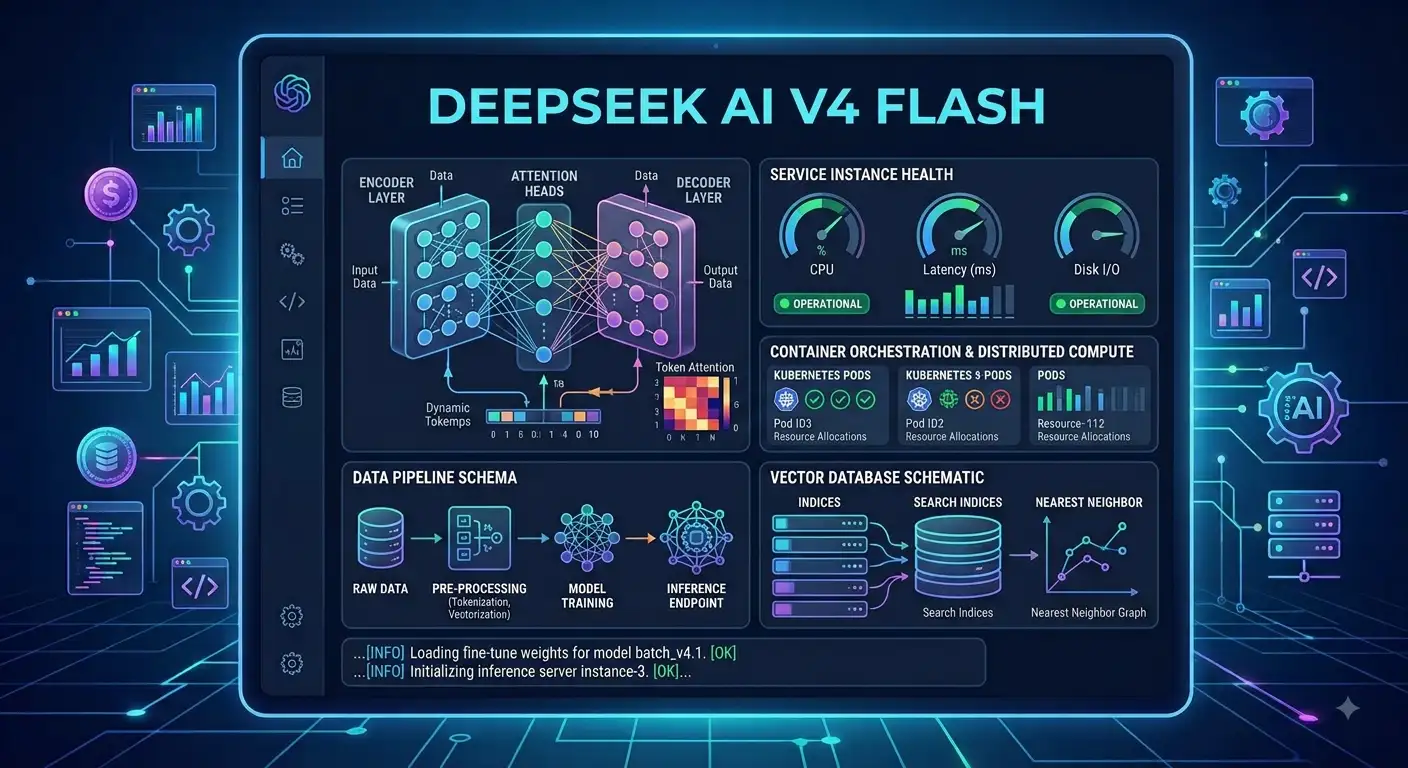
    Building upon the lightweight DeepSeek-V4-Flash architecture, the system expands total model capacity while retaining high-density Mixture-of-Experts (MoE) efficiency:

    • 1 Million Token Context Window: DeepSeek V4 Pro natively supports a 1,048,576-token context window alongside an expanded 384,000-token maximum output limit.
    • SWE-Bench Pro & Agent Performance: On standardized software engineering benchmarks, the model scored within 2.1 percentage points of top proprietary models on multi-file bug fixing and automated code reviews.
    • Native Dual-Mode Execution: Allows developers to toggle the engine between high-speed standard generation and extended “Thinking Mode” for complex mathematical and algorithmic tasks.

    2. API Economics & Production Deployment

    While DeepSeek announced upcoming general API price adjustments to manage server capacity, the release offers significant cost-per-token savings compared to Western enterprise endpoints.

    Developers building multi-agent workflows (such as Cursor, Windsurf, or terminal agents) can deploy DeepSeek V4 Pro directly via OpenAI-compatible and Anthropic-compatible API endpoints.

    2. Key Takeaways

    • Official Launch: DeepSeek V4 Pro officially released on August 12, 2026.
    • 1M Context Handling: Supports 1M input tokens and 384k max output tokens.
    • Agentic Parity: Approaches frontier reasoning capabilities at a fraction of proprietary API costs.

    Follow AICodeNews.com for daily updates on AI model releases, API changes, and developer tooling.

  • DeepSeek Signals API Price Hike as DeepSeek-V4-Flash Token Demand Surges

    DeepSeek Signals API Price Hike as DeepSeek-V4-Flash Token Demand Surges

    Published by AICodeNews Editorial Team | August 11, 2026

    Following unprecedented global adoption of its lightweight DeepSeek-V4-Flash-0731 model, Chinese AI laboratory DeepSeek has announced an upcoming DeepSeek API Price Increase for its developer endpoints.

    As reported by TechCentral and Mashable, the upcoming DeepSeek API Price Increase comes just ten days after the laboratory released its 284B parameter model at an ultra-low rate of $0.14 per 1M input tokens.

    1. Why a DeepSeek API Price Increase Is Coming

    The announcement of a DeepSeek API Price Increase highlights the severe server capacity and GPU infrastructure pressure facing low-cost AI providers:

    • Fastest Token Adoption in History: Since its July 31 release, DeepSeek-V4-Flash-0731 has become the fastest-growing model by token volume, overwhelming inference server clusters.
    • Infrastructure Overhead: Maintaining massive 1M context windows at $0.14/1M tokens created unsustainable GPU cluster utilization costs during peak developer hours.
    • Adjusting API Rates: DeepSeek advised enterprise users and developers to account for the DeepSeek API Price Increase in their upcoming infrastructure budgets.

    2. Developer Impact & Market Reaction

    Developer reactions on X/Twitter noted that while internal adjustments narrow the price gap, competition from rival open-weight model ( Qwen3.8 Max) remains fierce.

    Developers building high-volume automated agents are advised to implement multi-provider routing (such as LiteLLM or Unity AI Gateway) to switch between models dynamically as rates adjust.

    3. Key Takeaways

    • Price Hike Announcement: DeepSeek confirmed an upcoming DeepSeek API Price Increase due to record API demand.
    • Record Token Usage: DeepSeek-V4-Flash-0731 saw the fastest token growth in AI history.
    • Developer Advice: Multi-model routing recommended to manage infrastructure costs.

    Follow AICodeNews.com for daily updates on AI model pricing, API changes, and developer tooling.

  • What is Agentic AI? The Ultimate Guide to Autonomous AI Agents for Developers

    What is Agentic AI? The Ultimate Guide to Autonomous AI Agents for Developers

    Published by AICodeNews Editorial Team | August 2026 | Category: AI Basics
    |—|
    Artificial Intelligence has undergone a profound paradigm shift. For years, Generative AI operated primarily in a passive request-and-response mode: you typed a prompt into a chatbot interface, and it returned a block of text or a code snippet.

    In 2026, we have officially entered the era of Agentic AI—systems capable of autonomous decision-making, long-term planning, dynamic tool usage, and complex multi-step task execution without requiring continuous human prompting.

    In this comprehensive guide, AICodeNews breaks down what Agentic AI is, how autonomous agent architectures function under the hood, and how developers are leveraging agentic workflows in production environments.

    1. Defining Agentic AI: From Passive LLMs to Autonomous Execution

    image with laptop and other stuff on the table.

    Agentic AI refers to artificial intelligence systems designed to pursue complex goals autonomously by evaluating environment feedback, formulating sequential execution plans, executing tool calls (APIs, databases, web browsers, terminals), and self-correcting when errors occur.

    Unlike standard Large Language Model (LLM) completion APIs—which process input text and generate output tokens in a single forward pass—an AI Agent operates inside an iterative control loop:

    [Goal Received] ➔ [Plan Steps] ➔ [Select & Call Tool] ➔ [Observe Result] ➔ [Evaluate & Self-Correct] ➔ [Complete Task]

    2. The 4 Core Pillars of an Agentic AI Architecture

    Every modern AI agent framework (e.g., LangGraph, AutoGen, CrewAI, Claude Code) relies on four fundamental building blocks:

    Pillar 1: The Brain (Frontier LLM Engine)

    The foundation of any agent is an LLM with strong reasoning, instruction-following, and structured output capabilities (e.g., Claude Opus 5, GPT-5.5, or DeepSeek V4). The LLM processes environmental context, parses tool outputs, and decides the next action.

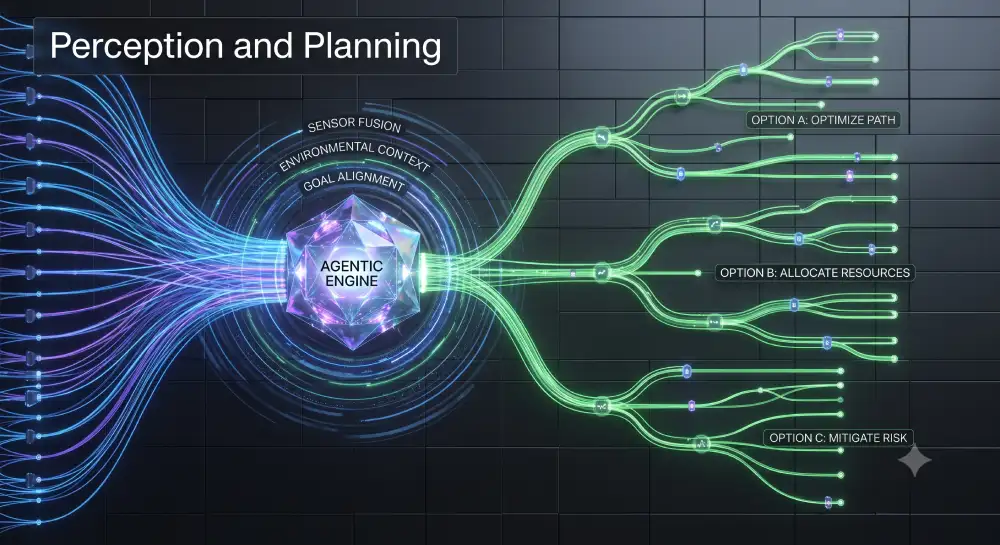
    Pillar 2: Planning & Reasoning Loops

    To accomplish multi-step objectives, agents break down goals into smaller sub-tasks using formal reasoning patterns:

    • ReAct (Reason + Act): Interleaves thinking (“Thought”) with execution (“Action”) and environmental evaluation (“Observation”).
    • Plan-and-Solve: Generates an initial multi-step execution plan upfront, executing steps sequentially while dynamically updating the plan based on intermediate results.
    • Reflection / Self-Correction: Analyzes failed code execution or API errors, diagnoses the root cause, and retries with corrected parameters.

    Pillar 3: Memory Systems

    • Short-Term Memory: The active context window holding the current execution state, recent chat history, and immediate tool call results.
    • Long-Term Memory: External vector databases (e.g., Pinecone, Qdrant) or local key-value stores allowing agents to recall past user preferences, project documentation, or historical execution logs across sessions.

    Pillar 4: Tool Use & Environment Perception

    An LLM alone cannot interact with the real world. Tools give agents “hands and eyes”:

    • Execution Environments: Bash terminals, Python code interpreters, Docker containers.
    • Data Access: SQL databases, web search, internal vector stores.
    • Protocols: Standards like the Model Context Protocol (MCP) allow agents to discover and call external tools securely via unified schema interfaces.

    3. Comparison Matrix: Standard LLM vs. RAG vs. Agentic AI

    DimensionStandard LLM ChatbotRetrieval-Augmented Generation (RAG)Agentic AI
    Primary FunctionSingle-turn text generationAnswering queries with static document contextAutonomous goal completion
    Execution LoopPassive (1 prompt ➔ 1 response)Passive (Query ➔ Retrieve ➔ Generate)Active (Iterative multi-turn loop)
    Tool UsageNone (Text only)Document search onlyFull API, DB, terminal & browser execution
    Error CorrectionRequires human re-promptingRequires human re-promptingSelf-corrects via environment observation
    Task ComplexitySingle isolated answersFactual Q&A over documentsEnd-to-end multi-file software engineering

    4. Real-World Developer Use Cases for Agentic AI

    1. Autonomous Software Engineering: Agents clone code repositories, reproduce bug reports, run local unit test suites, apply code fixes, and submit pull requests independently (e.g., Devin, Claude Code, GitHub Copilot Agents).
    2. DevSecOps & CI/CD Automation: AI agents monitor deployment pipelines, detect failing builds, analyze error logs, and automatically deploy rollback patches.
    3. Automated Data Engineering: Agents write SQL queries, validate data pipeline schemas, clean raw datasets, and generate analytical dashboards without human intervention.

    5. Security, Guardrails, and Human-in-the-Loop Governance

    Because agentic systems execute real code and make API calls, security and safety are paramount:

    • Sandboxed Execution: Always run agentic terminal/code execution inside isolated containers (Docker, e2b) to prevent unauthorized file deletion or system access.
    • Human-in-the-Loop (HITL): Require human approval before agents execute high-risk operations (e.g., production code deployments, database drops, or financial transactions).
    • Tool Access Scoping: Implement least-privilege permission models for agent API tokens.

    6. Summary & Key Takeaways

    • Agentic AI transitions artificial intelligence from passive information lookup to active, autonomous problem-solving.
    • Agents rely on an LLM engine, planning loops (ReAct), memory stores, and tool calling protocols (like MCP).
    • As models improve in long-horizon reasoning and context handling, agentic workflows will become the default paradigm for enterprise software development.

    Bookmark AICodeNews.com for weekly deep dives on AI foundational concepts, developer tools, and software engineering trends.