
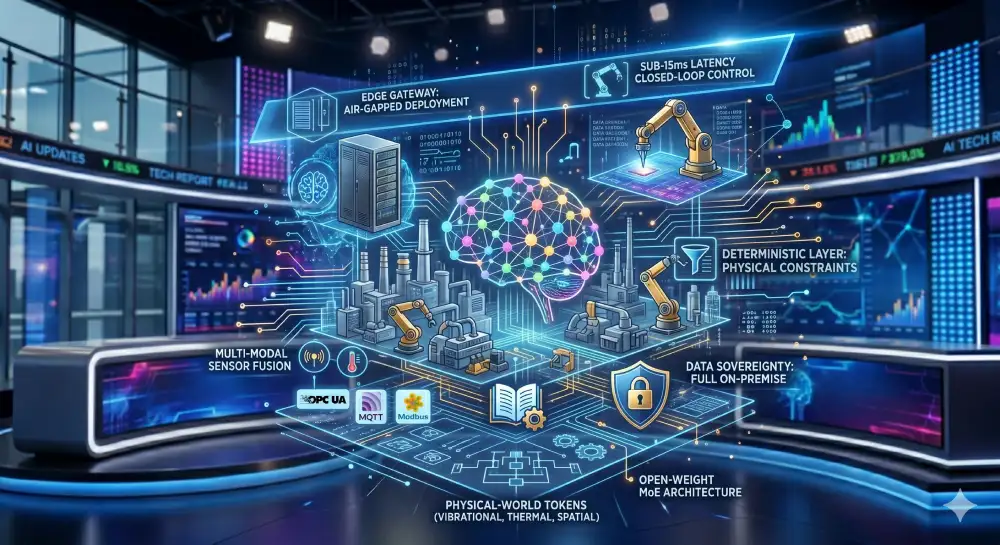
A watershed moment for industrial application, bridging digital reasoning with operational technology.
The recent $12 billion investment in Prometheus and Mistral marks a watershed moment for the industrial application of large-scale models. By pivoting from general-purpose LLMs toward a specialized “Physical-World” AI stack, this partnership aims to bridge the gap between digital reasoning and operational technology (OT).
Technical TL;DR
- ●Focus: Integration of generative AI with high-frequency telemetry and industrial control systems.
- ●Architecture: Utilization of Mistral’s open-weight Mixture-of-Experts (MoE) architectures adapted for low-latency inference.
- ●Deployment: Emphasis on edge-native execution to support air-gapped manufacturing environments.
- ●Protocol Support: Native integration for industrial standards including OPC UA, MQTT, and Modbus directly within the model’s tokenization layers.
- ●Data Sovereignty: Open-weight models allow for full on-premise fine-tuning, ensuring proprietary industrial data never leaves the facility.
Key Features/Benchmarks
The core of the Prometheus-Mistral stack is a specialized transformer architecture optimized for multi-modal sensor fusion. Unlike standard LLMs that process text, this stack introduces “Physical-World Tokens” capable of interpreting vibrational, thermal, and spatial data.
Preliminary benchmarks indicate that this industrial-tuned MoE architecture achieves sub-15ms latency for closed-loop control tasks—a 3x improvement over standard RAG (Retrieval-Augmented Generation) implementations. Furthermore, the stack includes a proprietary “deterministic layer” that filters LLM outputs through physics-based constraints to prevent hallucinations in safety-critical environments. This ensures that suggested adjustments to physical parameters (e.g., turbine pressure or robotic torque) remain within safe operating envelopes.
Developer Impact
For software engineers and system architects, this shift represents a move toward “Control-as-Code.” The availability of high-performance, open-weight models means developers are no longer tethered to cloud-heavy API dependencies that introduce unacceptable latency and security risks.
The Prometheus-Mistral SDK will allow developers to build autonomous agents capable of managing complex supply chains and robotic assembly lines using familiar Python-based workflows. By leveraging open-weights, teams can perform deep quantization to run these models on hardened industrial gateways and edge accelerators. This democratizes access to sophisticated AI, allowing even mid-sized industrial firms to implement custom, localized intelligence without the overhead of massive GPU clusters.
Leave a Reply