
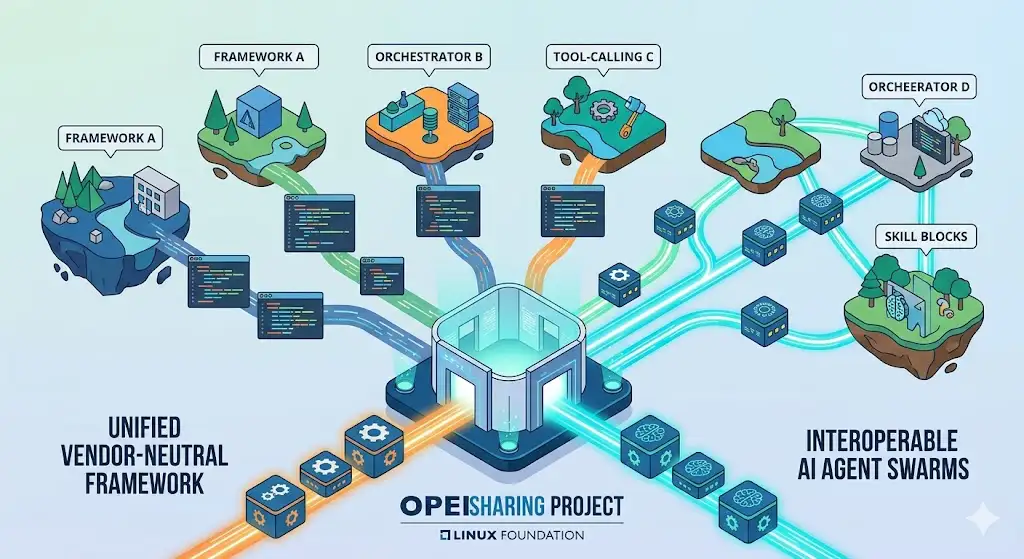
The Linux Foundation has officially announced the OpenSharing Project, a collaborative initiative aimed at establishing a unified, vendor-neutral framework for AI agent capabilities. As the industry shifts from monolithic LLM applications toward modular, multi-agent systems, the OpenSharing Project addresses the critical need for standardized “skill” definitions. This initiative seeks to bridge the architectural fragmentation currently hindering the deployment of autonomous swarms, ensuring that agentic tools remain interoperable regardless of the underlying model or runtime environment.
Technical TL;DR
- Objective: Establish a universal protocol for defining, discovering, and executing AI agent skills across distributed systems.
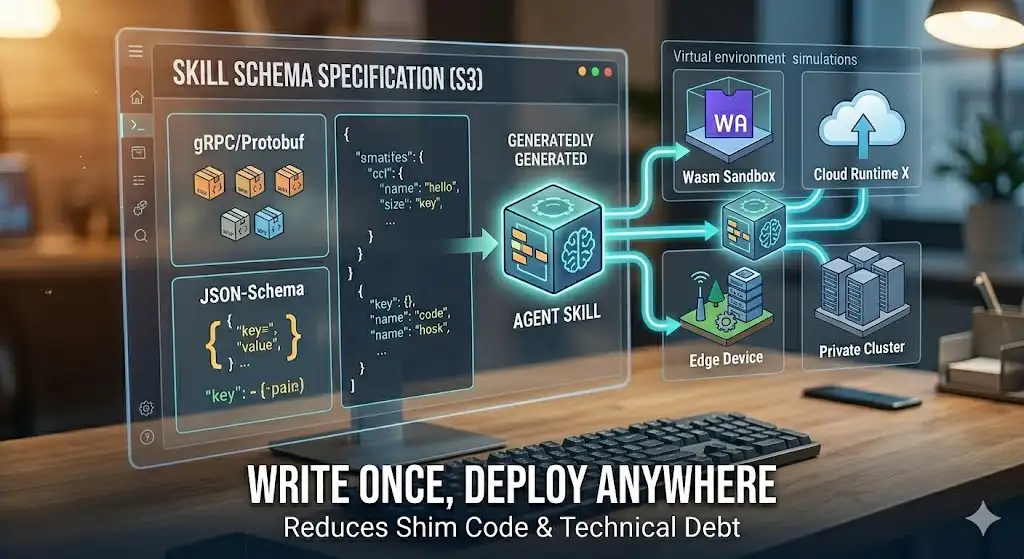
- Core Stack: Utilizes gRPC and Protocol Buffers (Protobuf) for high-performance communication, alongside JSON-Schema for strongly typed, human-readable skill manifests.
- Interoperability: Facilitates seamless capability sharing between frameworks like LangChain, AutoGen, and CrewAI via a standardized API layer.
- Security & Observability: Implements mTLS for secure skill invocation and integrated support for OpenTelemetry to track execution metrics.
Key Features/Benchmarks
The cornerstone of the project is the Skill Schema Specification (S3). This declarative format allows developers to define tool logic, required parameters, and output constraints in a machine-readable manifest.
- Dynamic Discovery Protocol (DDP): Implements a decentralized registry system, allowing agents to query and bind to capabilities in real-time.
- Execution Sandboxing: Defines a Wasm-based (WebAssembly) execution environment, ensuring skills remain portable and isolated within a “deny-by-default” security model.
- The “Agentic Latency” Benchmark: Introduces a new standardized metric to measure the overhead of multi-hop skill invocation.
Developer Impact
For the engineering community, the OpenSharing Project represents a departure from proprietary silos. By decoupling skill logic from specific orchestrators, developers can drastically reduce the “shim code” and technical debt associated with refactoring tool-calling logic. This standardization enables a “write once, deploy anywhere” approach to agentic tools.
Leave a Reply