
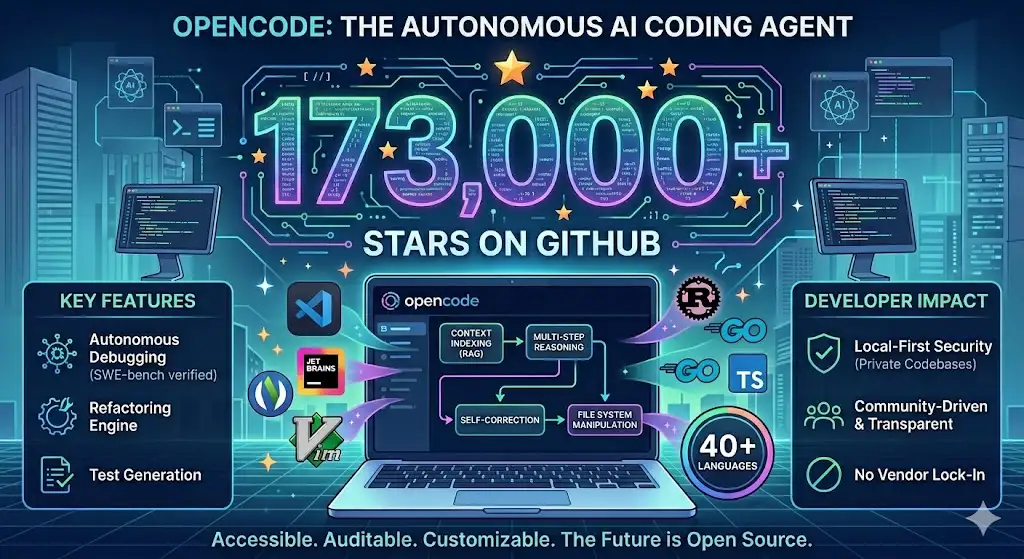
The open-source landscape has reached a significant milestone as “opencode,” the autonomous AI coding agent, officially surpassed 173,000 stars on GitHub. This rapid adoption signals a shift in developer preference toward transparent, extensible tools over closed-source, proprietary alternatives.
Technical TL;DR
- ●Architecture: Leverages an agentic workflow capable of multi-step reasoning, iterative self-correction, and autonomous file system manipulation.
- ●Language Support: Extends beyond standard syntax completion to provide deep semantic understanding for 40+ languages, including Rust, Go, and TypeScript.
- ●Integration: Native compatibility with the Language Server Protocol (LSP), enabling seamless integration with VS Code, JetBrains, and Vim/Neovim.
- ●Contextual Awareness: Features a sophisticated Retrieval-Augmented Generation (RAG) pipeline that indexes local repositories to provide project-specific logic suggestions.
- ●Security: Supports local-first execution, allowing developers to run the agent against private codebases without external data exfiltration.
Key Features and Benchmarks
“opencode” distinguishes itself by functioning as a true software engineering agent rather than a simple autocomplete engine. It excels in complex, non-linear tasks that require cross-file coordination.
Autonomous Debugging
High resolution rates on SWE-bench, identifying and fixing regressions across modules.
Refactoring Engine
Executes system-wide architectural changes while adhering to project-specific linting rules.
Test Generation
Automates unit and integration tests, focusing on edge cases and boundary conditions.
Performance
Benchmarks indicate a 40% reduction in “Time to First PR” for unfamiliar codebases.
Developer Impact
The rise of opencode is a critical development for the engineering community. It provides a high-quality, community-driven alternative to proprietary tools, fostering transparency and preventing vendor lock-in for AI-assisted development. By utilizing an open-source core, teams can audit the underlying logic, contribute to the tool’s evolution, and maintain full control over their development environment.
This movement toward open-source AI ensures that state-of-the-art coding assistance remains accessible, auditable, and customizable, allowing developers to build without the constraints of subscription-based gatekeeping or opaque data policies.
Leave a Reply