
May 20, 2024•5 min read
Key Features/Benchmarks
Omnigent addresses the limitations of monolithic LLM implementations by facilitating “agentic modularity.” Key technical features include:
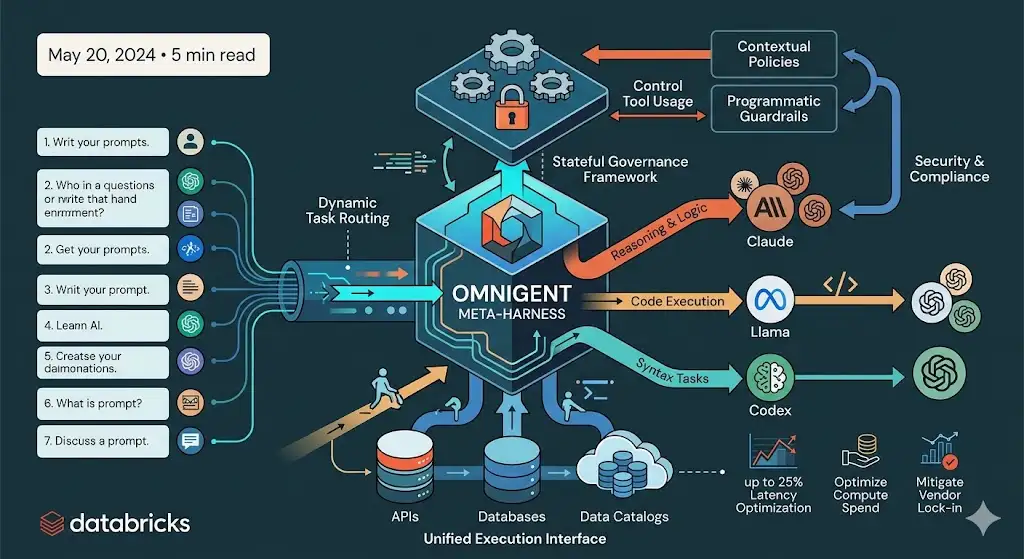
- Dynamic Task RoutingA sophisticated routing engine evaluates the requirements of a sub-task and dispatches it to the most efficient model. This prevents the over-utilization of expensive frontier models for deterministic tasks, significantly optimizing compute spend.
- Stateful Governance FrameworkBeyond simple input/output filtering, Omnigent maintains a contextual state across multi-turn agent interactions. This allows for real-time enforcement of policies that prevent unauthorized tool calls or data exfiltration.
- Unified Execution InterfaceIt standardizes how agents interact with external APIs and databases, providing a consistent abstraction layer that simplifies the management of tool-use and function-calling across different model families.
- Latency OptimizationBenchmarks suggest that by offloading specialized sub-tasks to smaller, tuned models via the Omnigent harness, developers can achieve up to a 25% reduction in end-to-end latency compared to single-model chains.
Developer Impact
For AI engineers, Omnigent represents a shift from fragile, prompt-dependent scripts to robust, architectural choreography. By providing a meta-harness, Databricks enables developers to mitigate vendor lock-in; teams can swap underlying models as the SOTA evolves without re-architecting the entire agentic workflow.
Furthermore, the introduction of contextual policies solves the primary barrier to enterprise agent adoption: predictability. Developers can now programmatically define the “sandbox” in which an agent operates, ensuring that autonomous actions remain within the bounds of corporate governance. Omnigent essentially provides the plumbing and the policing required to move AI agents from experimental notebooks into production-grade environments.
Technical TL;DR
- Architectural Role: Omnigent serves as a high-level coordination layer—a “meta-harness”—that decouples agentic logic from underlying model inference, allowing for heterogeneous model pipelines.
- Multi-Model Orchestration: It enables the seamless integration of specialized models within a single workflow, such as utilizing Claude for complex reasoning and logic while delegating code execution or syntax-heavy tasks to Llama or Codex.
- Policy-Driven Governance: The framework introduces “Contextual Policies,” which act as programmatic guardrails to enforce security, compliance, and operational boundaries on autonomous agents.
- Ecosystem Integration: Designed to mitigate fragmentation, Omnigent provides a unified interface for agent composition that integrates with existing data catalogs and observability tools.
Leave a Reply