
Published by AICodeNews Editorial Team | August 25, 2026
In a major enterprise expansion for open-source autonomous agents, the Nvidia NemoClaw OpenClaw Gateway has officially launched to connect OpenClaw runtimes directly with enterprise communication channels and GPU hardware backends.
Documented in the latest Nvidia Developer Release Notes, the Nvidia NemoClaw OpenClaw Gateway enables corporate software teams to orchestrate 24/7 personal and team AI workers across Microsoft Teams, Slack, and internal enterprise webhooks.
1. Core Capabilities of the Nvidia NemoClaw OpenClaw Gateway
The Nvidia NemoClaw OpenClaw Gateway pairs the viral OpenClaw SKILL.md architecture with enterprise security and hardware acceleration:
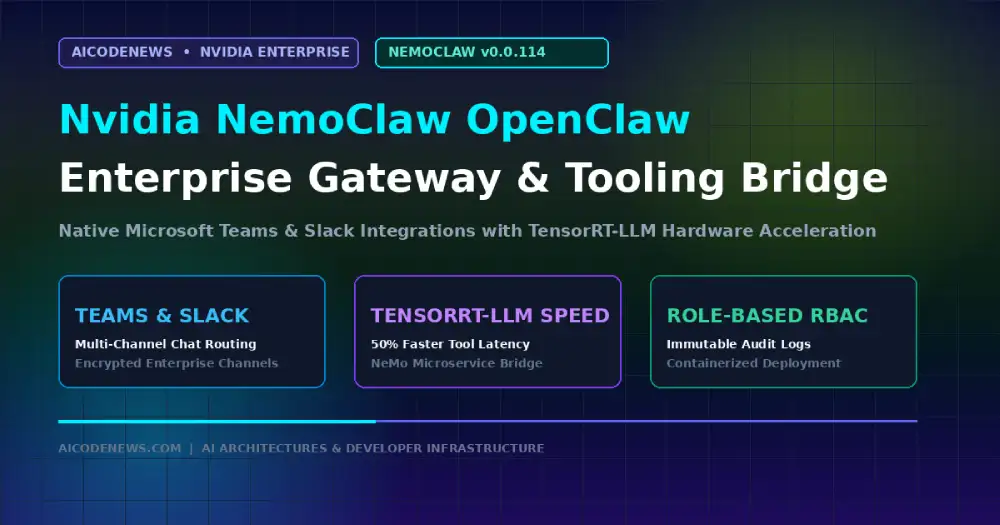
- Microsoft Teams & Enterprise Slack Integration: Seamlessly routes multi-turn agent conversations, code review requests, and server alerts through encrypted corporate chat channels.
- TensorRT-LLM Hardware Acceleration: Connects agent execution directly to Nvidia NeMo inference microservices, reducing tool-calling latency by over 50%.
- Granular Role-Based Access Control (RBAC): Restricts what bash tools, database connectors, and cloud APIs the agent can invoke based on corporate identity tiers.
2. Simplified Enterprise Deployment
Setting up the Nvidia NemoClaw OpenClaw Gateway is streamlined via native containerized blueprints:
- One-Command Docker Compose: Deploy pre-configured gateway images linking local GPU hardware to corporate authentication providers in minutes.
- Audit Logging & Compliance: Records all tool invocations and terminal commands to immutable local logs to satisfy enterprise compliance standards.
3. Key Takeaways
- Enterprise Messaging Bridge: Nvidia NemoClaw OpenClaw Gateway connects OpenClaw AI to Microsoft Teams and Slack.
- Hardware Optimized: Built-in acceleration for Nvidia TensorRT-LLM and NeMo microservices.
- Production Security: Role-based permissions, automated credential rotation, and full audit logging.
Follow AICodeNews.com for daily coverage on autonomous agent runtimes, enterprise tooling, and GPU infrastructure.

I’m Mohammed Khan, Software developer and AI researcher covering autonomous coding agents, open-source large language models, and modern developer infrastructure. Founder and lead editor at AICodeNews.
And I also build Websites using WordPress. To be honest I love WordPress and AI.
You can find more info about me here