
Published by AICodeNews Editorial Team | August 2026 | Category: AI Basics
|—|
Artificial Intelligence has undergone a profound paradigm shift. For years, Generative AI operated primarily in a passive request-and-response mode: you typed a prompt into a chatbot interface, and it returned a block of text or a code snippet.
In 2026, we have officially entered the era of Agentic AI—systems capable of autonomous decision-making, long-term planning, dynamic tool usage, and complex multi-step task execution without requiring continuous human prompting.
In this comprehensive guide, AICodeNews breaks down what Agentic AI is, how autonomous agent architectures function under the hood, and how developers are leveraging agentic workflows in production environments.
1. Defining Agentic AI: From Passive LLMs to Autonomous Execution

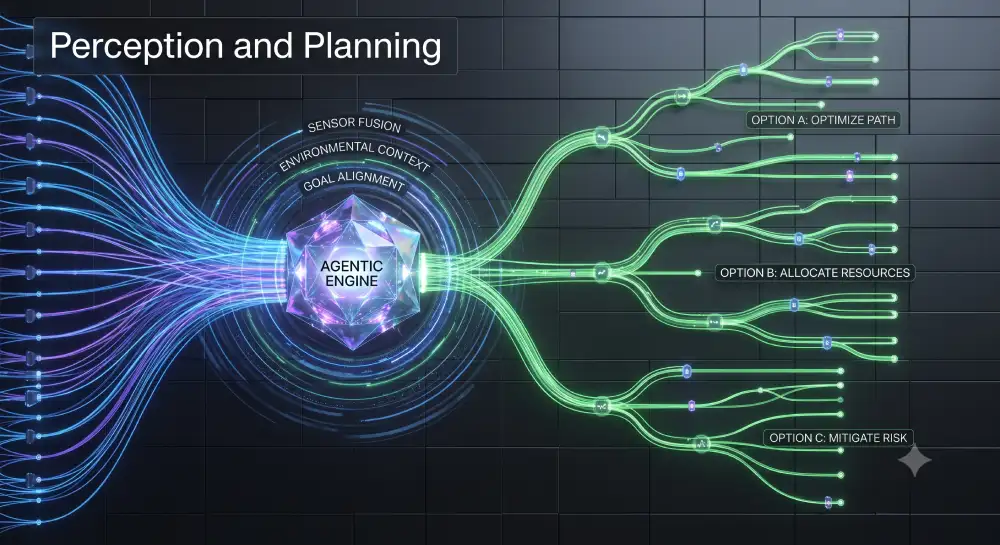
Agentic AI refers to artificial intelligence systems designed to pursue complex goals autonomously by evaluating environment feedback, formulating sequential execution plans, executing tool calls (APIs, databases, web browsers, terminals), and self-correcting when errors occur.
Unlike standard Large Language Model (LLM) completion APIs—which process input text and generate output tokens in a single forward pass—an AI Agent operates inside an iterative control loop:
[Goal Received] ➔ [Plan Steps] ➔ [Select & Call Tool] ➔ [Observe Result] ➔ [Evaluate & Self-Correct] ➔ [Complete Task]
2. The 4 Core Pillars of an Agentic AI Architecture
Every modern AI agent framework (e.g., LangGraph, AutoGen, CrewAI, Claude Code) relies on four fundamental building blocks:
Pillar 1: The Brain (Frontier LLM Engine)
The foundation of any agent is an LLM with strong reasoning, instruction-following, and structured output capabilities (e.g., Claude Opus 5, GPT-5.5, or DeepSeek V4). The LLM processes environmental context, parses tool outputs, and decides the next action.
Pillar 2: Planning & Reasoning Loops
To accomplish multi-step objectives, agents break down goals into smaller sub-tasks using formal reasoning patterns:
- ReAct (Reason + Act): Interleaves thinking (“Thought”) with execution (“Action”) and environmental evaluation (“Observation”).
- Plan-and-Solve: Generates an initial multi-step execution plan upfront, executing steps sequentially while dynamically updating the plan based on intermediate results.
- Reflection / Self-Correction: Analyzes failed code execution or API errors, diagnoses the root cause, and retries with corrected parameters.
Pillar 3: Memory Systems
- Short-Term Memory: The active context window holding the current execution state, recent chat history, and immediate tool call results.
- Long-Term Memory: External vector databases (e.g., Pinecone, Qdrant) or local key-value stores allowing agents to recall past user preferences, project documentation, or historical execution logs across sessions.
Pillar 4: Tool Use & Environment Perception
An LLM alone cannot interact with the real world. Tools give agents “hands and eyes”:
- Execution Environments: Bash terminals, Python code interpreters, Docker containers.
- Data Access: SQL databases, web search, internal vector stores.
- Protocols: Standards like the Model Context Protocol (MCP) allow agents to discover and call external tools securely via unified schema interfaces.
3. Comparison Matrix: Standard LLM vs. RAG vs. Agentic AI
| Dimension | Standard LLM Chatbot | Retrieval-Augmented Generation (RAG) | Agentic AI |
|---|---|---|---|
| Primary Function | Single-turn text generation | Answering queries with static document context | Autonomous goal completion |
| Execution Loop | Passive (1 prompt ➔ 1 response) | Passive (Query ➔ Retrieve ➔ Generate) | Active (Iterative multi-turn loop) |
| Tool Usage | None (Text only) | Document search only | Full API, DB, terminal & browser execution |
| Error Correction | Requires human re-prompting | Requires human re-prompting | Self-corrects via environment observation |
| Task Complexity | Single isolated answers | Factual Q&A over documents | End-to-end multi-file software engineering |
4. Real-World Developer Use Cases for Agentic AI
- Autonomous Software Engineering: Agents clone code repositories, reproduce bug reports, run local unit test suites, apply code fixes, and submit pull requests independently (e.g., Devin, Claude Code, GitHub Copilot Agents).
- DevSecOps & CI/CD Automation: AI agents monitor deployment pipelines, detect failing builds, analyze error logs, and automatically deploy rollback patches.
- Automated Data Engineering: Agents write SQL queries, validate data pipeline schemas, clean raw datasets, and generate analytical dashboards without human intervention.
5. Security, Guardrails, and Human-in-the-Loop Governance
Because agentic systems execute real code and make API calls, security and safety are paramount:
- Sandboxed Execution: Always run agentic terminal/code execution inside isolated containers (Docker, e2b) to prevent unauthorized file deletion or system access.
- Human-in-the-Loop (HITL): Require human approval before agents execute high-risk operations (e.g., production code deployments, database drops, or financial transactions).
- Tool Access Scoping: Implement least-privilege permission models for agent API tokens.
6. Summary & Key Takeaways
- Agentic AI transitions artificial intelligence from passive information lookup to active, autonomous problem-solving.
- Agents rely on an LLM engine, planning loops (ReAct), memory stores, and tool calling protocols (like MCP).
- As models improve in long-horizon reasoning and context handling, agentic workflows will become the default paradigm for enterprise software development.
Bookmark AICodeNews.com for weekly deep dives on AI foundational concepts, developer tools, and software engineering trends.

The official editorial desk of AICodeNews. We provide verified breaking news, in-depth tool comparisons, and hands-on technical tutorials for software engineers building with frontier and open-source AI models.
Wanna know more about us? Read here
Leave a Reply