
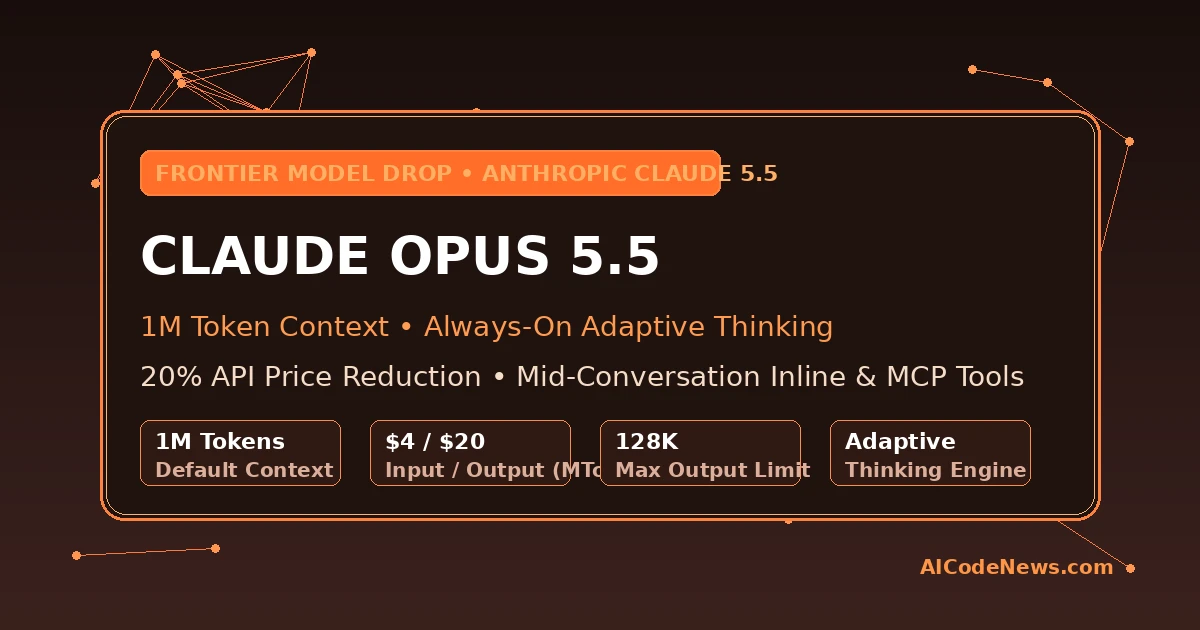
Anthropic has officially launched Claude Opus 5.5, introducing a high-performance frontier model engineered specifically for long-running agentic coding, deep research, and complex knowledge synthesis. Built with a default 1-million-token context window and 128,000 maximum output tokens, the release pairs sustained reasoning power with an immediate 20% API price reduction compared to its predecessor.
The launch underscores Anthropic’s commitment to making frontier-grade reasoning accessible for production workflows, dropping token costs to $4 per million input tokens and $20 per million output tokens.
Architectural Enhancements and Capabilities in Claude Opus 5.5
A central architectural upgrade in the new flagship is always-on adaptive thinking. Unlike earlier iterations where developers manually passed token budgets or toggled extended reasoning parameters, the system dynamically calibrates internal reasoning traces based on problem complexity, governed via a streamlined effort parameter.
The model also mandates updated tool interfaces, deprecating legacy computer use scripts in favor of modern standardized computer toolsets. In addition, Anthropic has opened a research preview of fast mode for low-latency reasoning queries, allowing developers to accelerate output token generation on latency-critical enterprise pipelines.
| Feature / Metric | Claude Opus 5 (Predecessor) | Opus 5.5 Architecture | Developer Advantage |
|---|---|---|---|
| Input Token Pricing | $5.00 / MTok | $4.00 / MTok | 20% Direct Cost Savings |
| Output Token Pricing | $25.00 / MTok | $20.00 / MTok | 20% Output Expense Cut |
| Default Context Window | 1,000,000 tokens | 1,000,000 tokens | Enterprise-Scale Codebase Ingestion |
| Max Output Limit | 128,000 tokens | 128,000 tokens | Large-File & Multi-Module Generation |
| Thinking Configuration | Optional / Budget-based | Always-On Adaptive Thinking | Automated Complexity Scaling |
| Tool Orchestration | Static Schema Configuration | Mid-Conversation Inline & MCP Tools | Zero Cache Invalidation on Schema Updates |
Mid-Conversation Inline Tools and Native MCP Connector
Beyond raw inference efficiency, the model enables dynamic inline tool definitions within mid-conversation system messages. Developers can now inject, modify, or update tool schemas on the fly without invalidating existing prompt caches, eliminating costly context re-processing during multi-turn agent loops.
When paired with Anthropic’s Model Context Protocol (MCP) connector, the model records fetched tool definitions in pinned response blocks, guaranteeing deterministic schema conformance across distributed microservices. The rollout of the flagship model across Amazon Bedrock, Google Cloud, and Microsoft Foundry ensures immediate enterprise availability without cloud vendor lock-in.
By blending reduced inference rates, expansive context limits, and modular tool orchestration, Anthropic delivers a robust engine for autonomous software engineering teams.
Key Takeaways for Developers
- 1M Default Context Window: Claude Opus 5.5 ships with a default 1-million-token context window and 128k output tokens for massive codebases.
- 20% Cost Reduction: Standard API pricing drops to $4 per million input tokens and $20 per million output tokens.
- Always-On Adaptive Thinking: Eliminates manual token budgets, scaling reasoning depth automatically using effort parameters.
- Dynamic Inline Tooling: Define and update MCP tool schemas mid-thread without busting prompt cache memory.

I’m Mohammed Khan, Software developer and AI researcher covering autonomous coding agents, open-source large language models, and modern developer infrastructure. Founder and lead editor at AICodeNews.
And I also build Websites using WordPress. To be honest I love WordPress and AI.
You can find more info about me here