Published by AICodeNews Editorial Team | September 17, 2026
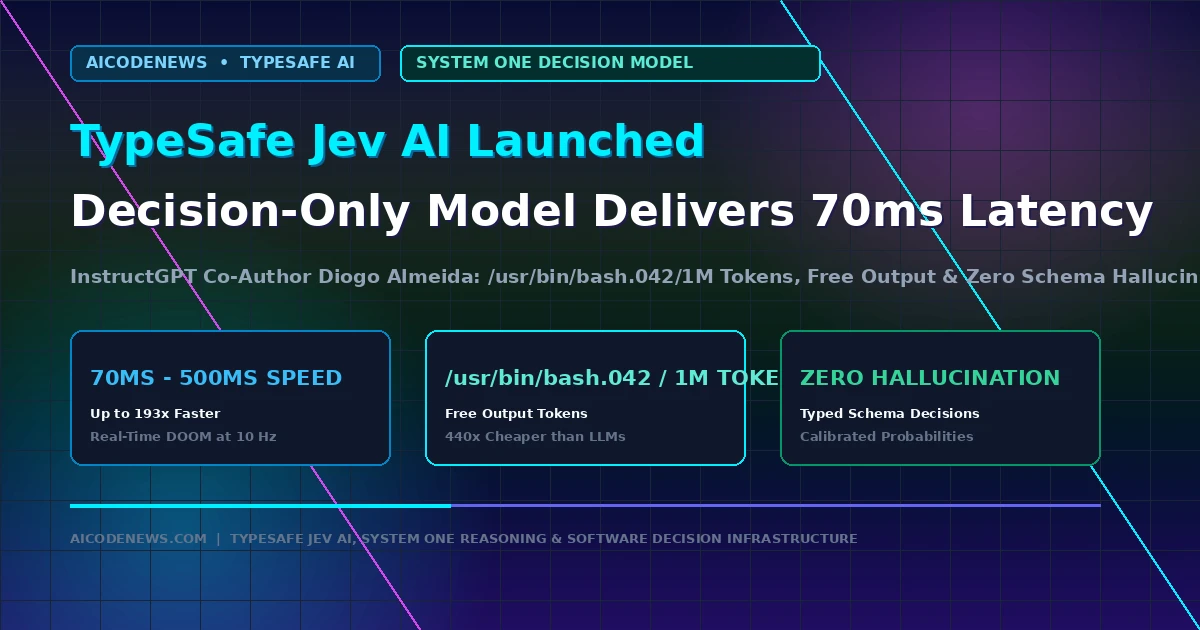
Abandoning conversational text generation in favor of fast, structured software decisions, TypeSafe Jev AI has officially been unveiled by TypeSafe AI and InstructGPT co-author Diogo Almeida.
Announced across official developer channels on typesafe.ai and shared by founder Diogo Almeida (@CompleteSkeptic), TypeSafe Jev AI introduces a new model class described as “System One” AI. Instead of generating open-ended prose word-by-word, the model evaluates state data against pre-declared schemas, delivering typed decisions and calibrated probabilities in 70 to 500 milliseconds at a disruptive cost of $0.042 per million input tokens with completely free output.
1. What Is TypeSafe Jev AI?
Most production AI workflows inside software engineering do not actually need an essay; they need an instant answer to a narrow, high-frequency question: Which support queue gets this ticket? Is this database mutation safe? Should this user invoice require human review? Rather than generating paragraphs or code snippets, TypeSafe Jev AI takes two inputs: a raw state context and typed questions:
Zero Schema Hallucination Guarantee: Because candidate outputs are strictly bound to pre-defined enums and types, the model mathematically cannot emit syntax outside your application’s schema.
Native Probability Calibration: Every decision returns confidence scores directly sampled at the model layer, allowing engineering pipelines to send low-confidence edge cases to human review automatically.
High-Frequency Real-Time Execution: In live demonstrations, developers ran Jev at 10 decisions per second (10 Hz) playing DOOM in real-time—executing tactical dodging and weapon switching for an entire hour for just $7.
2. Standard LLM Generation vs. TypeSafe Jev AI Architecture
The architectural trade-off replaces open-ended chatting with rapid programmatic evaluation:
Architecture Dimension
Standard Generative LLMs (e.g. GPT-5.6 / Claude)
TypeSafe Jev AI
Output Mode
Auto-regressive token generation (Text/JSON)
Direct typed decision sampling
Inference Latency
800ms – 3,500ms
70ms – 500ms (Up to 193x faster)
Input Pricing / 1M
$2.00 – $10.00
$0.042 (440x cheaper)
Output Pricing / 1M
$10.00 – $50.00
$0.00 (Completely Free Output)
Hallucination Risk
Frequent string/schema format errors
Zero structural hallucination
3. Developer Integration & Real-World Use Cases
The economic disruption of TypeSafe Jev AI is driven by its pricing structure: $0.042 per million input tokens with zero charge for output. The model is accessible via official Python and TypeScript REST SDKs, making it a drop-in replacement for triage routers, fraud classification gates, and autonomous agent routing layers.
4. Key Takeaways on TypeSafe Jev AI
Decision-Only Shift: TypeSafe Jev AI sacrifices conversational text generation to achieve instant, typed software decisions.
Disruptive Token Economics: $0.042/1M input pricing and free output make high-frequency background agent checks economically negligible.
Sub-500ms Reliability: Delivers calibrated probabilities with zero structural hallucination for automated software pipelines.
Bookmark AICodeNews.com for daily updates on novel AI architectures, developer models, and inference economics.
Published by AICodeNews Editorial Team | September 8, 2026
In a surprise developer preview, DeepSeek V4.1 Flash has officially launched across the DeepSeek API platform under the intermediate test endpoint deepseek-v4.1-flash-expires-on-0910.
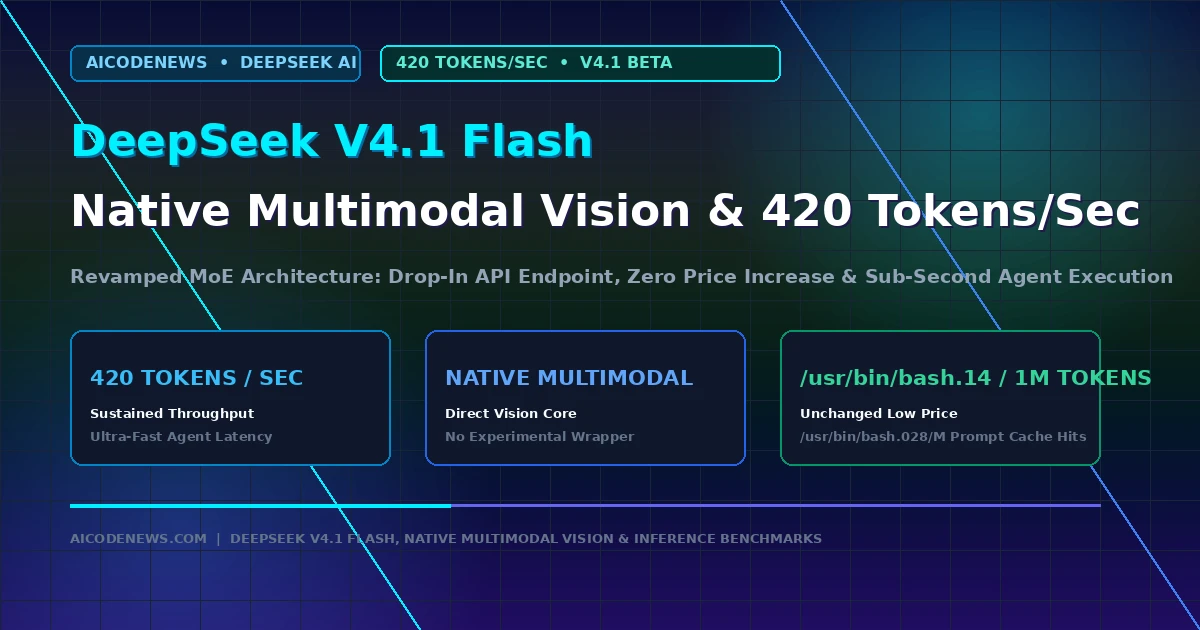
Released as an invite-and-feedback evaluation preview on the official DeepSeek API Platform, DeepSeek V4.1 Flash introduces a revamped Mixture-of-Experts (MoE) architecture with native multimodal vision capabilities, ultra-fast token output speeds, and identical pricing to the existing V4-Flash production tier.
1. What Is New in DeepSeek V4.1 Flash?
The release marks a significant intermediate architectural leap for DeepSeek’s lightweight model family:
Blazing 420 Tokens/Second Throughput: Initial benchmark telemetry shows that DeepSeek V4.1 Flash achieves sustained generation speeds of up to 420 tokens per second during multi-turn completion tasks, substantially reducing latency for autonomous agent loops and terminal code generation.
Native Multimodal Vision Integration: Unlike earlier iterations that required separate experimental vision wrappers, the new architecture processes images, charts, and terminal screenshots directly within the primary context window.
Unchanged Low-Cost Pricing: DeepSeek has maintained its industry-disrupting pricing structure at $0.14 per 1M input tokens and $0.28 per 1M output tokens, with prompt cache hits dropping input costs to $0.028 per 1M tokens.
Drop-In API Compatibility: Developers do not need to change their existing base_url (https://api.deepseek.com). Simply updating the model parameter to deepseek-v4.1-flash-expires-on-0910 immediately routes traffic to the new preview.
2. DeepSeek V4 Flash vs. DeepSeek V4.1 Flash Architecture Breakdown
This technical comparison highlights the performance differences between the current production release and the new preview endpoint:
To test DeepSeek V4.1 Flash, developers can maintain their existing OpenAI SDK or DeepSeek Harness configurations and update the model string in their environment settings. DeepSeek has placed an initial rate limit of 20 concurrent connections per account to manage server capacity while gathering community feedback through its official questionnaire ahead of a full general availability rollout.
4. Key Takeaways on DeepSeek V4.1 Flash
Speed Record: DeepSeek V4.1 Flash reaches up to 420 tokens per second, making it one of the fastest frontier-grade reasoning models available.
Native Multimodality: Directly processes visual inputs and text simultaneously with zero wrapper overhead.
Same Ultra-Low Pricing: Maintains identical $0.14/1M input pricing with a seamless drop-in endpoint change.
Bookmark AICodeNews.com for daily coverage on open-source AI models, developer tooling benchmarks, and API pricing updates.
Published by AICodeNews Editorial Team | September 2, 2026
In a major frontier intelligence update for software engineering and scientific research, Claude Fable 5.1 and Mythos 5.1 have officially launched across official Anthropic developer channels.
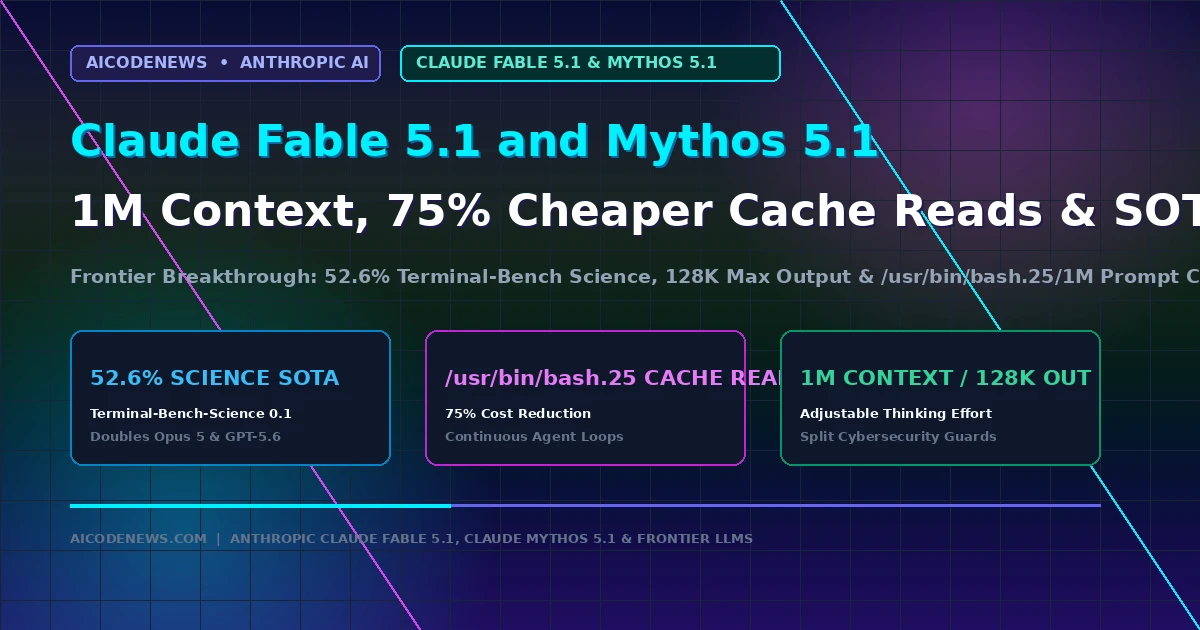
Announced on the official Anthropic Newsroom and deployed across Claude Code and the Claude Console API, Claude Fable 5.1 and Mythos 5.1 share the same underlying frontier weights while applying differentiated deployment safeguards. The release delivers a massive 1-million-token context window, 128k maximum output capacity, adjustable thinking effort levels, and a 75% cost reduction on prompt cache reads.
Claude Fable 5.1 (claude-fable-5-1): Generally available for coding, long-horizon agentic task execution, and scientific knowledge work. Features refined safeguards that allow the model to identify source-code vulnerabilities while reducing false refusals on benign biology requests by 85%.
Claude Mythos 5.1 (claude-mythos-5-1): Restricted to vetted institutional organizations through trusted access programs (such as Project Glasswing) for specialized cybersecurity defense and biology research.
Adjustable Thinking Effort: Introduces five selectable reasoning levels (low, medium, high, xhigh, max) supported mid-conversation via beta headers.
2. Benchmark Breakdown & Science SOTA for Claude Fable 5.1 and Mythos 5.1
On benchmark leaderboards, Claude Fable 5.1 and Mythos 5.1 established dominant new state-of-the-art results in autonomous reasoning:
3. Token Economics & 75% Cheaper Cache Reads in Claude Fable 5.1 and Mythos 5.1
While base input remains $10 per million tokens and output remains $50 per million tokens, the defining architectural improvement in Claude Fable 5.1 and Mythos 5.1 is its aggressive prompt caching discount:
$0.25 / 1M Cache Reads: Prompt cache hits fall from $1.00 down to $0.25 per million tokens, cutting operating expenses by 25% to 45% for developers running multi-turn autonomous loops in Claude Code and Cursor.
128k Completion Horizon: Generates up to 128,000 output tokens in a single inference call, enabling whole-application synthesis and full audit report generation without chunking.
The deployment of Claude Fable 5.1 and Mythos 5.1 across the developer ecosystem centers on differentiated access and refined safety weights. While the models are deployed via the Claude Console API and Claude Code, institutional availability extends through trusted channels.
Anthropic leverages a dual-configuration approach. Fable 5.1 remains accessible for general coding and agentic tasks, while Mythos 5.1 is restricted to vetted organizations via programs like Project Glasswing. This ensures specialized research in biology and cybersecurity is conducted within secured, institutional environments.
By reducing false refusals on benign requests by 85%, the new architecture allows developers to identify source-code vulnerabilities more effectively without hitting rigid safety walls. These updates are rolling out across major cloud partner environments including AWS Bedrock and Google Vertex AI, ensuring frontier intelligence is available where enterprise data resides.
5. Key Takeaways on Claude Fable 5.1 and Mythos 5.1
Unified Frontier Base: Claude Fable 5.1 and Mythos 5.1 share identical underlying weights, providing 1M context tokens and 128k maximum output.
Published by AICodeNews Editorial Team | August 27, 2026
In a major open-weights release targeting high-throughput developer inference, Qwen3.8-Flash-Next has officially launched across Hugging Face and Alibaba Cloud, introducing a dynamic sparse architecture with native Multi-Token Prediction (MTP).
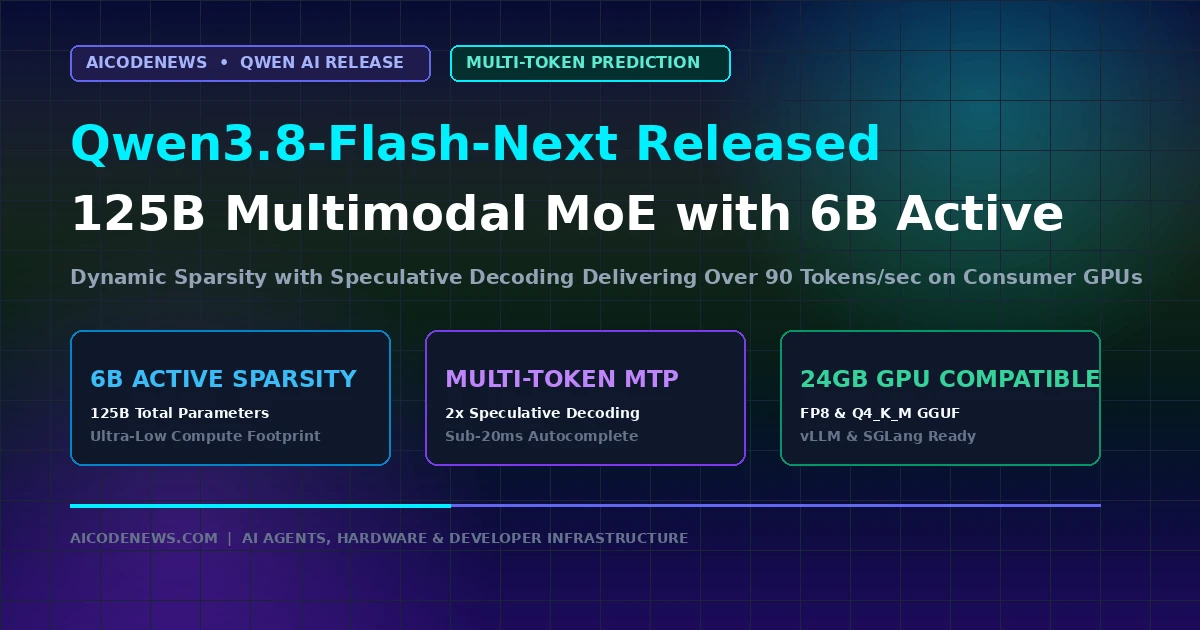
Following twelve days after the release of Qwen 3.8-27B, Qwen 3.8-Flash-Next scales up to 125 billion total parameters while activating only 6 billion parameters per token forward pass, delivering rapid generation speeds exceeding 90 tokens per second on consumer and enterprise GPUs.
1. Core Architecture of Qwen3.8-Flash-Next
Under the hood, Qwen 3.8-Flash-Next combines extreme expert sparsity with multi-token speculative heads to minimize memory bandwidth bottlenecks:
6B Active Sparsity: Routes tokens across specialized expert layers, requiring only a fraction of compute per token compared to dense 70B models.
Multi-Token Prediction (MTP): Generates multiple candidate tokens per forward pass, nearly doubling decoding throughput in local IDE autocompletion.
Native Multimodal Perception: Ingests dense UI screenshots, system architecture diagrams, and complex codebases within a 1M token context window.
2. Hardware Requirements & Inference Benchmarks
Precision Format
VRAM Footprint
Recommended Hardware
Sustained Throughput
FP8 Quantized
~32 GB
1x RTX 5090 (32GB) or Mac 64GB
~85 – 92 tok/s
INT4 GGUF (Q4_K_M)
~18.5 GB
1x RTX 3090 / 4090 (24GB)
~65 – 75 tok/s
Uncompressed BF16
~68 GB
2x A100 (80GB) / Multi-GPU
~45 – 55 tok/s
3. Local Deployment: Running Qwen3.8-Flash-Next on vLLM
Developers can deploy Qwen3.8-Flash-Next locally for private terminal pair-programming and Model Context Protocol (MCP) servers using standard OpenAI-compatible API configurations:
Published by AICodeNews Editorial Team | August 22, 2026
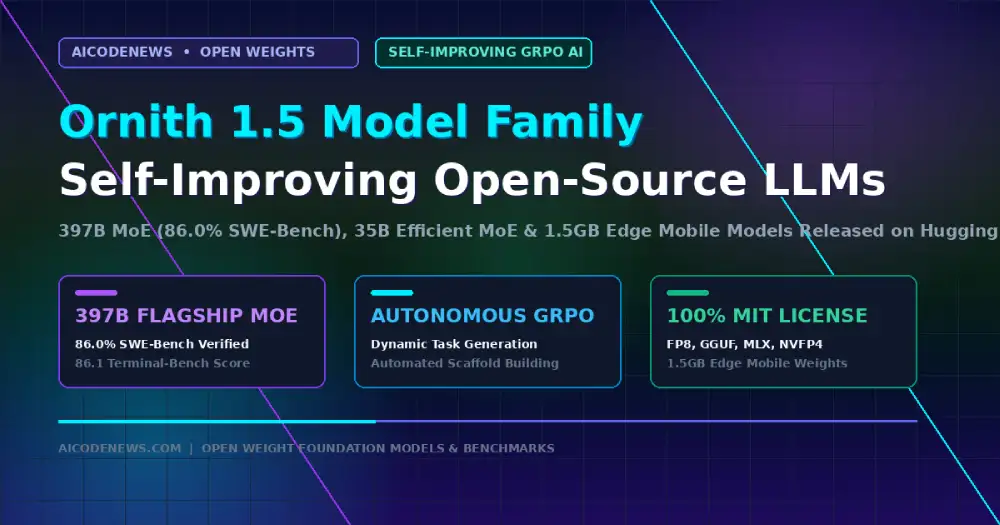
In a major milestone for open-weights artificial intelligence, Ornith 1.5 has officially launched on Hugging Face under the permissive MIT license, introducing an end-to-end autonomous self-improvement architecture that systematically expands its own training curriculum.
Developed as a continuation of Ornith-1.0 on top of Qwen 3.5 and Gemma 4 architectures, the Ornith 1.5 suite spans three distinct parameter scales (397B MoE, 35B MoE, and 9B Dense), delivering frontier-class reasoning and coding performance without closed API lock-in.
1. Three Production Scales of Ornith 1.5
The Ornith 1.5 family is architected to address diverse compute and deployment environments:
Ornith-1.5-397B MoE (Flagship Scale): Designed for heavy-duty reasoning, autonomous coding, and multi-agent systems, scoring 86.0% on SWE-bench Verified and 86.1 on Terminal-Bench 2.1.
Ornith-1.5-35B MoE (Mid-Scale Efficiency): Activates only 3 billion parameters per token, delivering 79.0% on SWE-bench Verified while cutting inference costs by over 80%.
Ornith-1.5-9B Dense (Edge & Mobile Scale): Compact model compressible down to a 1.5 GB footprint for native local execution on iPhones, iPads, and consumer Mac/Android hardware.
2. Benchmark Breakdown: How Ornith-1.5 Compares to Claude and DeepSeek
Independent evaluation suites show Ornith-1.5 setting new open-source standards across coding, terminal navigation, and scientific reasoning:
Model
Terminal-Bench 2.1
SWE-bench Verified
GPQA Diamond
BrowseComp
Ornith 1.5-397B MoE
86.1
86.0%
92.8%
86.6%
Claude Opus 4.8
85.0
85.8%
—
—
DeepSeek-V4-Flash
82.7
81.6%
—
—
GLM-5.2
81.0
—
—
—
Ornith 1.5-35B MoE (3B Active)
68.5
79.0%
—
—
Ornith 1.5-9B Dense (1.5 GB Mobile)
46.2
70.6%
86.4%
—
3. Under the Hood: Autonomous Task Generation and GRPO Optimization
Unlike traditional language models trained on static human-curated datasets, Ornith 1.5 utilizes a continuous three-stage self-improvement loop:
Stage 1 (Frontier Task Generation): The model proposes progressively harder tasks that expose its own reasoning gaps, optimized via a Task Reward (R_task) evaluating validity, frontier difficulty (targeting a 20% empirical success rate), and novelty.
Stage 2 (Dynamic Scaffold Construction): The system designs customized evaluation harnesses and toolsets for each generated problem, rewarded for alignment and resistance to reward hacking.
Stage 3 (Group Relative Policy Optimization): Using GRPO, the policy jointly optimizes task generation, scaffold design, and solution rollouts within the same training loop, yielding compounding capability gains over time.
4. Quantization, Formats & Open Availability
The entire Ornith 1.5 model suite is immediately available on Hugging Face under the MIT License:
Quantized Formats: Published in official FP8, GGUF, MLX, and NVFP4 formats for instant deployment on vLLM, SGLang, Ollama, and Apple Silicon.
Zero Server Dependencies: The 9B model can be deployed completely offline on consumer mobile devices with sub-50ms latency.
5. Key Takeaways on Ornith 1.5
Autonomous Self-Improvement: Ornith 1.5 continuously expands its capability frontier through joint task generation and GRPO optimization.
SOTA Open Performance: The 397B MoE flagship surpasses Claude Opus 4.8 on SWE-bench Verified (86.0%) and Terminal-Bench (86.1).
Full MIT Open Weights: Available immediately across 397B, 35B, and 9B parameter scales on Hugging Face.
Bookmark AICodeNews.com for daily updates on open-weight foundation models, LLM benchmarks, and AI developer infrastructure.
Artificial intelligence research firm Z.ai has launched glm 5.3, a groundbreaking open-weights model setting new industry standards for frontier coding and cyber capabilities. Built strictly by scaling post-training on the architectural stack established by its predecessor, it demonstrates that massive reinforcement learning (RL) on long-horizon task environments can yield immense performance gains without altering the base model.
GLM 5.3 – A New Standard for Autonomous Coding
For complex software engineering, glm 5.3 delivers a major 50% improvement over GLM-5.2 on Z.ai’s private Code Bench. The model handles intensive production tasks, taking full ownership of end-to-end infrastructure diagnostics and code optimization rather than relying on humans to decompose problems.
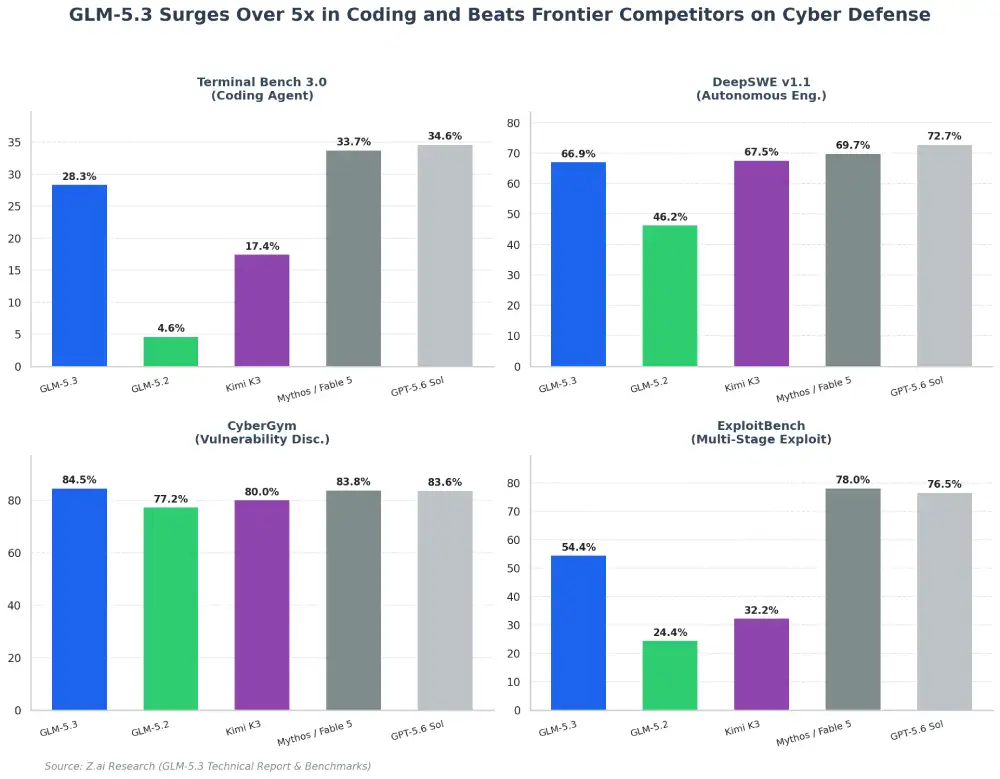
These post-training advancements are validated on public benchmarks. On Terminal Bench 3.0, glm 5.3 surged to a score of 28.3, up from 4.6 for GLM-5.2. It also scored 66.9 on DeepSWE v1.1, compared to 46.2 previously. These coding breakthroughs are powered by Z.ai’s open-source slime framework and SAO with compaction RL strategies, ensuring these gains hold over long-horizon workflows.
Emergent Cyber Defense
During post-training, the model developed highly advanced cyber capabilities. Rather than just identifying isolated flaws, glm 5.3 reasons across complex, multi-stage exploitation chains. It achieved state-of-the-art results on CyberGym with an 84.5% score and more than doubled its predecessor on ExploitBench with a 54.4% score.
In real-world security trials across 269 open-source projects, glm 5.3 successfully identified 2,436 vulnerabilities—including 1,097 critical and high-severity issues. These flaws spanned system operating systems, operating kernels, and web applications. Remarkably, these issues lived undetected for an average of 26.6 years, with the oldest vulnerability dating back to 1981.
Release and Availability
Developers can soon run glm 5.3 locally, as Z.ai will release the open-source weights in two weeks. The model is available via the Z.ai Coding Plan and features three customizable thinking effort levels: low, high, and max
Follow AI Code News for more news about AI and Coding.
Published by AICodeNews Editorial Team | August 13, 2026
In a major advancement for open-weight AI infrastructure, Chinese AI laboratory DeepSeek officially released DeepSeek V4 Pro, an upgraded flagship reasoning model engineered specifically for long-horizon agentic coding workflows.
Launched on August 12, 2026, DeepSeek V4 Pro delivers autonomous code generation and multi-step tool orchestration capabilities that approach closed frontier models like Claude Opus 5, while operating at a fraction of the per-token API cost.
2. Architectural Upgrades & Benchmark Capabilities in DeepSeek V4 Pro
Building upon the lightweight DeepSeek-V4-Flash architecture, the system expands total model capacity while retaining high-density Mixture-of-Experts (MoE) efficiency:
1 Million Token Context Window: DeepSeek V4 Pro natively supports a 1,048,576-token context window alongside an expanded 384,000-token maximum output limit.
SWE-Bench Pro & Agent Performance: On standardized software engineering benchmarks, the model scored within 2.1 percentage points of top proprietary models on multi-file bug fixing and automated code reviews.
Native Dual-Mode Execution: Allows developers to toggle the engine between high-speed standard generation and extended “Thinking Mode” for complex mathematical and algorithmic tasks.
2. API Economics & Production Deployment
While DeepSeek announced upcoming general API price adjustments to manage server capacity, the release offers significant cost-per-token savings compared to Western enterprise endpoints.
Developers building multi-agent workflows (such as Cursor, Windsurf, or terminal agents) can deploy DeepSeek V4 Pro directly via OpenAI-compatible and Anthropic-compatible API endpoints.
2. Key Takeaways
Official Launch: DeepSeek V4 Pro officially released on August 12, 2026.
1M Context Handling: Supports 1M input tokens and 384k max output tokens.
Agentic Parity: Approaches frontier reasoning capabilities at a fraction of proprietary API costs.
Follow AICodeNews.com for daily updates on AI model releases, API changes, and developer tooling.
What is an LLM? A Large Language Model (LLM) is an advanced type of artificial intelligence designed to understand, interpret, and generate human-like text by processing vast datasets. At its simplest, an LLM acts as a highly sophisticated “auto-complete” tool. Having ingested billions of pages of public internet data, it uses that knowledge to predict the most mathematically probable next word in a sentence, allowing it to write essays, answer complex questions, and hold natural conversations.
From a technical perspective, a Large Language Model is a deep learning algorithm based on the Transformer architecture. It utilizes self-attention mechanisms to process input sequences in parallel, representing human language as high-dimensional vectors to perform probabilistic inference. These models are considered “large” due to their massive number of parameters—the internal neural connections that often number in the hundreds of billions—and the sheer volume of training data they consume.
The advent of Generative AI has sparked a technological revolution comparable to the invention of the internet or the smartphone. By granting machines the ability to process and produce natural language, LLMs are fundamentally transforming how businesses operate, how software is written, and how humans interact with digital information.
2. A Brief History of Language Modeling
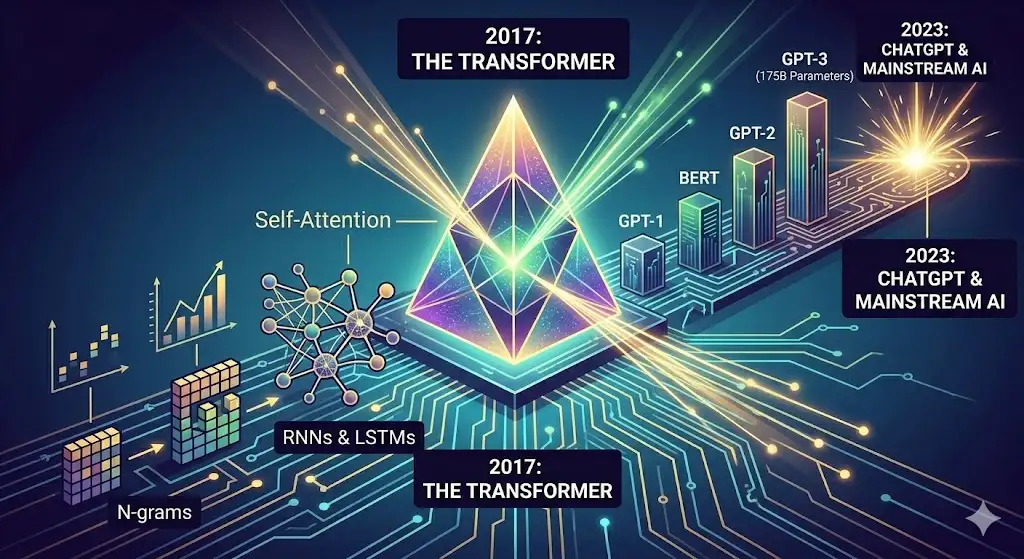
The history of language modeling is defined by a rapid evolution from rigid, rule-based algorithms to deep learning models capable of advanced, generalized reasoning. Before the modern artificial intelligence boom, natural language processing relied heavily on statistical models like N-grams. These early systems simply counted how often words appeared together to predict the next word. While functional for basic spell-check, they lacked any true understanding of meaning or context.
To solve this, researchers developed Recurrent Neural Networks (RNNs) and Long Short-Term Memory (LSTM) networks. These models represented a leap forward by processing text sequentially, reading sentences one word at a time. However, this sequential approach created a severe bottleneck. RNNs were incredibly slow to train and suffered from a “forgetting” problem; by the time the model reached the end of a long paragraph, it had lost the context of the opening sentence.
The landscape of artificial intelligence changed forever in 2017. Researchers at Google published a landmark paper titled “Attention Is All You Need,” which introduced the Transformer architecture. The Transformer abandoned sequential processing entirely, allowing models to look at an entire sentence or document simultaneously.
Following this breakthrough, 2018 saw the release of Google’s BERT (a bidirectional model revolutionizing search) and OpenAI’s GPT-1, which demonstrated the immense power of unsupervised pre-training. Between 2019 and 2022, the AI industry entered the “Scaling Era.” Developers realized that exponentially increasing the size of models—growing from GPT-2’s 1.5 billion parameters to GPT-3’s 175 billion—drastically improved their reasoning capabilities. By late 2022 and 2023, the integration of conversational alignment techniques birthed ChatGPT, catapulting Generative AI into the global mainstream.
3. How LLMs Work: Under the Hood
Large Language Models work by converting human language into mathematical representations and using deep learning networks to predict the next logical piece of a sequence. They do not “understand” words as humans do; rather, they calculate the complex statistical relationships between concepts.
Neural Network Basics
At their core, LLMs are built upon artificial neural networks, mathematical frameworks designed to loosely mimic the human brain. These networks consist of multiple layers of artificial “neurons” or nodes. When data enters the model, it passes through these layers via weighted connections. The model adjusts these weights—known as parameters—during training to minimize errors. A higher parameter count generally correlates with a model’s ability to capture higher complexity, nuance, and factual knowledge.
The Transformer Architecture and Self-Attention
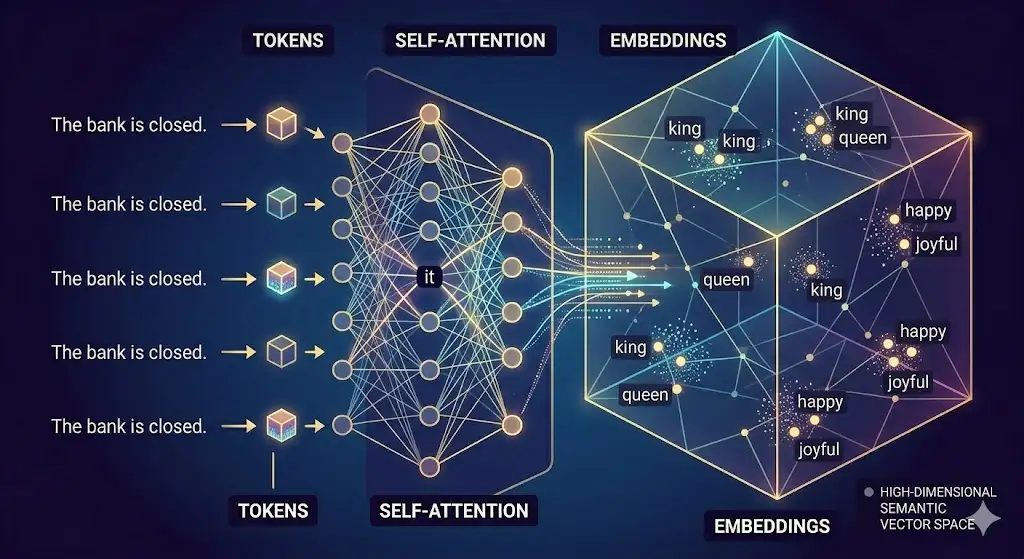
The secret engine driving every modern LLM is the Transformer architecture, specifically its “self-attention” mechanism. Self-attention allows the artificial intelligence to assign different levels of “weight” or importance to various words in a prompt, regardless of their position in a sentence.
For example, consider the sentence: “The bank was closed because it was a holiday.” In older models, the word “it” was difficult to parse. Through self-attention, the Transformer architecture analyzes the surrounding context and assigns a high attention weight connecting “it” to “bank,” rather than “holiday.” This mechanism enables the LLM to capture long-range dependencies and maintain deep contextual accuracy across massive documents.
Tokens and Embeddings
Computers cannot process letters or words; they can only process numbers. Therefore, before an LLM can read a prompt, the text must be broken down into “tokens.” A token can be an entire word, a syllable, or just a single letter.
Once tokenized, these fragments are converted into “embeddings.” Embeddings are high-dimensional mathematical vectors. In the model’s internal map, words with similar meanings (like “king” and “queen” or “happy” and “joyful”) are placed physically closer together in this mathematical space. This allows the LLM to understand semantic relationships and analogies through spatial geometry.
Context Windows
An LLM’s context window is its active memory span during a single conversation. It dictates how many tokens the model can “hold in its head” at one time. Early models had context windows of a few thousand tokens (roughly a few pages of text). Today, advanced models feature context windows of up to two million tokens, allowing users to upload entire books, codebases, or legal transcripts for the model to analyze in a single prompt without forgetting the initial instructions.
4. The Lifecycle of an LLM: Training and Tuning
The lifecycle of a Large Language Model consists of three primary stages: ingesting massive amounts of raw text to learn the mechanics of language, supervised fine-tuning to learn how to answer prompts, and human alignment to ensure the outputs are safe and helpful.
Phase 1: Pre-training
The first phase, pre-training, requires massive computational power and months of processing time. During this stage, the model is fed a vast corpus of human knowledge—typically terabytes of data scraped from Wikipedia, digitized books, GitHub repositories, and public websites.
This is a self-supervised learning process. The model is repeatedly shown a sequence of text with the final word hidden and is asked to predict it. At first, its guesses are random. But over trillions of iterations, it adjusts its parameters to reduce its error rate. By the end of pre-training, the model has learned grammar, syntax, facts, reasoning, and the general statistical structure of language. However, at this point, it is just a document-completion tool; if you prompt a pre-trained model with “What is the capital of France?”, it might respond with “What is the capital of Germany?” rather than answering the question.
Phase 2: Instruction Fine-Tuning
To transform the base model into a useful Generative AI assistant, it must undergo Supervised Fine-Tuning (SFT). Researchers expose the model to highly curated datasets consisting of “Instruction-Response” pairs. By studying thousands of examples of questions followed by accurate, well-formatted answers, the LLM shifts its behavior. It learns that its purpose is no longer to seamlessly continue a document, but to fulfill commands, write poetry, generate code, or summarize data based on the user’s explicit instructions.
Phase 3: RLHF (Reinforcement Learning from Human Feedback)
The final stage bridges the gap between a capable model and a safe, conversational one. Reinforcement Learning from Human Feedback (RLHF) aligns the LLM with human values. Human evaluators are given multiple responses generated by the model for a single prompt and are asked to rank them based on helpfulness, accuracy, and safety.
These human preferences are used to train a separate “Reward Model,” which then automatically scores the LLM’s outputs during further training. The LLM is optimized to generate the types of responses that yield the highest reward scores. This critical phase is what stops the model from generating toxic content, teaches it to refuse harmful requests, and gives modern AI chatbots their remarkably polite and helpful conversational tone.
5. Key Metrics: Parameters and Performance
Parameters are the fundamental numerical variables—the internal weights and biases—that a Large Language Model adjusts during training to determine how it processes information and makes predictions. In the context of neural networks, you can think of parameters as millions or billions of microscopic “knobs and dials.” Whenever a model learns a new fact, grammar rule, or reasoning pathway, it physically adjusts the mathematical value of these dials to minimize its error rate.
Historically, the AI industry operated under the assumption that increasing a model’s parameter count automatically resulted in superior intelligence. This drove the creation of massive models boasting hundreds of billions, or even trillions, of parameters. However, modern AI research has revealed that bigger does not always mean better. Performance is deeply tied to the quality, diversity, and density of the training data. A highly optimized model with 70 billion parameters trained on meticulously curated, high-quality data can often outperform a model with 300 billion parameters trained on low-quality, repetitive internet scrapings. As the industry matures, the focus has shifted from simply inflating parameter counts to improving data quality, training efficiency, and architectural optimization.
6. Comparison of Leading LLMs in 2026
The leading Large Language Models in the current market include OpenAI’s GPT-5, Anthropic’s Claude 4.8, Meta’s Llama 3.1/4, and Google’s Gemini 2.5/3.1. each offering distinct advantages in reasoning, context limits, and accessibility. Choosing the right LLM depends entirely on the specific use case, budget, and deployment requirements of the user or enterprise.
Claude remains an industry benchmark with models like Claude Opus 4.6 and its iterative updates, which excel as “all-rounders” capable of deep logical reasoning and dynamic problem-solving. Anthropic’s Claude has carved out a massive user base by prioritizing nuanced, safe responses and demonstrating superior capabilities in software engineering and coding tasks. Google’s Gemini series differentiates itself through native multimodality—processing text, audio, and video simultaneously without external translation layers—and massive context windows reaching up to two million tokens.
Comparison of Leading Large Language Models
7. LLM Applications: How the World Uses AI
Generative AI applications span a vast array of industries, revolutionizing how professionals write code, generate business content, analyze complex data, and interact with customers. By seamlessly processing human language, LLMs are acting as cognitive engines powering hundreds of modern software solutions.
Software Engineering and Coding
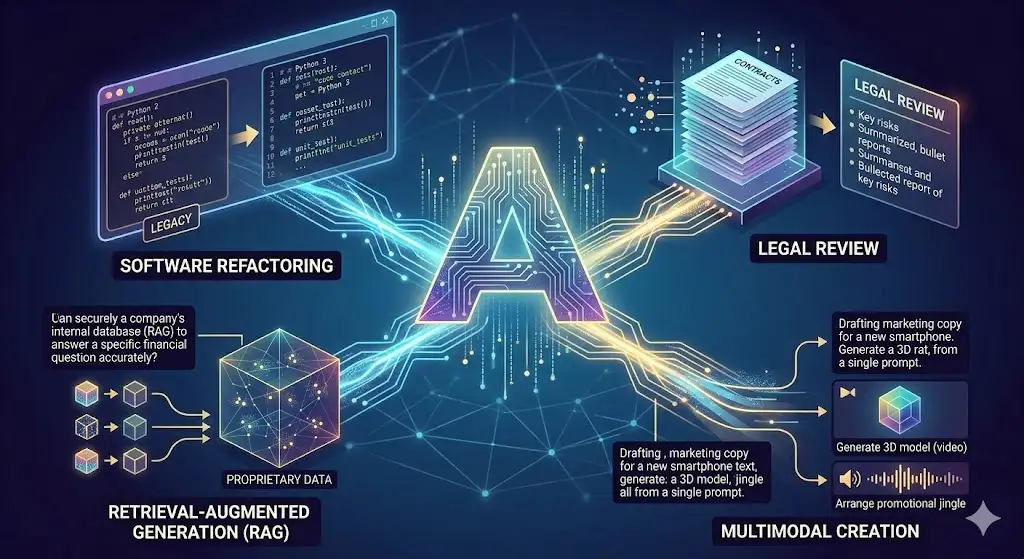
LLMs have fundamentally changed the software development lifecycle. Developers use AI to instantly generate boilerplate code, write unit tests, and translate legacy codebases from one language to another (such as migrating outdated Python scripts to C++). Furthermore, models serve as real-time debugging assistants, identifying logic errors in complex code arrays much faster than manual review.
Business and Customer Support
In the corporate sphere, advanced AI chatbots have largely replaced the rigid, decision-tree chatbots of the past. Modern customer support LLMs can understand frustrated customers, reference internal knowledge bases, process refunds, and generate highly personalized responses. Businesses also utilize Retrieval-Augmented Generation (RAG) frameworks, allowing them to connect an LLM to their private corporate databases for secure, real-time data querying.
Content Creation and Marketing
For writers, marketers, and legal professionals, LLMs are unparalleled drafting tools. They are routinely used to generate marketing copy, outline blog posts, draft routine legal contracts, and synthesize long, convoluted reports into bulleted executive summaries. This drastically reduces the time professionals spend on the blank-page phase of creation.
Education, Science, and Data Analysis
In scientific research and education, LLMs excel at extracting structured data from massive troves of unstructured text. Researchers use them to run sentiment analysis on millions of public reviews, summarize hundreds of academic papers simultaneously, and act as personalized, interactive tutors that can adapt their teaching style to a student’s specific learning pace.
8. Limitations, Ethics, and Risks
Despite their immense capabilities, Large Language Models face critical limitations and risks, including factual hallucinations, ingrained societal biases, and severe environmental impacts due to their high computational demands. Addressing these issues is the primary focus of modern artificial intelligence ethics.
Hallucinations and Accuracy
Because LLMs are probabilistic rather than deterministic, they do not inherently know what is true; they only know what is mathematically likely. This leads to “hallucinations,” where the model confidently generates fabricated facts, fake academic citations, or incorrect historical dates simply because the text output mathematically fits the pattern of the prompt.
Bias and Toxicity
LLMs are trained on human data, which means they inherit all human prejudices. Without rigorous RLHF and human alignment, models can easily generate biased outputs regarding race, gender, religion, and politics. Ensuring that these models remain neutral and safe, without crossing into extreme censorship, is a highly debated topic in artificial intelligence ethics.
Sustainability and Data Privacy
The environmental footprint of training and running LLMs is staggering. Data centers require massive amounts of electricity and millions of gallons of water for cooling to sustain the GPUs powering these models. Additionally, data privacy remains a significant risk; employees pasting sensitive, proprietary corporate data into public LLM interfaces risk exposing trade secrets to external training pipelines.
9. The Future of Large Language Models
The future of Large Language Models is defined by a rapid transition toward agentic AI workflows, native multimodality, and highly efficient Small Language Models (SLMs). Instead of merely answering questions, the next generation of models will take direct action on behalf of users.
Agentic AI
Future AI will operate as “Agents.” Rather than just writing a script for a user, an agentic LLM will be given a high-level goal, browse the internet for information, use third-party software tools, write its own code, execute that code, and complete multi-step workflows entirely autonomously.
Multimodality and SLMs
Models are increasingly becoming natively multimodal, meaning they process vision, audio, text, and robotics data simultaneously from the ground up. Simultaneously, the rise of Small Language Models (SLMs) is democratizing access. These highly efficient, compact models require vastly less computing power, allowing them to run locally and offline on smartphones and laptops, ensuring strict user privacy and zero latency.
10. Conclusion
Large Language Models represent a foundational shift in the history of computing, moving technology away from rigid, syntax-heavy programming and toward intuitive, natural language understanding. By turning the vast expanse of human knowledge into navigable mathematical space, LLMs have democratized access to high-level analysis, coding, and creative generation. While challenges regarding bias, hallucinations, and environmental impact remain, the continuous refinement of these models promises a future where artificial intelligence acts as an accessible, highly capable cognitive partner for every digital endeavor.
11. FAQ Section
What does LLM stand for?
LLM stands for Large Language Model, a type of artificial intelligence designed to understand and generate human language using deep neural networks and massive datasets.
Is an LLM the same as ChatGPT?
No. The LLM (such as GPT-4) is the underlying algorithmic engine, whereas ChatGPT is the user-facing chat application built on top of that engine.
Do LLMs think?
No. LLMs do not possess consciousness, true comprehension, or the ability to think. They perform highly complex statistical calculations to predict the most probable sequence of words.
Why do LLMs make mistakes?
LLMs are probabilistic. They predict what word should come next based on patterns in their training data. Sometimes, the most mathematically probable next word is factually incorrect, leading to a “hallucination.”
What is an LLM context window?
A context window is the model’s short-term memory limit for a single conversation. It determines how much text (measured in tokens) the model can analyze and remember at one time.
Can LLMs run offline?
Yes. While massive models require cloud infrastructure, smaller, highly optimized models (Small Language Models or SLMs) can be downloaded and run locally on personal laptops and smartphones without an internet connection.
What is RAG in the context of LLMs?
RAG stands for Retrieval-Augmented Generation. It is a technique where an LLM is securely connected to an external database (like a company’s internal documents), allowing the model to search that specific data to provide accurate, customized answers.
12. Citations/References
AWS AI Insights. “What are Large Language Models?” Amazon Web Services.
Google DeepMind Blog. “The Transformer Architecture and Next-Generation AI.”
IBM Research. “Understanding Large Language Models and Enterprise Governance.”
OpenAI Documentation. “GPT Models, RLHF, and AI Alignment.”
TechTarget. “Definition: Large Language Model (LLM).”