
Published by AICodeNews Editorial Team | August 22, 2026
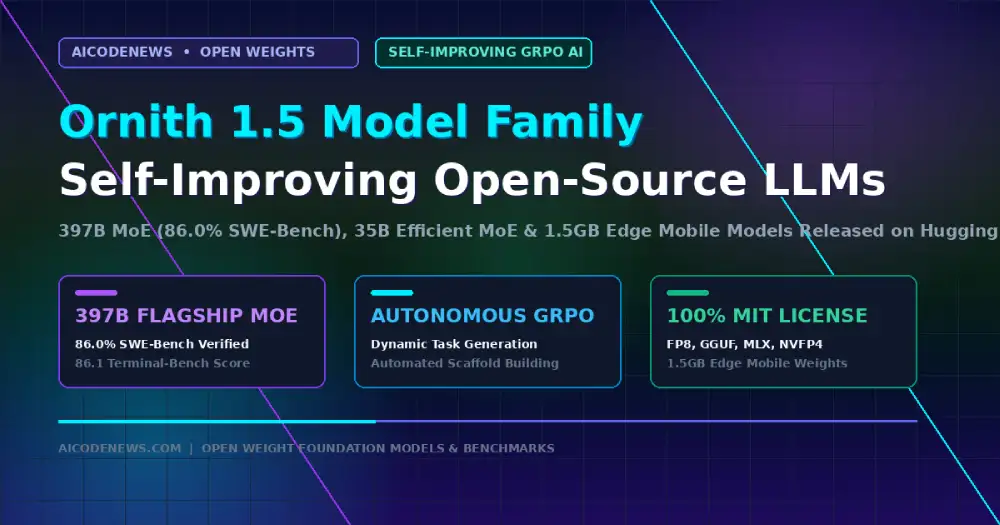
In a major milestone for open-weights artificial intelligence, Ornith 1.5 has officially launched on Hugging Face under the permissive MIT license, introducing an end-to-end autonomous self-improvement architecture that systematically expands its own training curriculum.
Developed as a continuation of Ornith-1.0 on top of Qwen 3.5 and Gemma 4 architectures, the Ornith 1.5 suite spans three distinct parameter scales (397B MoE, 35B MoE, and 9B Dense), delivering frontier-class reasoning and coding performance without closed API lock-in.
1. Three Production Scales of Ornith 1.5
The Ornith 1.5 family is architected to address diverse compute and deployment environments:
- Ornith-1.5-397B MoE (Flagship Scale): Designed for heavy-duty reasoning, autonomous coding, and multi-agent systems, scoring 86.0% on SWE-bench Verified and 86.1 on Terminal-Bench 2.1.
- Ornith-1.5-35B MoE (Mid-Scale Efficiency): Activates only 3 billion parameters per token, delivering 79.0% on SWE-bench Verified while cutting inference costs by over 80%.
- Ornith-1.5-9B Dense (Edge & Mobile Scale): Compact model compressible down to a 1.5 GB footprint for native local execution on iPhones, iPads, and consumer Mac/Android hardware.
2. Benchmark Breakdown: How Ornith-1.5 Compares to Claude and DeepSeek
Independent evaluation suites show Ornith-1.5 setting new open-source standards across coding, terminal navigation, and scientific reasoning:
| Model | Terminal-Bench 2.1 | SWE-bench Verified | GPQA Diamond | BrowseComp |
|---|---|---|---|---|
| Ornith 1.5-397B MoE | 86.1 | 86.0% | 92.8% | 86.6% |
| Claude Opus 4.8 | 85.0 | 85.8% | — | — |
| DeepSeek-V4-Flash | 82.7 | 81.6% | — | — |
| GLM-5.2 | 81.0 | — | — | — |
| Ornith 1.5-35B MoE (3B Active) | 68.5 | 79.0% | — | — |
| Ornith 1.5-9B Dense (1.5 GB Mobile) | 46.2 | 70.6% | 86.4% | — |
3. Under the Hood: Autonomous Task Generation and GRPO Optimization
Unlike traditional language models trained on static human-curated datasets, Ornith 1.5 utilizes a continuous three-stage self-improvement loop:
- Stage 1 (Frontier Task Generation): The model proposes progressively harder tasks that expose its own reasoning gaps, optimized via a Task Reward (R_task) evaluating validity, frontier difficulty (targeting a 20% empirical success rate), and novelty.
- Stage 2 (Dynamic Scaffold Construction): The system designs customized evaluation harnesses and toolsets for each generated problem, rewarded for alignment and resistance to reward hacking.
- Stage 3 (Group Relative Policy Optimization): Using GRPO, the policy jointly optimizes task generation, scaffold design, and solution rollouts within the same training loop, yielding compounding capability gains over time.
4. Quantization, Formats & Open Availability
The entire Ornith 1.5 model suite is immediately available on Hugging Face under the MIT License:
- Quantized Formats: Published in official FP8, GGUF, MLX, and NVFP4 formats for instant deployment on vLLM, SGLang, Ollama, and Apple Silicon.
- Zero Server Dependencies: The 9B model can be deployed completely offline on consumer mobile devices with sub-50ms latency.
5. Key Takeaways on Ornith 1.5
- Autonomous Self-Improvement: Ornith 1.5 continuously expands its capability frontier through joint task generation and GRPO optimization.
- SOTA Open Performance: The 397B MoE flagship surpasses Claude Opus 4.8 on SWE-bench Verified (86.0%) and Terminal-Bench (86.1).
- Full MIT Open Weights: Available immediately across 397B, 35B, and 9B parameter scales on Hugging Face.
Bookmark AICodeNews.com for daily updates on open-weight foundation models, LLM benchmarks, and AI developer infrastructure.

I’m Mohammed Khan, Software developer and AI researcher covering autonomous coding agents, open-source large language models, and modern developer infrastructure. Founder and lead editor at AICodeNews.
And I also build Websites using WordPress. To be honest I love WordPress and AI.
You can find more info about me here