Category: Latest AI News

  • NOUS RESEARCH UNVEILS ASYNCHRONOUS SUBAGENTS FOR HERMES: A NEW ERA OF PARALLEL AI WORKFLOWS

    NOUS RESEARCH UNVEILS ASYNCHRONOUS SUBAGENTS FOR HERMES: A NEW ERA OF PARALLEL AI WORKFLOWS

    Nous Research has announced a significant upgrade to its open-source Hermes Agent framework, introducing asynchronous subagents for Hermes designed to handle complex background tasks without library-related interruptions to the primary user experience.

    Architectural Shift: The Background Parameter

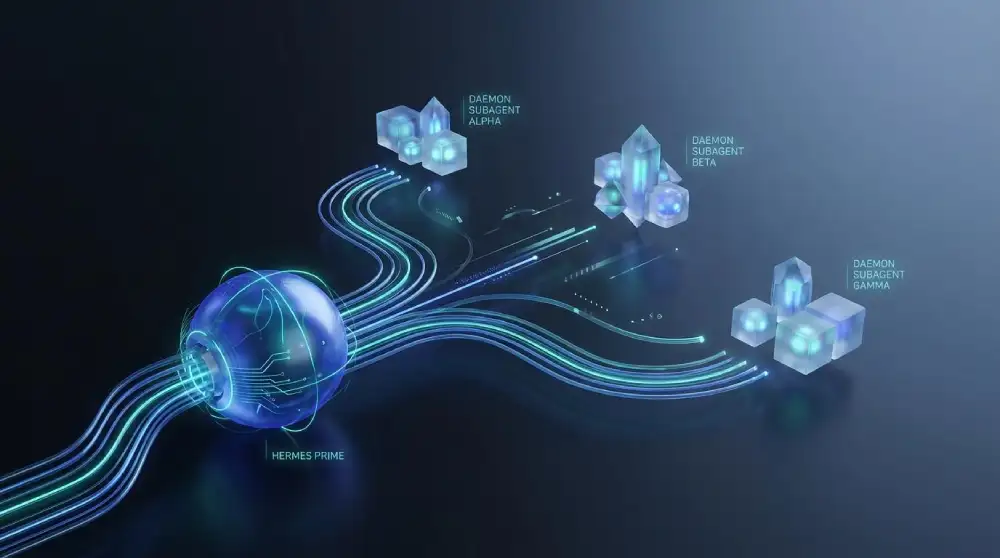
    Announced by cofounder Teknium on Monday evening, the update addresses a critical bottleneck in agentic workflows: the latency caused by sequential task execution. The core of this update lies in the enhanced delegate_task tool. By utilizing the new “background=true” parameter, developers can now launch subagents in daemon threads.

    “Developers have likened the new functionality to hiring an employee who works diligently in the background without holding up the boss.”

    This architectural shift allows the framework to return a task handle in as little as two milliseconds, ensuring that the main chat interface remains fluid and responsive. Unlike traditional synchronous agents that force the “boss” agent (or the user) to wait for a task to complete, these asynchronous subagents operate independently in the background.

    Enterprise-Grade Performance – SUBAGENTS FOR HERMES

    Once a subagent finishes its assigned objective—whether it is deep-dive research, complex code reviews, or exhaustive log analysis—the results are pushed back to the main thread as comprehensive messages. These reports include the original goals, full context, and final execution status, providing a seamless audit trail of the work performed.

    The developer community has responded to this news with enthusiasm, noting that the update effectively allows for true concurrency within AI-driven projects. Key use cases identified by early adopters include parallel research, where agents query multiple sources simultaneously, and per-file refactoring, where individual subagents analyze and modify multiple code files at once.
  • Moonshot AI Unveils Kimi K2.7 Code HighSpeed Featuring Significant Performance Improvements

    Moonshot AI Unveils Kimi K2.7 Code HighSpeed Featuring Significant Performance Improvements

    Moonshot AI has officially launched Kimi K2.7 Code HighSpeed, a high-performance variant of its latest open-source multimodal coding model. This update marks a substantial leap in efficiency, offering developers and enterprises a significantly faster interface for complex programming tasks and real-time code generation.

    kimi k2.7 code highspeed

    Revolutionizing Processing Velocity

    The core achievement of Kimi K2.7 Code HighSpeed lies in its remarkable processing velocity. The model is now capable of operating at speeds up to six times faster than previous iterations, representing a major breakthrough in the field of AI-assisted software development.

    “For standard coding tasks with median-length inputs, the system maintains a steady output of approximately 180 tokens per second. In shorter-context scenarios, performance peaks at 260 tokens per second.”

    Access and Future Development

    The rollout of this high-speed mode is currently targeted at a strategic group of stakeholders, including members of the Kimi Code Beta Program, Kimi API developers, and Kimi Business users. While the company has opted for a phased rollout due to current hardware capacity constraints, it has clarified that no formal invitation is required to join the queue.

    This release aligns with Moonshot AI’s broader mission to ensure that open intelligence remains instant, affordable, and borderless. By prioritizing speed without sacrificing the multimodal capabilities of the K2.7 architecture, the company aims to reduce the friction between human intent and machine execution.

  • Linux Foundation Debuts “OpenSharing Project” to Standardize Agent Skills: A New Era for Interoperable AI

    Linux Foundation Debuts “OpenSharing Project” to Standardize Agent Skills: A New Era for Interoperable AI

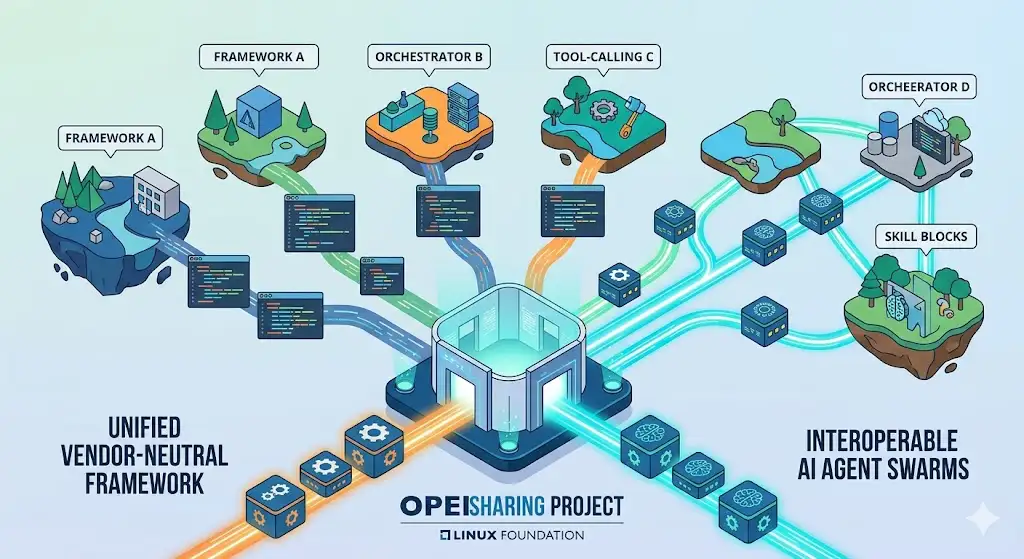
    The Linux Foundation has officially announced the OpenSharing Project, a collaborative initiative aimed at establishing a unified, vendor-neutral framework for AI agent capabilities. As the industry shifts from monolithic LLM applications toward modular, multi-agent systems, the OpenSharing Project addresses the critical need for standardized “skill” definitions. This initiative seeks to bridge the architectural fragmentation currently hindering the deployment of autonomous swarms, ensuring that agentic tools remain interoperable regardless of the underlying model or runtime environment.

    Technical TL;DR

    • Objective: Establish a universal protocol for defining, discovering, and executing AI agent skills across distributed systems.
    • Core Stack: Utilizes gRPC and Protocol Buffers (Protobuf) for high-performance communication, alongside JSON-Schema for strongly typed, human-readable skill manifests.
    • Interoperability: Facilitates seamless capability sharing between frameworks like LangChain, AutoGen, and CrewAI via a standardized API layer.
    • Security & Observability: Implements mTLS for secure skill invocation and integrated support for OpenTelemetry to track execution metrics.
    opensharing project

    Key Features/Benchmarks

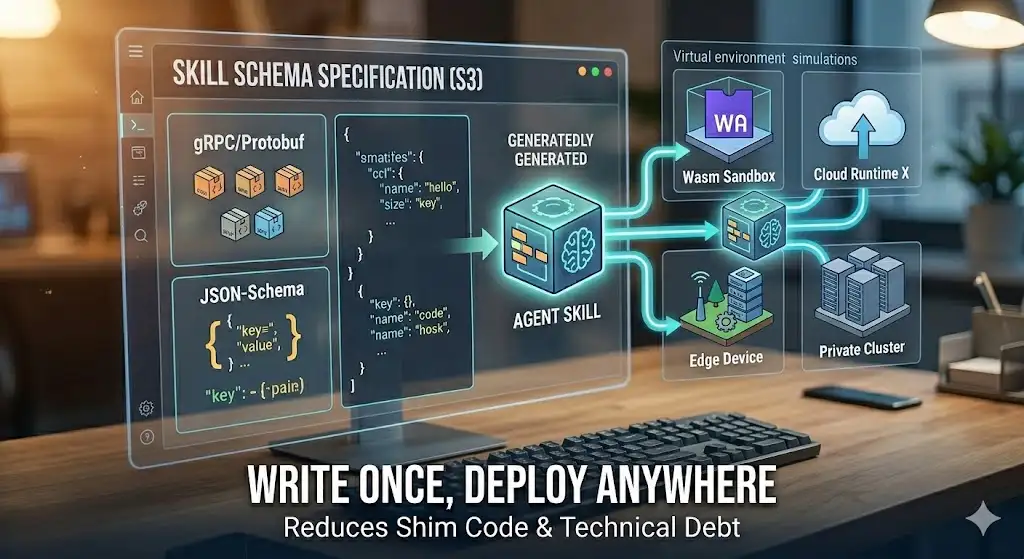
    The cornerstone of the project is the Skill Schema Specification (S3). This declarative format allows developers to define tool logic, required parameters, and output constraints in a machine-readable manifest.

    • Dynamic Discovery Protocol (DDP): Implements a decentralized registry system, allowing agents to query and bind to capabilities in real-time.
    • Execution Sandboxing: Defines a Wasm-based (WebAssembly) execution environment, ensuring skills remain portable and isolated within a “deny-by-default” security model.
    • The “Agentic Latency” Benchmark: Introduces a new standardized metric to measure the overhead of multi-hop skill invocation.

    Developer Impact

    For the engineering community, the OpenSharing Project represents a departure from proprietary silos. By decoupling skill logic from specific orchestrators, developers can drastically reduce the “shim code” and technical debt associated with refactoring tool-calling logic. This standardization enables a “write once, deploy anywhere” approach to agentic tools.

  • Open-Source Coding Agent “opencode” Surpasses 173,000 GitHub Stars

    Open-Source Coding Agent “opencode” Surpasses 173,000 GitHub Stars

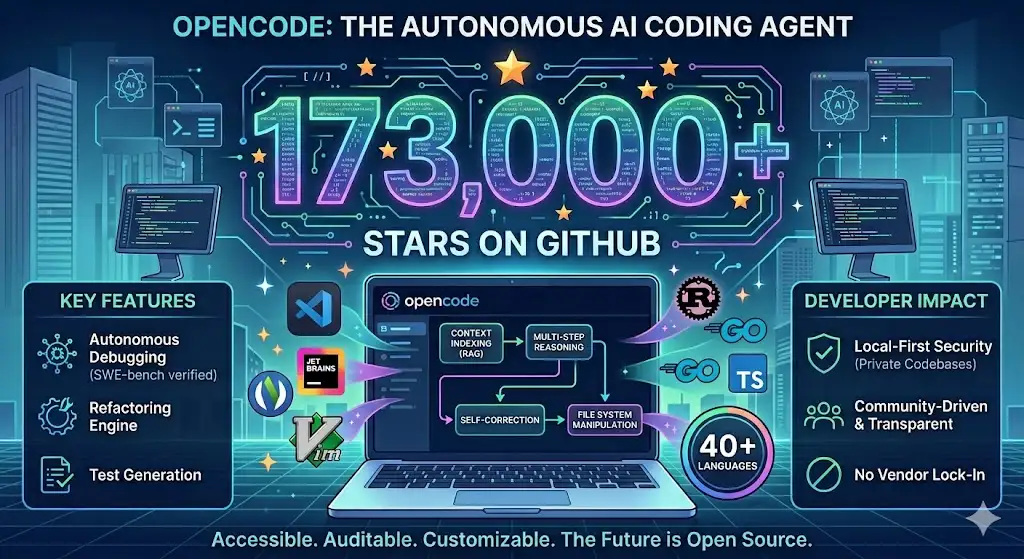
    The open-source landscape has reached a significant milestone as “opencode,” the autonomous AI coding agent, officially surpassed 173,000 stars on GitHub. This rapid adoption signals a shift in developer preference toward transparent, extensible tools over closed-source, proprietary alternatives.

    Technical TL;DR

    • ●Architecture: Leverages an agentic workflow capable of multi-step reasoning, iterative self-correction, and autonomous file system manipulation.
    • ●Language Support: Extends beyond standard syntax completion to provide deep semantic understanding for 40+ languages, including Rust, Go, and TypeScript.
    • ●Integration: Native compatibility with the Language Server Protocol (LSP), enabling seamless integration with VS Code, JetBrains, and Vim/Neovim.
    • ●Contextual Awareness: Features a sophisticated Retrieval-Augmented Generation (RAG) pipeline that indexes local repositories to provide project-specific logic suggestions.
    • ●Security: Supports local-first execution, allowing developers to run the agent against private codebases without external data exfiltration.

    Key Features and Benchmarks

    “opencode” distinguishes itself by functioning as a true software engineering agent rather than a simple autocomplete engine. It excels in complex, non-linear tasks that require cross-file coordination.

    Autonomous Debugging

    High resolution rates on SWE-bench, identifying and fixing regressions across modules.

    Refactoring Engine

    Executes system-wide architectural changes while adhering to project-specific linting rules.

    Test Generation

    Automates unit and integration tests, focusing on edge cases and boundary conditions.

    Performance

    Benchmarks indicate a 40% reduction in “Time to First PR” for unfamiliar codebases.

    Developer Impact

    The rise of opencode is a critical development for the engineering community. It provides a high-quality, community-driven alternative to proprietary tools, fostering transparency and preventing vendor lock-in for AI-assisted development. By utilizing an open-source core, teams can audit the underlying logic, contribute to the tool’s evolution, and maintain full control over their development environment.

    This movement toward open-source AI ensures that state-of-the-art coding assistance remains accessible, auditable, and customizable, allowing developers to build without the constraints of subscription-based gatekeeping or opaque data policies.

  • Databricks Open-Sources Omnigent: A Meta-Harness for Composing and Governing AI Agents

    Databricks Open-Sources Omnigent: A Meta-Harness for Composing and Governing AI Agents

    May 20, 2024•5 min read

    Key Features/Benchmarks

    Omnigent addresses the limitations of monolithic LLM implementations by facilitating “agentic modularity.” Key technical features include:

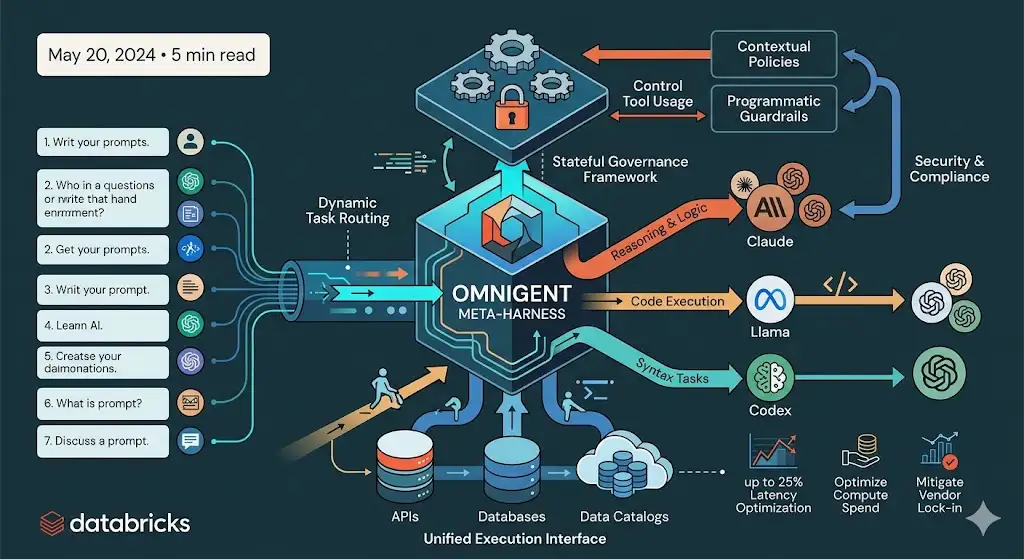
    • Dynamic Task RoutingA sophisticated routing engine evaluates the requirements of a sub-task and dispatches it to the most efficient model. This prevents the over-utilization of expensive frontier models for deterministic tasks, significantly optimizing compute spend.
    • Stateful Governance FrameworkBeyond simple input/output filtering, Omnigent maintains a contextual state across multi-turn agent interactions. This allows for real-time enforcement of policies that prevent unauthorized tool calls or data exfiltration.
    • Unified Execution InterfaceIt standardizes how agents interact with external APIs and databases, providing a consistent abstraction layer that simplifies the management of tool-use and function-calling across different model families.
    • Latency OptimizationBenchmarks suggest that by offloading specialized sub-tasks to smaller, tuned models via the Omnigent harness, developers can achieve up to a 25% reduction in end-to-end latency compared to single-model chains.

    Developer Impact

    For AI engineers, Omnigent represents a shift from fragile, prompt-dependent scripts to robust, architectural choreography. By providing a meta-harness, Databricks enables developers to mitigate vendor lock-in; teams can swap underlying models as the SOTA evolves without re-architecting the entire agentic workflow.

    Furthermore, the introduction of contextual policies solves the primary barrier to enterprise agent adoption: predictability. Developers can now programmatically define the “sandbox” in which an agent operates, ensuring that autonomous actions remain within the bounds of corporate governance. Omnigent essentially provides the plumbing and the policing required to move AI agents from experimental notebooks into production-grade environments.

    Technical TL;DR

    • Architectural Role: Omnigent serves as a high-level coordination layer—a “meta-harness”—that decouples agentic logic from underlying model inference, allowing for heterogeneous model pipelines.
    • Multi-Model Orchestration: It enables the seamless integration of specialized models within a single workflow, such as utilizing Claude for complex reasoning and logic while delegating code execution or syntax-heavy tasks to Llama or Codex.
    • Policy-Driven Governance: The framework introduces “Contextual Policies,” which act as programmatic guardrails to enforce security, compliance, and operational boundaries on autonomous agents.
    • Ecosystem Integration: Designed to mitigate fragmentation, Omnigent provides a unified interface for agent composition that integrates with existing data catalogs and observability tools.
  • GLM-5.2 Debuts as Flagship Model with 1M-Context Support and MIT-Licensed Open-Source Commitment

    GLM-5.2 Debuts as Flagship Model with 1M-Context Support and MIT-Licensed Open-Source Commitment

    The landscape of accessible artificial intelligence shifted today with the launch of GLM-5.2, the latest flagship model designed by Z.ai to empower the global developer community. Built on the principle that intelligence should be open and ready for immediate deployment, GLM-5.2 arrives as a high-performance solution tailored for complex coding tasks and massive data processing.

    Immediate Availability and Enhanced Developer Tools

    GLM-5.2 has been officially integrated into all GLM Coding Plan tiers, including the Lite, Pro, Max, and Team versions. Developers currently utilizing these plans can access the model immediately through the latest development packages. This rollout ensures that teams of all sizes—from individual hobbyists to enterprise-level organizations—have the tools necessary to build sophisticated applications using the most advanced iteration of the GLM architecture to date.

    Unprecedented Context and Coding Prowess

    “As the new flagship of the series, GLM-5.2 introduces several critical technical upgrades. Most notably, the model features a usable 1-million-token context window.”

    Beyond its expansive memory, GLM-5.2 is optimized for “long-horizon tasks”—complex operations that require sustained logic over many steps. These capabilities, combined with refined coding intelligence, position the model as a primary competitor in the field of automated software development and technical problem-solving.

    glm 4.5

    The Path to Open Source

    In a move that underscores a commitment to the “open future of AI,” the developers behind GLM-5.2 have announced a rapid expansion of the model’s accessibility. While currently restricted to coding plan users, API access and dedicated chatbot services are scheduled to launch next week.

    Furthermore, the model will be officially open-sourced next week under the MIT License. By opting for one of the most permissive software licenses available, the GLM team aims to foster a collaborative environment where the global community can inspect, modify, and build upon the model’s architecture.

  • Moonshot AI Disrupts Developer Ecosystem with Kimi-K2.7-Code: A 1 Trillion Parameter Mixture-of-Experts Model

    Moonshot AI Disrupts Developer Ecosystem with Kimi-K2.7-Code: A 1 Trillion Parameter Mixture-of-Experts Model

    Published: Recent Update48 minutes ago

    Original Tweet Context

    “Moonshot AI Releases Kimi-K2.7-Code for Efficient Coding Tasks. The Beijing-based company unveiled this 1 trillion-parameter Mixture-of-Experts model on Friday, boasting a 256,000-token context window and support for text, images, and video. It cuts reasoning-token usage by 30% compared to K2.6, delivering big benchmark wins like 62.0% on Kimi Code Bench v2 and strong agent eval scores that rival high-end models from GPT and Claude—all at low prices of $0.95 per million input tokens. Developers praise its open weights on Hugging Face, cheap API access, and potential as the top open-source coding tool, though independent tests are still pending.”

    Beijing-based Moonshot AI has officially announced the release of Kimi-K2.7-Code, a high-performance Mixture-of-Experts (MoE) model designed to redefine the landscape of AI-assisted programming. Launched on Friday, the new model arrives with a staggering 1 trillion parameters and a vast 256,000-token context window. By integrating support for text, images, and video, Moonshot AI positions Kimi-K2.7-Code as a versatile powerhouse capable of handling complex, multimodal coding environments.

    Advanced Technical Specifications and Multimodal Integration

    The Kimi-K2.7-Code model utilizes a sophisticated Mixture-of-Experts (MoE) architecture, allowing it to maintain a high parameter count while optimizing computational efficiency. With a 256,000-token context window, the model is built to digest and reason over massive codebases, long-form documentation, and intricate project structures. Unlike many specialized coding tools, this iteration supports multimodal inputs, enabling developers to incorporate visual data and video demonstrations directly into their troubleshooting and development workflows.

    Unprecedented Efficiency and Competitive Pricing

    A key highlight of the Kimi-K2.7-Code launch is its significant leap in reasoning efficiency. The model boasts a 30% reduction in reasoning-token usage compared to its predecessor, K2.6. This optimization does not come at the cost of performance; the model achieved a 62.0% score on the Kimi Code Bench v2. Furthermore, its agent evaluation scores suggest it is now a direct competitor to industry leaders such as OpenAI’s GPT series and Anthropic’s Claude.

    Moonshot AI is also targeting the market through aggressive pricing. At just $0.95 per million input tokens, the API access is positioned as one of the most cost-effective solutions for enterprise-grade AI coding tools, lowering the barrier to entry for startups and independent developers alike.

    Industry Impact and the Rise of Open-Source Power

    The developer community has reacted with early enthusiasm, particularly regarding Moonshot AI’s decision to release open weights on Hugging Face. This commitment to the open-source ecosystem, combined with low-cost API access, positions Kimi-K2.7-Code as a top-tier contender for the most capable open-source coding tool currently available.

    While the internal benchmarks are impressive, the industry is now looking toward independent third-party testing to verify these claims in real-world production environments. If these results hold, Kimi-K2.7-Code could represent a significant shift in the balance of power between proprietary and open-source AI models.

    Conclusion: A New Frontier for AI Coding Tools

    With the launch of Kimi-K2.7-Code, Moonshot AI has signaled its intent to lead the next generation of generative AI for software engineering. By combining 1 trillion parameters with massive efficiency gains and a multimodal framework, the model offers a compelling alternative to the current market leaders. As developers begin integrating Kimi-K2.7-Code into their daily stacks, the focus will remain on how its 256k context window and MoE architecture translate into sustained productivity gains across the global tech industry.

  • Prometheus and Mistral Secure $12B to Architect the ‘Physical-World’ AI Industrial Stack

    Prometheus and Mistral Secure $12B to Architect the ‘Physical-World’ AI Industrial Stack

    A watershed moment for industrial application, bridging digital reasoning with operational technology.

    The recent $12 billion investment in Prometheus and Mistral marks a watershed moment for the industrial application of large-scale models. By pivoting from general-purpose LLMs toward a specialized “Physical-World” AI stack, this partnership aims to bridge the gap between digital reasoning and operational technology (OT).

    Technical TL;DR

    • ●Focus: Integration of generative AI with high-frequency telemetry and industrial control systems.
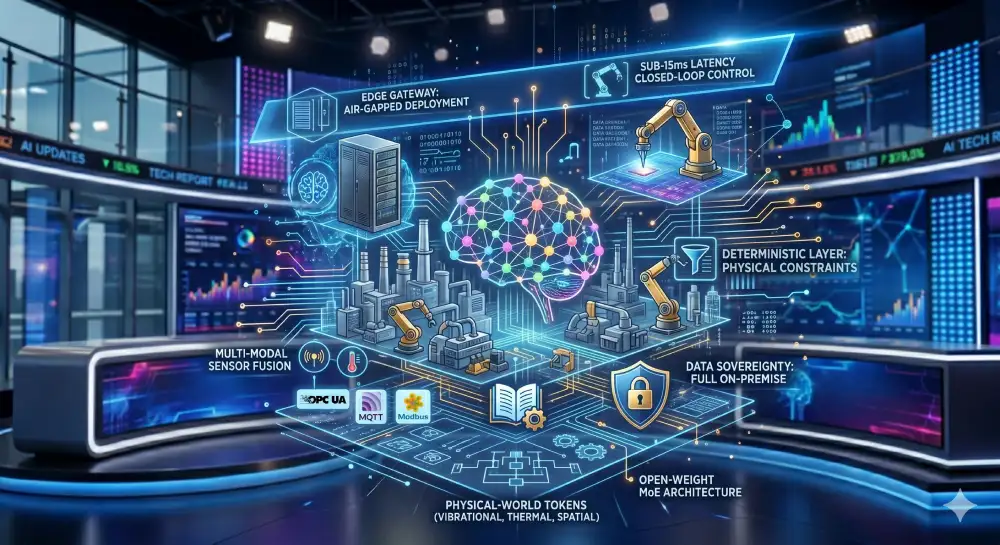
    • ●Architecture: Utilization of Mistral’s open-weight Mixture-of-Experts (MoE) architectures adapted for low-latency inference.
    • ●Deployment: Emphasis on edge-native execution to support air-gapped manufacturing environments.
    • ●Protocol Support: Native integration for industrial standards including OPC UA, MQTT, and Modbus directly within the model’s tokenization layers.
    • ●Data Sovereignty: Open-weight models allow for full on-premise fine-tuning, ensuring proprietary industrial data never leaves the facility.

    Key Features/Benchmarks

    The core of the Prometheus-Mistral stack is a specialized transformer architecture optimized for multi-modal sensor fusion. Unlike standard LLMs that process text, this stack introduces “Physical-World Tokens” capable of interpreting vibrational, thermal, and spatial data.

    Preliminary benchmarks indicate that this industrial-tuned MoE architecture achieves sub-15ms latency for closed-loop control tasks—a 3x improvement over standard RAG (Retrieval-Augmented Generation) implementations. Furthermore, the stack includes a proprietary “deterministic layer” that filters LLM outputs through physics-based constraints to prevent hallucinations in safety-critical environments. This ensures that suggested adjustments to physical parameters (e.g., turbine pressure or robotic torque) remain within safe operating envelopes.

    Developer Impact

    For software engineers and system architects, this shift represents a move toward “Control-as-Code.” The availability of high-performance, open-weight models means developers are no longer tethered to cloud-heavy API dependencies that introduce unacceptable latency and security risks.

    The Prometheus-Mistral SDK will allow developers to build autonomous agents capable of managing complex supply chains and robotic assembly lines using familiar Python-based workflows. By leveraging open-weights, teams can perform deep quantization to run these models on hardened industrial gateways and edge accelerators. This democratizes access to sophisticated AI, allowing even mid-sized industrial firms to implement custom, localized intelligence without the overhead of massive GPU clusters.

  • Claude Launches Fable 5 AI Model Alongside Security-Focused Mythos 5

    Claude Launches Fable 5 AI Model Alongside Security-Focused Mythos 5

    Claude has officially announced the release of Fable 5, a highly anticipated artificial intelligence model that establishes new state-of-the-art standards across multiple industry benchmarks. Accompanied by robust, automated safety protocols and a specialized, unrestricted tier known as Claude Mythos 5, this dual-release represents a significant leap forward in balancing raw AI capability with responsible deployment.

    Unprecedented Capabilities and Performance

    Fable 5 has been engineered to deliver exceptional performance across a wide array of demanding domains, including software engineering, complex knowledge work, scientific research, and computer vision. According to the company, Fable 5 truly distinguishes itself when processing extended, multi-step tasks. The longer and more complex the assignment, the larger Fable 5’s performance lead becomes when compared to Claude’s previous AI models, making it a powerful tool for enterprise and research applications.

    Proactive Risk Management and the Opus 4.8 Fallback

    Releasing a model with Fable 5’s level of sophistication inherently introduces new security risks. Without proper guardrails, the model’s advanced reasoning could be weaponized by bad actors to cause serious damage, particularly in sensitive sectors. To mitigate this, Fable 5 is equipped with strict automated safeguards that detect potentially harmful requests related to cybersecurity, biology, chemistry, and AI distillation.

    When a prompt enters these restricted zones, Claude initiates a transparent fallback protocol. The system informs the user of the safeguard trigger and automatically reroutes the query to Claude’s next-most-capable model, Opus 4.8. Currently, this fallback mechanism is activated in less than 5% of user sessions, and Claude’s engineering teams are continuously refining the guardrails to reduce false positives and ensure a frictionless user experience.

    Claude Mythos 5 for Cyber Defenders and Critical Infrastructure

    Recognizing that security professionals require unrestricted access to advanced AI to effectively defend against emerging threats, Claude is simultaneously launching Mythos 5. Built on the exact same underlying architecture as Fable 5, Mythos 5 features lifted safeguards in critical areas. This targeted release is designed specifically for a select group of cyber defenders and critical infrastructure providers, allowing them to utilize the AI’s full potential for defensive analysis, threat hunting, and infrastructure protection.

    Global Availability and Future Expansion Plans

    Starting today, Claude Fable 5 is widely available to users everywhere. The unrestricted Mythos 5 model, however, is currently strictly limited to Glasswing partners to ensure secure and controlled deployment. Claude has confirmed plans to expand access to Mythos 5 in the near future through a broader “trusted access program.” Once launched, this program will open doors for vetted professionals working in both defensive cybersecurity and advanced biomedical research.

    The Significance of the Fable 5 Release in the AI Landscape

    The introduction of Fable 5 and Mythos 5 marks a pivotal moment in the evolution of artificial intelligence. By delivering unprecedented computational capabilities while simultaneously enforcing strict, context-aware routing, Claude is actively addressing the industry’s most pressing challenge: accelerating innovation without compromising global security. As next-generation AI models grow increasingly powerful, this tiered, safety-first framework establishes a highly effective blueprint for the responsible commercialization of artificial intelligence.

  • Google Overhauls NotebookLM with Gemini 3.5 and Agentic Workflows

    MOUNTAIN VIEW, CA — Google has rolled out its most significant update to NotebookLM in three years, transforming the experimental note-taking assistant into an advanced, agentic AI research tool.

    Effective June 8, 2026, the updated platform is powered by Google’s next-generation Gemini 3.5 architecture and Antigravity execution engine. The release focuses on solving complex, multi-step research problems by providing deep visibility into the AI’s step-by-step reasoning process.


    Agentic Infrastructure and Multi-Step Workflows

    The biggest structural shift in the system is the inclusion of a private, secure cloud computer assigned to each individual notebook workspace. This virtual sandbox allows NotebookLM to write and execute code in real time, drastically improving how it handles massive, unstructured datasets.

    Equipped with a library of over 100 pre-packaged software skills, the tool can now perform complex data analysis and autonomously execute multi-step workflows.

    Internal benchmarks released by Google highlight massive performance gains over its previous model:

    • 78.2% win rate in advanced web research and automated source discovery.
    • 69.9% win rate in processing and analyzing lengthy, large-scale documentation.
    • An overall 15% point margin improvement across top core evaluation categories.

    Enhanced Web Research and Studio Exports

    Users no longer need a pre-assembled repository of files to begin a project. NotebookLM can now take loose ideas or questions dropped into the chat window and actively crawl the web to construct a grounded, fully cited source repository.

    The update also expands the Studio Panel, introducing highly requested downloadable export formats. Users can now generate and post-edit comprehensive data visualizations, spreadsheets (XLSX, CSV, JSON), slide decks (PPTX), and formatted documents (PDF, DOCX, Markdown).

    The upgrade is available globally for Google AI Ultra subscribers at $99.99/month and select Workspace business users, with expansions to free tiers planned for the future.


    This Google Gemini 3.5 Flash video demonstrates the capabilities and speed of the underlying architecture powering this update.